
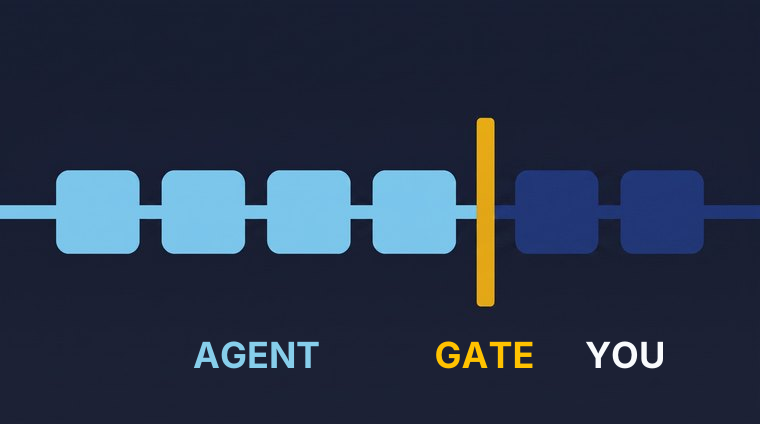
Ask an AI agent to make Facebook ads and you will get Facebook ads. Forty of them, overnight, on brand, clean copy, every one plausible. Then you open the folder and realize you have no idea which three should run, what they should spend, or how you would know afterward whether any of them worked.
That folder is what most AI media buyer demos are showing you. Generation got solved. The ad ops around it decides whether the spend does anything, and that part is still sitting on your desk.
Which is the awkward spot a lot of media buyers are in right now. A vendor is pitching an agent, or someone upstairs is asking why the account is not running on one yet, and answering either one means knowing which parts of your process a machine can hold and which parts break when you hand them over. The demo covers none of that.
Search "can ai manage facebook ads" and page one gives you Meta's product docs, two vendors, two tool roundups, and a thread in r/FacebookAds where thirty-odd operators ask each other whether anyone has made this work at all. Nobody in that thread gets a complete answer. That reader is who this post is for.
I have been building a Meta ads agent in public for the past month. It publishes real campaign objects to a real ad account through a write proxy. What follows is which stations of your process an agent can hold, what it has to know to hold them, and where mine still falls over.
The short version
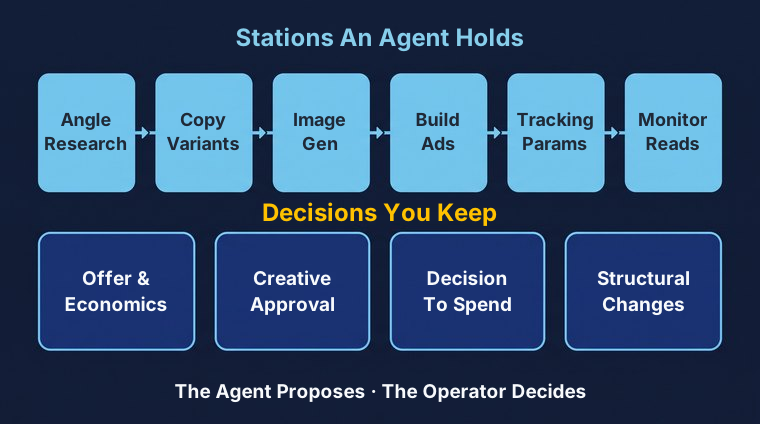
- Hand the agent stations, not the loop. Angle research, copy variants, image generation, campaign assembly, tracking parameters, and monitoring reads. You keep the offer, creative approval, and the decision to spend.
- It needs your economics before it needs your ad account. Margins and conversion value are inputs you supply. An agent that has to guess them will optimize efficiently toward the wrong number.
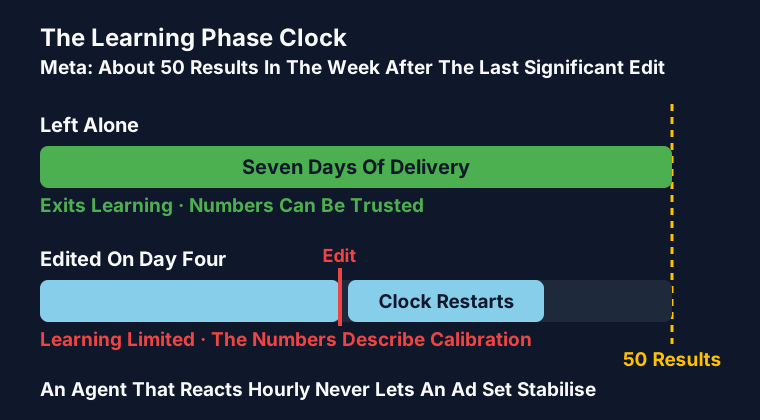
- Meta's delivery rules have to be written down as code. Ad sets exit the learning phase after roughly 50 results in the week following the last significant edit. Every edit restarts that clock.
- Publish paused, always. The review gate between "built" and "delivering" is what separates creative volume from creative slop.
- Our numbers are ours. Copy the structure of the guardrails. Derive the thresholds from your own account.
Where an agent actually fits in a loop you already run
You already have a loop. Research an angle, brief the creative, make the assets, assemble the campaign, launch it, watch it, prune the losers, scale the winners. It runs whether or not anyone writes it down.
An agent takes stations in that loop. It does not take the loop.
The stations that hand over cleanly are the ones with a defined input and a checkable output: angle research, copy variants, image generation, campaign assembly, tracking parameters, and the monitoring reads that pull numbers back out of Ads Manager. The ones that stay with you are the offer and its economics, creative approval, the decision to spend, and any structural change to the account.
Connecting an agent to the account is the easy half now. Meta's Ads AI connectors put an agent on an ad account through a business login flow with no developer credentials required, and self-hosted options have existed for a while. Wiring was never the part that decided outcomes.
The part that decides outcomes is what the agent knows once it is connected. To hold any of those stations it needs your business context first: the offer, the price points, what a conversion is worth to you, and which landing page each variant should point at. Ours picks a base landing path per variant at the copy stage, then validates the host and path before anything gets created.
Skip that and you get the folder of forty. An agent without your economics still writes fluent copy and still generates clean images, and it aims all of it at nothing in particular. That is the mechanical origin of slop. The models are fine. The inputs are missing.
If you have never pinned down what a conversion is worth in your own account, that question is upstream of everything here, and MER versus ROAS is the better place to start than this post.
Meta's delivery rules have to be encoded, not assumed
A human operator carries Meta's delivery mechanics as instinct. You know not to touch an ad set on day two. You know why the account went sideways after you rebuilt everything on a Friday. Nobody taught you that as a rule; you learned it by paying for it.
An agent carries only what is written down. Three of Meta's own published best practices have to become explicit code, and they are the three that most automation gets wrong.
The learning phase has a number. Meta's documentation says ad sets exit the learning phase once they can deliver stably, and that this usually happens after "about 50 results in the week after the ad set's last significant edit". Two details matter for an agent. Meta counts results, which means the optimization event you selected, and the window runs from the last significant edit rather than a rolling seven days. Below that, Meta labels the ad set "learning limited" and its numbers describe calibration.
Edits restart the clock. Meta's guidance is to wait to edit an ad set until it is out of the learning phase, because editing resets learning and delays optimization. This is where most autonomous designs break. An agent that reacts hourly, adjusting budgets and swapping targeting because something looked off at lunchtime, keeps every ad set in permanent calibration and never lets a single one stabilize.
The fix is to give the agent two decision surfaces with different speeds. Pausing a single ad is cheap and reversible, so that one can move fast. Anything structural, ad set budgets, targeting, placement, needs a minimum age of seven days and gets batched into one weekly window instead of trickling out.
Budget stability is a delivery input. Meta also advises setting a budget large enough to collect enough total results and avoiding frequent budget changes, which can themselves push an ad set back into learning. That constrains how an agent is allowed to scale. A winner does not get a raise every morning because the dashboard looked good.
If your ad sets are stuck in learning limited right now, that diagnosis has its own home in why your Facebook ads aren't converting. And the human version of the kill and scale rules an agent would execute lives in our Meta ads testing framework. This post is about what happens when you try to hand those rules to something that cannot use judgment to fill the gaps.
What we build, what we cap, and why yours will differ
Here is what ours constructs. Then the part that matters more, which is why you should not copy it.
Campaigns go up with budget at the ad set rather than the campaign, ad set budget sharing switched off, lowest cost without a bid cap, a broad US audience, and Advantage+ audience explicitly disabled. Every one of those is a deliberate choice for a machine reader. The campaign objective is the one setting you should not inherit from anyone: it has to match the event you plan to gate decisions on, or the agent spends the whole test collecting a signal it will not be allowed to act on. Ad set budgets keep the split even and legible, so when a result comes back I can attribute it to a creative. Campaign budget optimization moves money between ad sets for reasons the agent cannot observe, which makes the same attribution guesswork.
On spend, the agent gets one lever and a ceiling it cannot move. A human sets a daily cap on the campaign, and the agent has no path to raise it. Lifetime budgets and account-level spend caps are rejected outright at creation, so there is exactly one number in play and it is the conservative one.
The number itself is ours, and it will not fit your business. What we are willing to lose in a day comes out of our offer, our margins, and our tolerance for being wrong, and none of those transfer to your account.
What travels is the shape. A cap exists, the agent cannot raise it, and a human set it from historical account data rather than from a default. To set yours, work backward from your own numbers: what a conversion is worth to you, how many results you need before the data means anything (Meta's rough 50 is a floor rather than a target), and what you can lose in a day without changing how you feel about the test. Your own account history is the best input you have here, and it beats any figure you could copy from a post like this one. If you want reference points before you commit, our Facebook ads cost benchmarks and ecommerce CPA benchmarks are built for exactly that. For the CBO and ABO mechanics behind the structure choice, see how to build a Meta ad campaign, and for where automation should take over entirely, Advantage+ Shopping.
Tracking is the precondition for every decision that follows
This is the least interesting section in the post and the one I would cut last.
An agent that cannot attribute a result back to a specific creative cannot make a single downstream decision. Not a pause, not a scale, not a brief for next week. Tracking stops being hygiene and becomes the input the whole loop runs on, which is why it belongs in the publish step rather than in a cleanup ticket.
Ours sets UTM parameters plus Meta's dynamic macros as url_tags on the ad creative at publish time. The campaign and content values resolve from Meta's own {{campaign.name}} and {{ad.id}} placeholders, so the platform fills in the correct values at delivery and the agent never has to guess or hand-assemble them. Those same values get written to our database next to the creative record, which is what makes the monitoring read possible later.
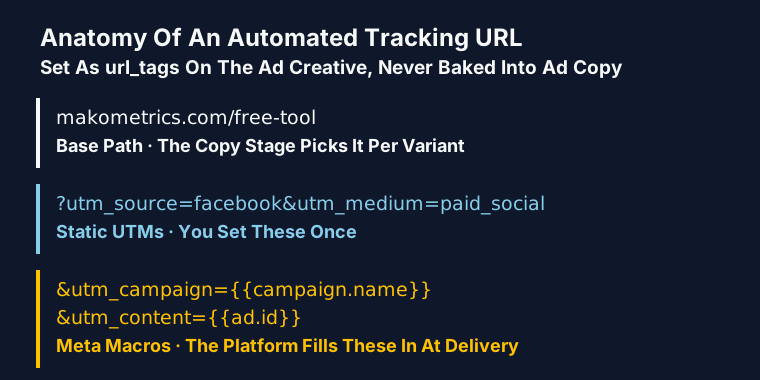
One rule that saved us rework: UTMs never get baked into the ad copy. The copy stage picks a base landing path, the publisher resolves the final URL, and a validation step checks the host and path before creation. Copy and tracking stay separate, so changing one never corrupts the other.
A note for anyone arriving from Google Ads: ValueTrack is Google's term. Meta's equivalent is dynamic URL macros, and the syntax differs. If the measurement underneath is shaky, fix that before automating on top of it, starting with the Meta pixel, then the Conversions API, and understanding what iOS did to attribution windows.
Publish paused. Always.
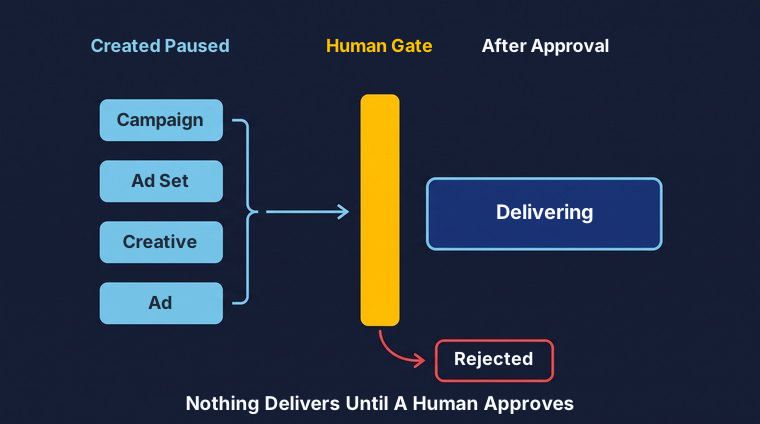
The agent builds the entire object graph. Campaign, ad set, creative, ad. Then it stops.
Our proxy refuses any ACTIVE status at creation and forces PAUSED. A separate guard blocks flipping an existing object to ACTIVE on update, so there is no path where the agent turns its own work on. Every write gets appended to a log. Across three creative batches, nothing has ever delivered.
That gate is the whole difference between creative volume and creative slop. A human opens Ads Manager, looks at what was built, checks the setup is correct, and decides whether it goes live. It takes a few minutes and it is the cheapest control in the system.
Here is the receipt for why it matters. In one batch, our compliance screener ran ten generated creatives and blocked one for inventing performance metrics that we have never published. Nine passed. The blocked asset was fluent, on brand, and completely wrong, and it would have sailed through any check that measured quality by how finished something looks. The bar is a person at the gate.
The broader guardrail design, including what the proxy refuses and why the agent never holds the API token, is its own post. The skill stack that produces the work arriving at this gate is in the anatomy post.
Wait for results before you let it call a winner
The gate on any scale decision is conversion results. Not impressions, and never a raw CTR sort.
An agent sorting creatives by click-through rate at 300 impressions will hand you a winner with total confidence, and it will be handing you variance. Meta's own floor is the useful anchor here: roughly 50 results in the week after the last significant edit. Under that, the ad set is learning limited by Meta's own definition, and asking it which creative won is asking a question the data cannot answer yet.
So the design has three outcomes, not two. Ours enforces winner, loser, or undecided as a constraint at the database level, with a written rationale attached to each call. Undecided is a recorded state, not a missing row. It is also the answer most dashboards refuse to give you, because a dashboard that says "not yet" looks broken, and an agent that says "not yet" looks slow. Both are being accurate.
Which event you count is your call, not the agent's. A skincare brand at a $30 average order value and a B2B service at $4,000 do not gate on the same event, do not need the same volume, and should not use the same patience. Pick the optimization event that reflects real revenue, set the volume floor you will actually respect, and the agent's job becomes holding that line when the early numbers look exciting.
For choosing the metric, MER versus ROAS covers blended versus platform-reported. For what good looks like once you have a number, see the Facebook ads ROAS benchmarks. And when two variants look different and you want to know whether the gap clears the noise, run them through the A/B test significance calculator before anything gets scaled.
More creative is not the win the category is selling
Every agent demo leads with throughput. Two hundred creatives a week, endless variants, a tireless machine.
Meta's delivery documentation says the opposite. Under its learning phase best practices, Meta tells advertisers to "avoid high ad volumes", because spreading delivery across many ads and ad sets gives the system less to learn from on each one than a smaller set would. Volume fragments the results that the learning phase needs concentrated.
Read those two claims next to each other and the pitch inverts. An agent that can produce two hundred creatives a week is a liability until something upstream decides how few of them ship. At a $1,000 to $2,000 monthly budget, the arithmetic comes out to five to eight creatives a day, which is the math from the first post in this series, and it sits a long way from the twenty-plus in the headlines. The cost per usable asset turns out to matter far less than the count you can feed.
The counterweight to shipping less is making sure the few you ship are not all the same ad. If the loop only reinforces what already won, your creative converges, and Meta starts treating near-identical assets accordingly. Ours reserves 20 to 30 percent of creative slots as an explore quota, deliberately tested outside the winning patterns file, stored as a column on every creative row rather than as a sentence in a document nobody opens.
The hard part of an explore quota is knowing what to explore
Your own account only teaches you about angles you already ran. That is the ceiling on exploring from your own data: it can tell you which of your ideas worked, and nothing about the ideas you never had.
Your competitors are running that experiment in public right now. A Mako Metrics report pulls every live ad a rival is running from the Meta Ad Library, with their hook patterns, format mix, CTA distribution, and how fast their creative engine is actually shipping. It reads as a list of angles that are working in your category and are missing from your account, which is precisely what an explore quota needs as input.
See what a finished report looks like before you spend anything. No login, no card.
See Sample ReportsCreative fatigue is the other half of this. Knowing when a winner has stopped winning is what makes room for the next test, and both the seven signs of fatigue and the detection playbook for smaller budgets cover the thresholds.
What our own build still gets wrong
Everything above describes a design. Some of it is running code and some of it is a document, and it would be poor form to blur which is which.
The decision layer is the part that is not built. The performance analyzer and the budget optimizer are both stubs. No batch we have run carries a classification on a single ad. Nothing has been called a winner or a loser because nothing has delivered.
Writing the rules down exposed three more that turned out not to be rules at all.
The analyzer says an ad only gets marked a loser with both high CPA deviation and sufficient impressions. "High CPA deviation" is never quantified anywhere in the repo. The same file says to compare conversion rate against the ad set baseline, and the baseline is never defined. The budget optimizer specifies when a scale increase needs human approval and never says by how much to scale, because the step size is still a TODO. For good measure, the impression floor appears as one number in one file and a range in another.
That is the general lesson, and it applies whether you build or buy. A rule a machine can execute needs five parts: a threshold, a baseline, a window, an action, and a tie-break for when the comparison is ambiguous. Most operator heuristics carry two or three and let judgment supply the rest. Judgment is exactly what you removed. The first honest thing an agent build does is show you which of your rules were never rules. The empty memory file in Post 2 was the same kind of finding.
Five questions for any ads agent, yours or a vendor's
Whether you are building this or sitting through a demo, these five separate an ad ops system from a content generator.
- Where does business context live, and who edits it? You want a file or a settings surface you control, holding the offer, the economics, and the landing pages. A good answer names the artifact.
- What does it publish into, and can it write directly to the API? An agent holding a raw token with unrestricted write access has no ceiling on a bad afternoon. You want a proxy, a scoped connector, or a queue in between.
- Who sees the work before it delivers, and can that gate be switched off? Paused-by-default with a human review step is the answer. If the gate is optional, ask what the default is and who can change it.
- What event does it count, and what is the minimum volume before it calls a result? A vendor who cannot name both numbers is reading a dashboard back to you.
- What happens when the answer is unclear? Ask whether "undecided" exists as an outcome. Systems built on a two-state model will always produce a winner, including from noise.
A vendor who answers all five with thresholds is running an ad ops system. One who answers with throughput is selling you a creative generator with API access.
If you run several client accounts, ask all five per account rather than once per vendor. The answers move when the offer, the margins, and the conversion event move, and an agent configured for a $30 skincare repeat purchase will do the wrong thing on a $4,000 lead-gen account.
Architecture first, sandbox second, live spend last
That order has not changed since the first post in this series, and this build has stayed in it: read-only first, paused writes on a linked account second, live spend last.
Next up is the recursive loop, where performance data starts writing back into the winning patterns file and each sprint gets briefed by the results of the one before it. That post ships when there is live data worth writing back. The memory file is still empty today, deliberately, because seeding it with guesses would defeat the point of having one.
An agent is only as good as the numbers you gave it and the gate you kept.
The stations this post hands over are the ones the Meta Ads Agent runs today, packaged for agencies working a client roster.
FAQ
Can an AI agent manage Facebook ads on its own?
It can build and manage; it should not decide to spend. An agent handles angle research, copy, creative, campaign assembly, and tracking well, because each has a defined input and a checkable output. The step worth keeping human is the transition from built to delivering. Ours publishes every object paused and physically cannot switch it on, which turns a few minutes of review into the control that catches setup errors and off-brand creative before either costs money.
How many conversions do you need before scaling a Meta ad?
Meta's published guidance is that ad sets exit the learning phase after about 50 results in the week following the last significant edit, and below that it flags them learning limited. Treat 50 as a floor rather than a target. The event you count and the volume you require are yours to set: a $30 average order value and a $4,000 contract call for different patience, different optimization events, and different budgets to reach a readable result.
Should an AI ads agent use CBO or ABO?
Ad set budgets, for anything the agent needs to read a clean result from. An even split across ad sets makes it possible to attribute an outcome to a specific creative. Campaign budget optimization shifts money between ad sets on signals the agent cannot see, which muddies that attribution during a test. Scaling a proven winner is a different job, and the CBO and ABO breakdown covers when each structure earns its place.
How do you set up UTM tracking for automated Meta campaigns?
Set them as url_tags on the ad creative rather than appending them to the destination URL in your copy. Use Meta's dynamic macros, {{campaign.name}} and {{ad.id}}, so the platform resolves the values at delivery and no automation has to assemble them by hand. Store the resulting values alongside the creative record at publish time; that is what makes it possible to join performance data back to the creative that produced it.