
Search "best AI image generator for Facebook ads" and page 1 sells you a list. Cometly ranks nine generators. Venngage ranks ten. Two more vendors rank their own product somewhere near the top. Between them they name dozens of models, and the top-ranked one never generates a single ad.
So I ran the test the roundups skip. One brand brief, five image models, identical prompts: Flux Schnell, Nano Banana 2, Ideogram V3, Recraft V3, and Seedream 4, all on fal.ai. Fifteen creatives, 64 cents of generation, and a strict bar for what counts as usable.
Three passed. All three came from one model.
The interesting part is where the other twelve died. Two models set my headline in better type than I would have picked myself, then stamped a logo on the ad that has never existed anywhere. Your brand is where these models break.
The short version
- Five models, one identical brand brief, all on fal.ai so the per-call costs compare: Flux Schnell, Nano Banana 2, Ideogram V3, Recraft V3, Seedream 4.
- Usable meant three things at once: the headline spelled right, our actual logo mark, and nothing invented. Only Nano Banana 2 cleared it, 3 for 3, at $0.08 per usable asset.
- The typography specialists lost on branding. Ideogram and Recraft render beautiful headlines and then design you a brand new logo. Seedream printed my palette's hex codes into the picture.
- Flux Schnell costs $0.003 a shot and produced nothing shippable, because it garbles any text you give it.
- Cost per generation is a vanity number. Divide by what you can actually run and the cheapest model becomes the most expensive one.
- Fair-test caveat: this ran text-to-image only, with no logo reference image. From a prompt alone, one model was brand-safe.
Page 1 ranks tools. It can't tell you which one ships.
I went looking for prior art before spending a cent, the same way you'd check whether someone had already answered your question. Page 1 came back nine results deep in recommendations and zero deep in evidence.
The top result ranks nine AI Facebook ad image generators. Below it, Canva's product page for its ad generator. Then two of Meta's own pages, one for Advantage+ creative and one help doc about generating image variations inside Ads Manager, both useful for what they are and silent on which model to use. Then another roundup of ten AI ad generators, this one spanning every ad type ever made. Then a vendor asking which AI is best for Facebook ad generation and answering with itself.
Every one of those pages names tools. I read the top-ranked roundup end to end: nine generators, each illustrated with a screenshot from the vendor's own marketing site, and not one image the writer made themselves. No brief, no method, nothing that came out of the tools they're ranking.
The only unsponsored voice on page 1 is a Reddit thread. Someone in r/FacebookAds asked which AI tools actually make high-quality ad creative, got twenty-odd contradictory replies, and the thread has been sitting there for eight months without an answer. That reader is who this post is for.
I'm building a Meta ads agent in public. The thesis post argued that an AI media buyer is a loop you operate. The second post opened the hood on the ten skills that loop is made of, and promised this one: the image factory, and what a creative actually costs once you count only the ones you can run.
The test: one brand, five models, one usable bar
Three ad concepts for the Mako Metrics offer, written once. The same prompt text sent to five models. Same aspect ratio, same brand instructions, same everything except the model.
All five run on fal.ai, which matters more than it sounds: one platform means the per-call price is directly comparable, no currency conversion between somebody's credit system and somebody else's subscription. Fifteen images. Total generation cost, 64 cents.
Then the bar. A creative counted as usable only when all three of these were true at once:
- The headline is spelled correctly. The exact words from the brief, legible, no invented characters.
- The logo is ours. A navy rounded square with a white M. That mark, and no other.
- Nothing is invented. No fabricated metrics, no garbled interface text, no fragments of the prompt rendered into the picture.
That third rule exists because of a creative the agent's compliance screener blocked last month. An image model had drawn a product interface and filled it with confident-looking numbers we have no data to support. Meta's advertising standards have strong opinions about exaggerated and unsubstantiated claims, so the rule now is that any interface region is either blank or a real screenshot from a fixture file.
Two of those three rules have nothing to do with image quality. That turns out to be the finding.
Why Grok and DALL·E aren't in this test
Both live on their own APIs, xAI and OpenAI, which breaks the one-platform price comparison this whole post rests on. Aurora is also weak at the kind of text an ad needs. They're a deliberate exclusion, and worth a separate run against a reference image later.
The scorecard: cost per usable ad creative
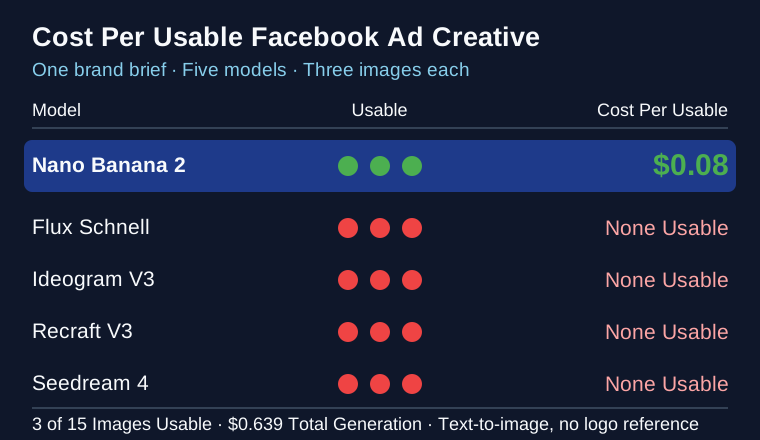
Here is the whole test in one table.
| Model | Generated | Usable | Batch cost | Cost per generation | Cost per usable asset |
|---|---|---|---|---|---|
| Flux Schnell | 3 | 0 | $0.009 | $0.003 | n/a |
| Nano Banana 2 | 3 | 3 | $0.24 | $0.08 | $0.08 |
| Ideogram V3 | 3 | 0 | $0.18 | $0.06 | n/a |
| Recraft V3 | 3 | 0 | $0.12 | $0.04 | n/a |
| Seedream 4 | 3 | 0 | $0.09 | $0.03 | n/a |
| Total | 15 | 3 | $0.639 |
Per-image prices are fal.ai's published rates at the time of the run (Nano Banana 2 lists at $0.08); the batch costs are what the runs actually billed.
Read the last two columns together, because they disagree.
By cost per generation, Nano Banana 2 is the worst deal on the board. It runs about twenty-seven times the price of Flux Schnell. If you were picking a model off a pricing page, you'd pick almost anything else.
By cost per usable asset, it's the only model with a number at all. The other four have no cost per usable asset, because they produced no usable assets. You can't divide by zero, and the four cheap models are all sitting on the wrong side of that division.
That's the reframe I'd take to a budget conversation. The price on the model's pricing page describes an image. Your ad account only ever runs the survivors.
The same ad, five ways
Enough table. Here is one concept, "Manual research eats your week," generated by all five models from the same prompt.
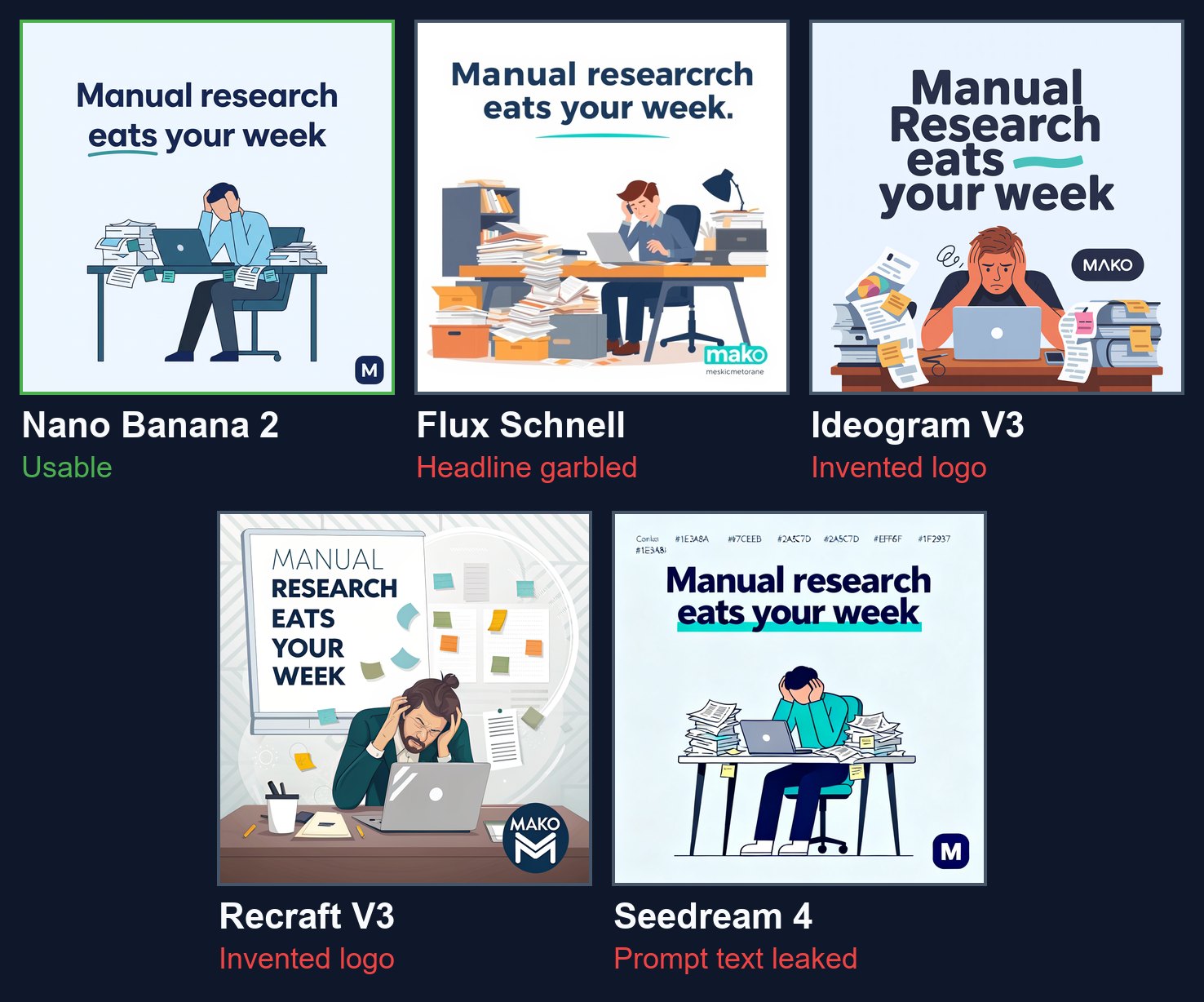
Nano Banana 2: the one you could run
Headline crisp and correctly spelled. A teal underline lands under "eats," which the brief asked for and I half expected to be ignored. The navy rounded square with the white M sits in the bottom right corner, the actual mark, drawn from a text description of it. Flat brand palette throughout. I could put this in Ads Manager this afternoon.
Flux Schnell: can't spell
The headline reads "Manual researcrch eats your week." The logo is a light blue "mako" wordmark with the string "meskicmetorane" underneath it, which is not a word in any language. The whole thing skews orange, a color that appears nowhere in our palette.
At $0.003 an image this is the cheapest creative I generated all week, and I can't use a pixel of it. Flux Schnell renders gorgeous abstract backgrounds. Give it letters and it produces something that looks like text from across the room and dissolves up close.
Ideogram V3 and Recraft V3: perfect type, invented brand
These two are the reason I wrote this post.
Ideogram set the headline cleanly. Then it drew a dark rounded pill in the corner with "MAKO" in it. Recraft did the best typography of the entire test, and put a circular navy badge in the corner with "MAKO" arched over a geometric M. Neither mark exists. Both models invented a logo, competently, and in Recraft's case a different one every single run.
This is the failure mode nobody warns you about, because it reads as a designer taking liberties rather than a model breaking. Describe a logo in words and you've written a design brief. The model answers it with a new logo, every time, and the answer looks plausible enough that a hurried person waves it through.
Seedream 4: leaks the prompt
Headline fine. The M mark is correct, too. And across the top of the image, in small grey type: #1E3A8A, #7CEEB, #2A5C7D, #EFF6F, #1F2937.
Those are my brand palette's hex codes, half of them mangled in the rendering. The prompt told the model which colors to use and the model printed the instruction into the picture as though it were ad copy. On another concept it invented an "80%" and some subtext to go with it, a statistic attached to nothing.
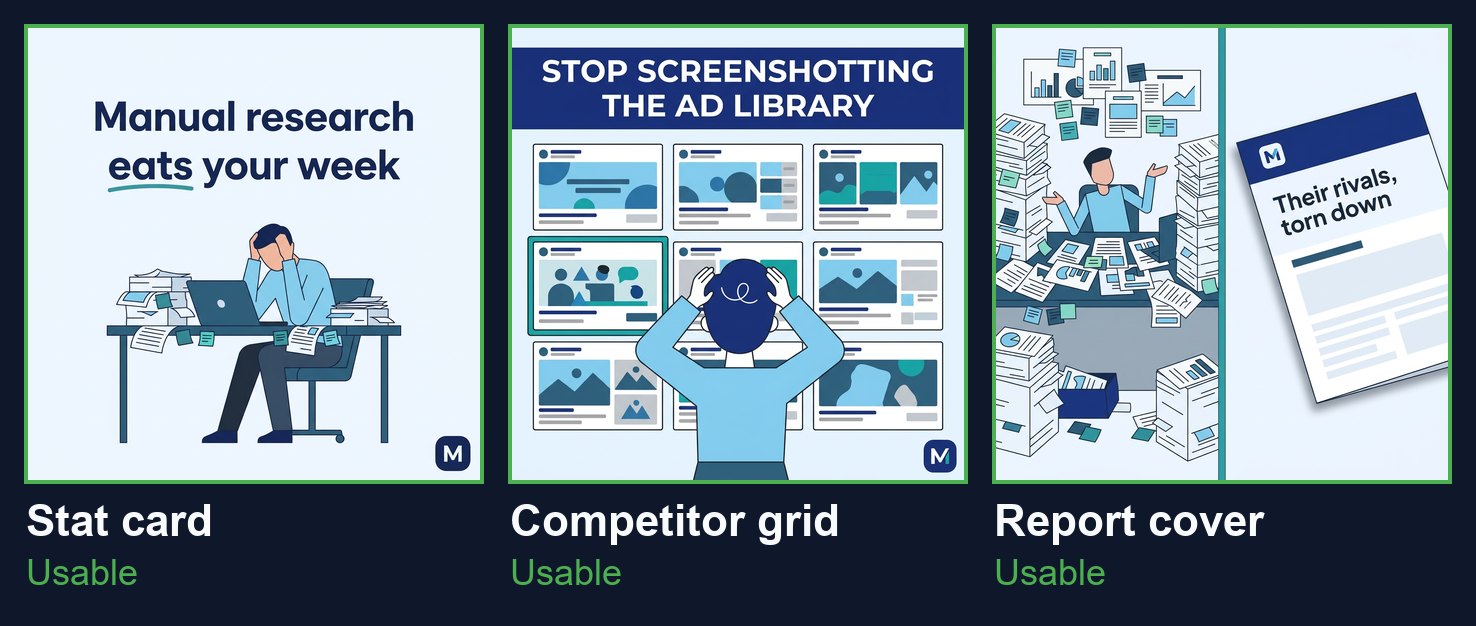
For contrast, the three that passed, all Nano Banana 2. A stat card, a 3x3 competitor grid with one tile highlighted in teal, and a before-and-after report cover reading "Their rivals, torn down." Correct headline, correct mark, nothing fabricated, on all three.
Flux's attempt at that third concept read "Their rales, torn dow."
Legibility is easy. Brand fidelity is the wall.
Here's the opinion this whole test bought me: text rendering is a solved problem and everybody is still shopping for it.
Four of the five models put my headline on the page in readable, correctly spelled type. That was the hard problem two years ago, the one every model comparison still leads with, and in 2026 it's mostly table-level competence. The roundups ranking generators on whether they can spell are answering a question the field already closed.
The open problem is whether the model can be trusted with your brand. Your exact mark, your exact palette, and the discipline to leave a rectangle empty when it has nothing true to put in it. Every failure in this test was a branding failure or a fabrication, and only Flux's was about letters.
That reorders the question. "Which AI image generator renders text best?" gets you Recraft, and Recraft will hand you an ad with a logo you've never seen. "Which one will draw my brand and invent nothing?" got me exactly one answer out of five candidates.
It also explains a pattern I've watched in competitor libraries for a year. Creative that looks slightly off-brand burns out fast, because the audience clocks the wrongness before they read the offer. If you've read how competitor creative fatigue reads from the outside, an ad with a subtly wrong logo is that, on day one.
The fair-test caveat
This bake-off ran text-to-image only. No reference images, no logo file, nothing but words describing the mark. That was the fair comparison to run, because every model got the identical brief.
It's also the narrow claim. Feed these models the actual logo.png as a reference image and the branding gap likely closes, at least partway. The production pipeline does exactly that, and Ideogram and Recraft both support reference conditioning. So the finding is: from a prompt alone, one model out of five was brand-safe. Whether the typography specialists catch up when you hand them the file is the next test, and I'd rather publish the caveat than the cleaner headline.
What "20 creatives a day" actually costs
Vendors advertise twenty-plus creatives a day. That number is generation throughput, and generation throughput is the easy half.
Run the arithmetic with the usable bar instead. Every creative that reaches Ads Manager needs a correct headline, a correct mark, and no invented data. In this test one model in five produced that from a prompt, and it charges $0.08 a shot. Add the screening pass that catches the failures, add the human who looks at the batch, add the regenerations when a concept comes back wrong, and the cost per shippable ad stops looking like a line on a pricing page.
At a $1,000 to $2,000 a month budget, compute is nearly free: 64 cents bought fifteen images. What gates you is how many survive the bar and how much human attention the survivors need. That puts honest throughput around five to eight creatives a day, the same number the thesis post gave before any of this had been tested, and well under the twenty-plus in the headlines.
Nothing here has touched a live auction. Total Meta spend across this build to date: zero dollars. The order of operations hasn't changed.
Every one of those ad concepts started with a competitor's ads
The three concepts in this test came out of the agent's research skill, which reads live competitor ads in Meta's public Ad Library and pulls out the angles worth testing. That's the same source a Mako report runs for you: every ad a rival has live right now, their hook patterns, format mix, CTA distribution, and how fast their creative engine is actually shipping.
If you want the finished read instead of the pipeline, look at a real report first. No login, no card.
How to test any AI ad generator on your own brand
The answer in this post is mine, on my brand, with my mark. Yours could differ, because a wordmark is an easier draw than a custom glyph and a two-color palette is easier than six. So run the test yourself. It takes an afternoon and about a dollar.
- Write one real brief. Your actual headline, your actual logo, your actual hex codes. A generic prompt tests the model's imagination; your brief tests the thing you'd ship.
- Send the identical brief to every candidate. Same words, same aspect ratio. The model is the only variable you change.
- Score usable before you score pretty. Headline spelled right, your mark, nothing invented. Grade it in a spreadsheet, one row per image, so you can't talk yourself into a near-miss at 11pm.
- Divide cost by usable, not by generated. The per-image price on the pricing page is the number the vendor wants you to compare. Your ad account only runs the survivors.
Four steps, and it beats every roundup on page 1, because those pages can't know what your logo looks like.
The model that draws your brand wins
Five models, fifteen images, 64 cents, three usable ads. Nano Banana 2 at $0.08 per asset that a person could actually put behind money, from a prompt alone, with the reference-image rematch still to run.
The typography race is over and most of the field can spell. Ask instead which model will draw your mark and leave the empty box empty, and the field thins out fast.
Nano Banana 2 is the model behind the creative on our Meta Ads Agent page, where you can watch it draw five ads for a brand you pick.
Next in this series is the part that scares me more than a garbled headline: connecting the thing to Meta. The proxy that stands between an agent and your ad account, why the account-nuking stories all rhyme, and what Meta's App Review does to your timeline. After that, the ad ops the agent has to get right before any of it is allowed to spend. Architecture first, sandbox second, live spend last.
FAQ
What's the best AI image generator for Facebook ads?
In this test, Nano Banana 2, and by a wide margin. It was the only model of five that produced a creative meeting all three requirements at once: correct headline, correct logo mark, and nothing fabricated. It managed 3 for 3 at $0.08 per usable asset while the four cheaper models went 0 for 12. This test ran text-to-image with no reference image, so the ranking may shift once you feed a model your actual logo file.
Can AI generate Facebook ad images with your text and logo?
Text, yes. Four of the five models tested set a headline in clean, correctly spelled type. Your logo from a text description, mostly no. Ideogram and Recraft both invented a plausible mark instead of drawing ours, and Recraft invented a different one on every run. If you need your real mark in the image, pass the logo file as a reference image rather than describing it in words, or composite the logo in afterward.
Nano Banana vs Ideogram for ad creative: which is better?
Ideogram's typography is excellent and its headlines were among the cleanest in the test. It lost on branding: given only a written description of our mark, it drew a "MAKO" pill logo that has never existed, and on another concept it garbled the footer text and added fake browser chrome. Nano Banana 2 handled the same briefs with the correct mark. For a brand-locked ad creative from a prompt alone, Nano Banana 2 won this test. For pure typography with your logo composited in later, Ideogram earns a look.
What's the cheapest AI model for ad creative?
Flux Schnell at $0.003 an image, and it produced nothing I could run. It garbled every headline it touched, including turning "Their rivals, torn down" into "Their rales, torn dow." The cheapest model per generation and the cheapest model per usable ad are different models, and only the second number affects your account. Flux Schnell still earns its price on text-free backgrounds, which is where the pipeline uses it.