
You launched six new ads on Monday. By Friday two are crushing it, three are dead, and one is just fine. The client asks what you learned, and you still cannot point to much you can repeat. You know what won this week. You have no idea why, or whether it'll win again next week.
That's boost-and-pray with extra steps. Without a system, every result is a one-off, and an account full of one-offs is one you can't optimize, can't report on, and can't hand to anyone else. A real Meta ads testing framework fixes that, and it starts well before you open Ads Manager: it starts with deciding what to test from your data, then running the test cleanly enough that the answer is worth keeping.
This post is that framework. What to test first and how to choose it, how to run a test so the result actually means something, when to use Meta's built-in A/B tool versus duplicating ad sets yourself, the budget math, clear kill and scale rules, and how to keep it running so the account improves every month. Meta ads and Facebook ads are the same platform here (Meta runs Facebook and Instagram), so the terms are used interchangeably.
Bottom line
- Start by deciding what to test. Your account data already points at the weak link. Test the biggest lever first: creative and angle before offer, audience, or placement.
- Pull test ideas from competitors. The angles and offers they keep running are a free backlog of hypotheses worth testing.
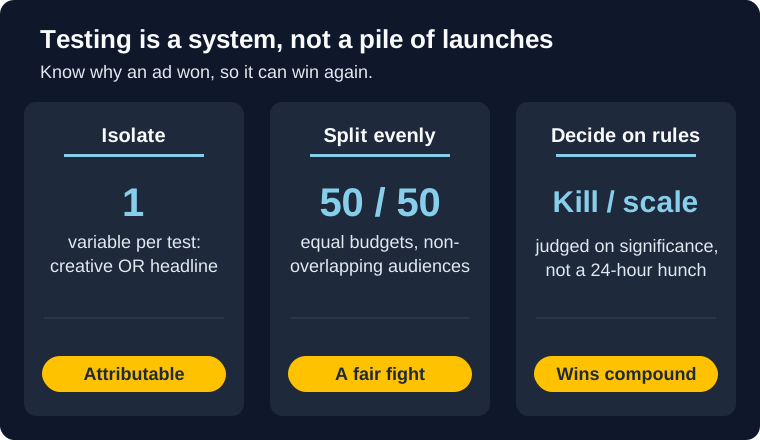
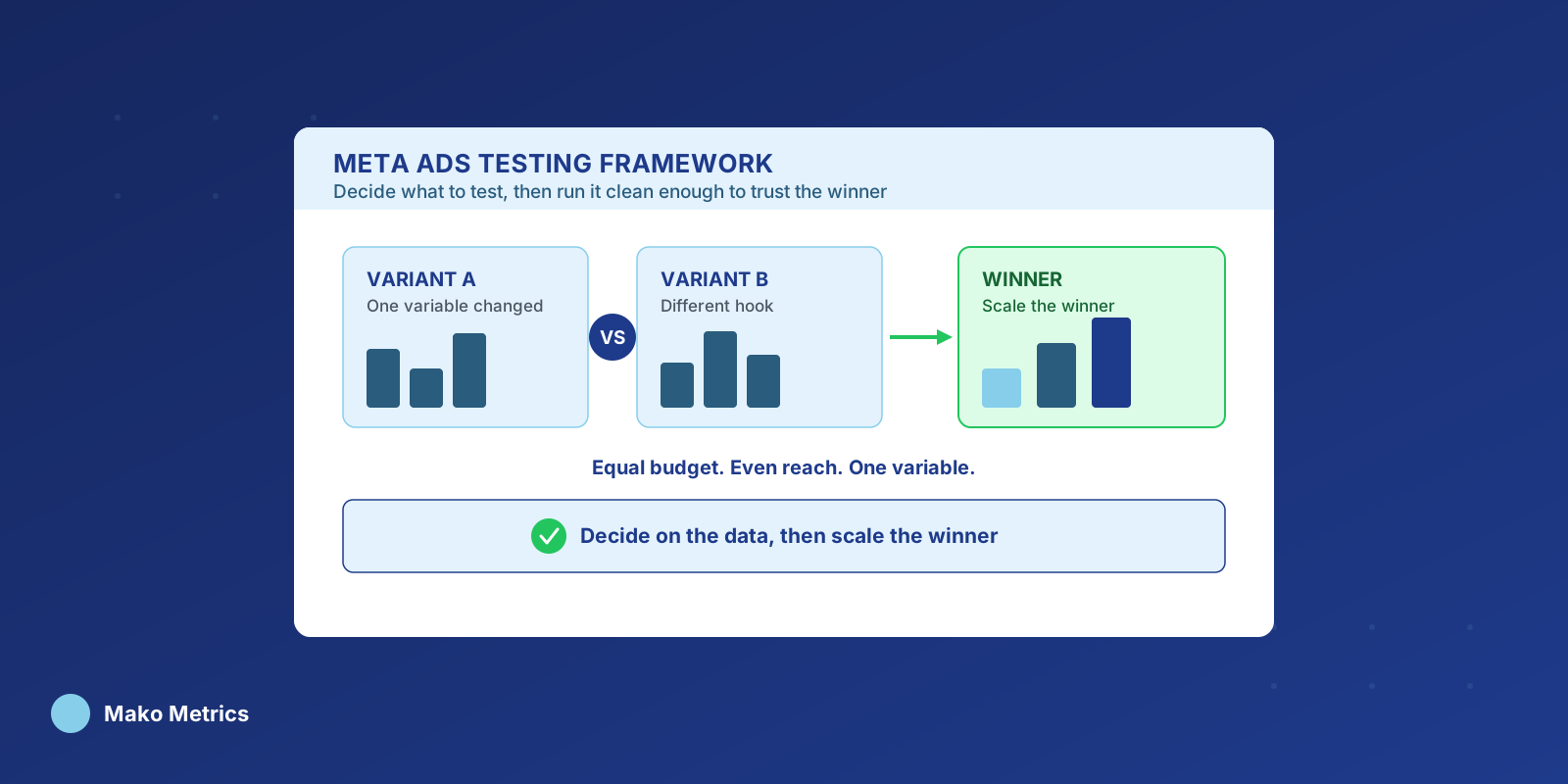
- Isolate one variable. Change the creative OR the headline OR the audience, never several at once, or you can't attribute the result.
- Split budget and reach evenly. Equal budgets and non-overlapping audiences are the only way the comparison is fair.
- Give it time to reach significance. Hold a no-touch window and judge on conversions, not a 24-hour hunch. Use the A/B significance calculator in this post to confirm a winner clears the noise before you scale.
- Test on a cadence and document everything. A standing test schedule plus a simple log is what makes wins compound and the account auditable.
A testing framework is a system, not a pile of launches
Most accounts have a history of launches in place of a testing framework. Someone had an idea, shipped three ads, kept the one that worked, and moved on. Repeat that for a year and you get an account nobody can read: dozens of live ads, no record of what was tried, and no way to tell a real winner from one that got lucky with the algorithm.
That gap is why testing is the emptiest area of most inherited accounts. When you audit a new client's Meta ads account, the testing section is almost always where you find the least evidence of a system, and the most room to add value fast.
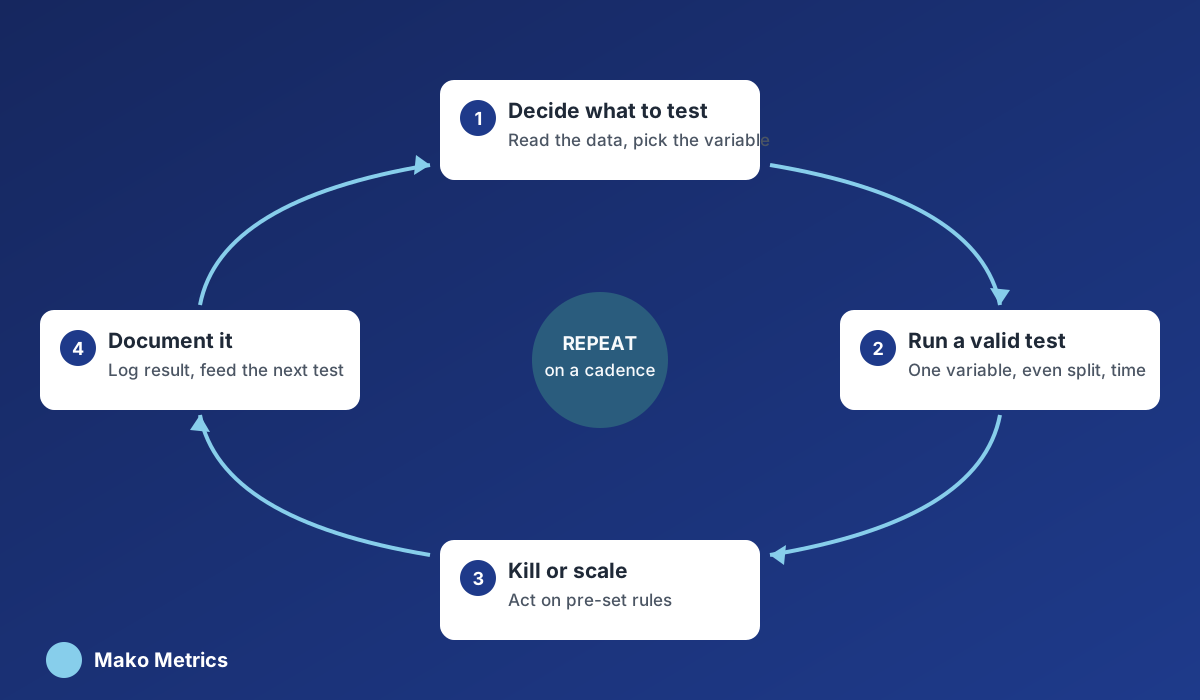
A framework turns that around by making testing a loop instead of a series of guesses. You decide what to test, run it so the result is trustworthy, kill or scale on pre-set rules, write down what happened, and feed that into the next test. Each turn of the loop makes the next decision sharper. The byproduct is an account with a paper trail: something you can optimize on purpose and hand to a client or a teammate without a shrug.
Step 1: Decide what to test (use your data, don't guess)
Almost every guide on how to test Facebook ads jumps straight to setup. That skips the most important decision you make: what to test in the first place. Testing a button color while your creative is the thing bleeding money is a wasted week. The move that matters most is choosing the right variable, and you don't have to guess it. Your account data tells you where the leak is.
Let your metrics pick the variable
Read the funnel and match the symptom to the variable worth testing:
- Low click-through rate or a weak hook. The problem is upstream, in the creative and the angle. Test new concepts, hooks, and formats, not the landing page.
- Healthy CTR but a low conversion rate. People are clicking and then leaving. The creative is doing its job; test the offer, the landing experience, or whether the audience matches the message.
- Rising frequency with falling CTR. That's the classic creative fatigue signature, and the variable is fresh creative concepts, not another color tweak on a tired ad. Our creative fatigue playbook has the frequency and spend-band thresholds for calling it.
- High CPM or thin reach. Now you're looking at audience and placement. Test a broader audience or a different placement mix.
There's an order of impact here, and it's worth respecting. Creative and angle move results the most, then the offer, then audience and copy, then placement. Test the biggest lever first. Running a placement test while your creative is the actual constraint is how accounts stay flat for months. And judge the result against something real: compare your numbers to category CPA benchmarks so you know whether you're fixing a genuine problem or chasing noise.
Pull test ideas from competitor ads
You don't have to invent every hypothesis from scratch. Your competitors are running a live experiment in public, and the angles, offers, hooks, and formats they keep running are a signal those things work. An ad that's been live for months is paying for itself, or they'd have killed it.
So before you brainstorm in a vacuum, go see what's already winning in your market. Skim a competitor's active ads, note the patterns they return to, the promise they lead with, the format they favor, the offer structure, and turn those patterns into test variants for your own account. This is exactly how to turn competitor ads into a creative brief your designer can build from without copying anyone.
Stuck on what to test next?
Browse the Mako Metrics sample reports to see how a competitor's ads, formats, and angles get surfaced, no login required. Order one on your top competitor and every recurring pattern becomes a hypothesis for your next test, so you walk into Step 2 with a backlog instead of a blank page.
Step 2: Run a test that actually means something
Once you know what you're testing, the job is to run it so the answer is trustworthy. This is where most "tests" fall apart. Three rules decide whether a test produces a real answer or just a number you'll act on anyway. Break any one of them and you've learned nothing, you just don't know it yet.
Test one variable at a time
Change the creative, or the headline, or the audience, but never several at once. If you swap the image, rewrite the hook, and widen the audience in the same test and CPA drops, you have no idea which change did it. You can't reuse a result you can't attribute, and a learning you can't reuse isn't a learning. One variable per test is slower and it's the only version that compounds.
Split budget and reach evenly
Give each variant an equal budget and a non-overlapping audience. This is the rule informal tests almost always break. Stack three ads in one ad set and Meta will pick an early front-runner and pour most of the spend into it before the others get a fair sample, so you end up crowning the ad that got the most reach, not the best ad. An even split, with audiences that don't bleed into each other, is the entire reason a test is fair. Meta's own A/B testing tool exists specifically to enforce that non-overlapping split.
Give it time to reach statistical significance
Patience is part of the method, not the absence of one. Hold a no-touch window of about seven days, or until the ad set approaches the roughly 50 weekly optimization events Meta says it needs to exit the learning phase. Read CTR and CPC in the first 24 to 48 hours as a directional early signal, but make the keep-or-kill call on CPA or ROAS, and only after you have enough conversions per variant to trust the number. A handful of purchases is a coin flip, not a verdict. As a rough floor, many operators want 50 to 100 conversions per variant, or a quick run through the significance calculator near the kill and scale rules below, before they crown a winner.
The hard part is leaving it alone. Editing budget, audience, or creative mid-test resets the learning phase and throws away the signal you've gathered, which means you've restarted the clock without realizing it. Set the test, set a reminder to check it on day seven, and keep your hands off it until then. Valid tests also assume your tracking is trustworthy. If your pixel or Conversions API is misfiring, even a perfectly structured test reports fiction.
Meta's A/B test tool vs. duplicating campaigns and ad sets
There are two honest ways to run a Facebook ads A/B test, and both can be valid. The question is which fits the test in front of you.
The first is Meta's built-in A/B test (split test) feature in Ads Manager. The second is doing it by hand: duplicating campaigns or ad sets, giving each an equal budget, and managing the structure yourself with ad set budget optimization (ABO). Here's how they trade off:
| Meta's A/B test tool | Duplicate campaigns/ad sets (manual ABO) | |
|---|---|---|
| Audience split | True non-overlapping split, handled for you | You manage overlap yourself |
| Significance | Built-in readout | You judge it |
| Flexibility | Rigid, best for one clean A-vs-B | Flexible, fits ongoing creative volume |
| Setup discipline | Guided | High, equal budgets and clean structure are on you |
| Best for | High-stakes one-off decisions | A continuous creative-testing cadence |
The decision rule is simple. Use Meta's A/B tool when you need a clean, defensible answer to one question, which creative wins, which audience wins, which placement wins, especially when you'll point to the result to justify a budget shift. Use disciplined manual ABO when you're running a steady stream of creative tests and folding the winners into a scale campaign, where the tool's rigidity would slow you down.
One convention holds across both: test in ABO and scale in CBO. Ad set budget optimization gives each variant its fair, equal share during the test. Once you have a winner, campaign budget optimization is the better home for scaling it. And if you lean on Advantage+ Shopping campaigns, remember that ASC automates away much of this control, so run deliberate tests in a manual structure, not inside ASC.
How much budget to test with (and how many ads per ad set)
Generic advice like "test 50 creatives for every $25k in spend" is useless to an account spending $2k a month. At that budget, 50 tests means each ad gets pocket change and none of them ever gather enough signal to prove anything. Test budgets have to match the account.
A workable floor: an ad set needs roughly your target CPA times 50, spread across a week, to exit the learning phase in that week. So if your target CPA is $30, that's about $1,500 over seven days, or a little over $200 a day, to give one ad set a real shot at significance. For a single test, budget around 20 to 30 times your target CPA per ad set over 7 to 10 days. If that math doesn't fit your spend, run fewer tests, not thinner ones. A $2k-per-month account should test five to eight creatives properly rather than spreading the same money across fifty.
How many ads per ad set depends on what you're doing. For a controlled test, run one variable per ad set so the comparison stays clean. If you put three to five ads in a single ad set, know what you're getting: Meta will quickly favor one and starve the rest, which is fine when you just want it to find the best of a batch, but it isn't a controlled test and you shouldn't report it as one.
When to kill a Facebook ad (and when to scale)
The biggest reason operators make bad calls mid-test is that they decide the rules while emotionally invested in the result. Set your kill and scale thresholds before you launch, write them down, and follow them. Treat the numbers below as common operator practice, not platform law, and tune them to your own benchmarks.
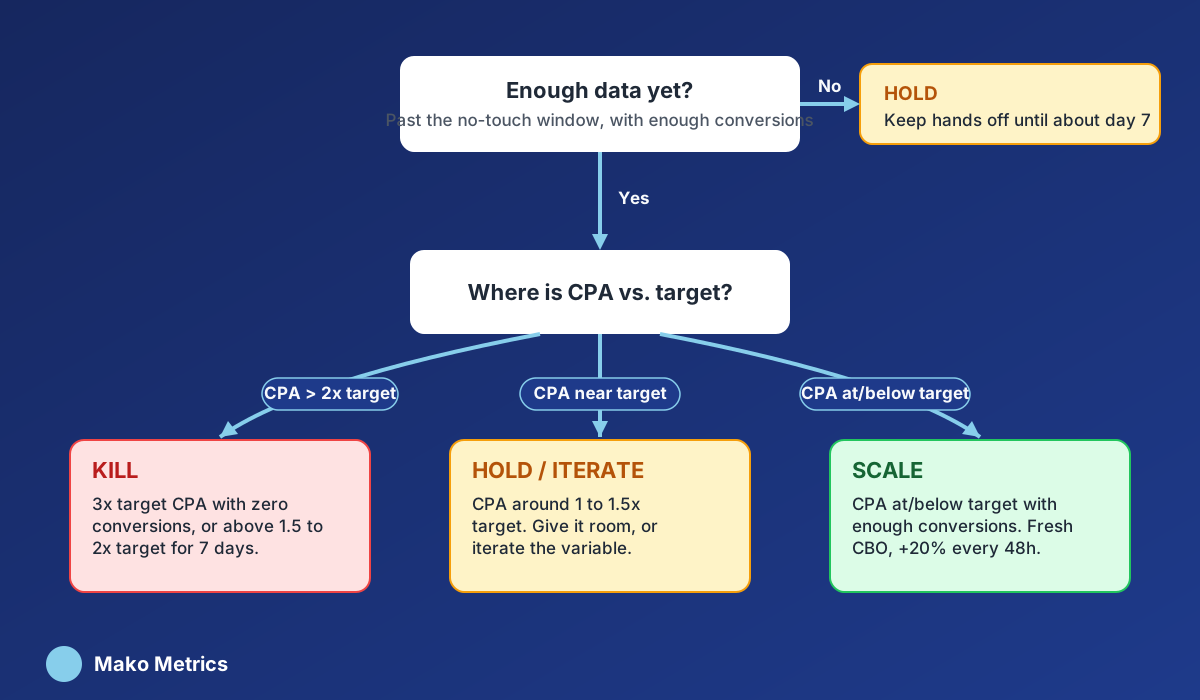
When to kill. Cut an ad immediately if it spends about three times your target CPA with zero conversions, that's a clear miss, not bad luck. Kill it if CPA sits above roughly 1.5 to 2 times target for seven straight days once it has adequate spend and conversions behind it. The one exception is the no-touch window: don't kill inside the first few days unless a hard floor breaks, like CTR collapsing, because the algorithm is still calibrating.
When to scale. When an ad set holds CPA at or below target with enough conversions to trust, move it into a fresh CBO campaign rather than editing the winning ad set in place. Then raise the budget by no more than about 20% every 48 hours. Bigger jumps reset the learning phase and spike your CPM, which can erase the win you're trying to scale. Check the move against your ROAS benchmark so you're scaling real profit, not a vanity number.
One last guardrail before you scale: make sure the winner is actually winning. If two variants look different but the gap sits inside the noise, scaling the "winner" just scales luck. Run your variants through the calculator below to see whether the difference clears the noise and whether you've given it enough time.
Full-screen tool: A/B Test Significance Calculator
Make it a habit: testing on a regular cadence
A testing framework is the engine that keeps the account improving, not a one-time project you finish, and engines only help if they're always running. The goal is simple: always have something in test.
A useful default is a 60-30-10 split of your testing energy. Roughly 60% goes to your proven winners, 30% to variations on those winners, and 10% to fresh concepts that could become the next winner. That mix keeps you defending what works while always probing for the next thing, so you're never caught flat when a top ad fades.
And ads do fade. Rising frequency and falling CTR are your cue that a current winner is fatiguing and needs a fresh challenger queued, which loops you right back to Step 1 and deciding what to test next. Set a standing rhythm, a weekly review of what's in flight and a monthly batch of fresh concepts, and run tests at every stage of the funnel, not just at the top. Keep it a cadence you actually hold, not a rigid calendar you abandon in week three.
Document every test: the learning library
A test you don't write down is a test you'll accidentally run again in six months. The thing that separates a real framework from a busy account is the record, and it costs almost nothing to keep.
Log one row per test: the hypothesis, the single variable you changed, the dates, the budget, the result against target, the decision you made (kill, scale, or iterate), and the next idea it sparked. Over a few months that log becomes a learning library. It stops you repeating dead ends, it onboards the next teammate in an afternoon, and it's exactly what a new agency or an auditor looks for when judging whether an account has a real process. It's also your client-reporting backbone: when the monthly check-in or QBR comes, you can show what you tested, what won, and what you're scaling next, which is how you prove progress before anyone asks why they're paying you. Circle back to that account audit: the presence of this log is often the difference between a testing section graded red and one graded green. Keep the log disciplined enough and you've built the thing an AI ads agent automates: the test record becomes the memory a self-improving loop reads before it briefs the next round.
What to remember
- Start by deciding what to test. Read your account data to find the weak link, and test the biggest lever first: creative and angle before offer, audience, or placement.
- Mine competitor ads for hypotheses so you walk into every test with a real backlog instead of a guess.
- Isolate one variable and split budget and reach evenly, or the result isn't attributable and the comparison isn't fair.
- Give the test time to reach significance, and choose Meta's A/B tool versus manual ABO on purpose based on the decision in front of you.
- Pre-commit kill and scale rules, test on a standing cadence, and document every result so wins compound and the account stays auditable.
Your next test idea is in a competitor's ad account
The fastest source of test hypotheses is seeing what your competitors are already scaling. A Mako Metrics report packages that competitive read for a client account: the creatives, formats, and angles worth testing, scored and ready to brief.