
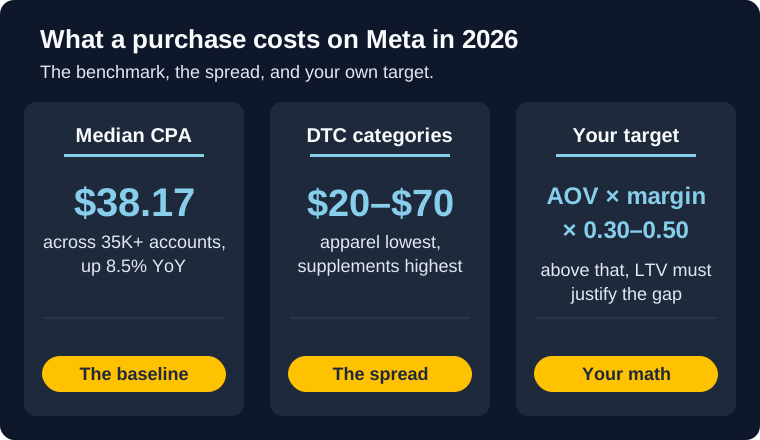
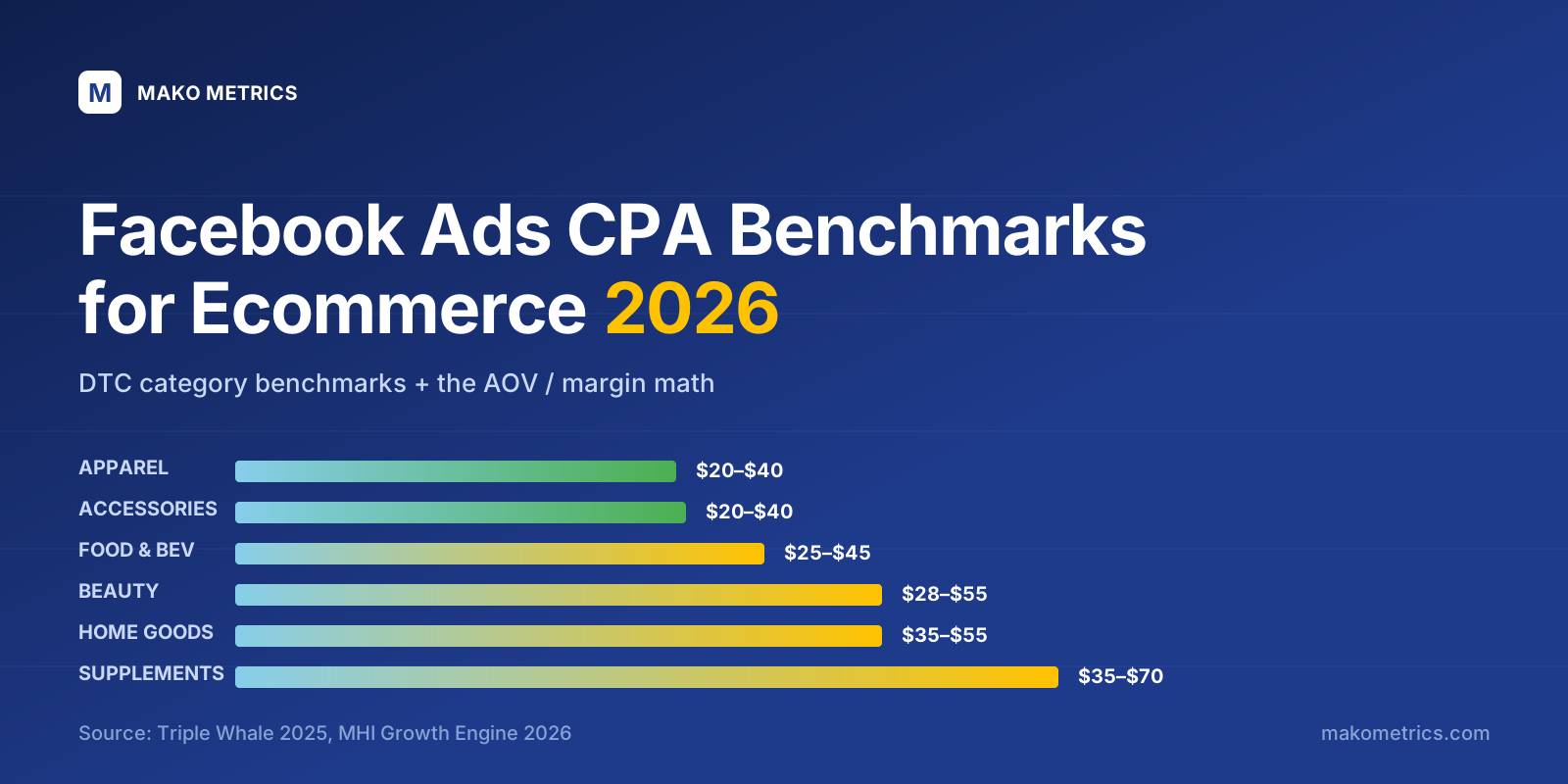
The median CPA on Meta ads sits around $38, but for DTC ecommerce that range stretches from about $20 in apparel to $70+ in supplements (Triple Whale, MHI Growth Engine). The number on its own is almost useless. A $45 CPA can be a steal for a supplement brand with $200 LTV, and a fast way to lose money for an apparel brand selling $35 t-shirts.
So this post does two things. First, it gives you the 2026 Facebook ads CPA benchmarks for ecommerce, broken out by DTC category instead of the broad industry buckets every other benchmark report uses. Second, it walks through the AOV and margin math to figure out what your own target CPA should be. By the end you'll have a defensible answer to "is my cost per purchase good?" instead of staring at a $45 CPA and wondering whether to scale, pause, or rewrite the whole media plan.
Bottom line
- All-industry median CPA: $38.17 across 35K+ ad accounts in 2025 (Triple Whale).
- Ecomm range by category: Lifestyle/Boutique low at $29.99, Electronics high at $49.48.
- DTC subcategory ranges: Apparel $20–40, Beauty/Skincare $28–55, Supplements $35–70.
- Costs are climbing: CPA up 8.5% YoY, CPMs up 20% from $11.82 to $14.19.
- Advantage+ Shopping: 32% lower CPA than manual campaigns on average.
- Your target CPA: (AOV × gross margin %) × 0.30 to 0.50. Anything above that needs LTV to justify.
What Counts as a "Good" CPA for Ecommerce
There is no universal good CPA. There's the benchmark for your category, and there's the math against your margin. You need both.
The all-industry median CPA across Triple Whale's 2025 dataset of 35,000+ accounts landed at $38.17. Ecommerce specifically came in slightly lower, with Lifestyle and Boutique brands sitting at the low end ($29.99) and Electronics at the high end ($49.48). That's a useful anchor, but it's the average of an enormous spread, and your category likely doesn't look like the average.
Quick definitional note before we go further: CPA and CPP are the same number. "Cost per purchase" is the DTC-operator vocabulary. "Cost per acquisition" is the Ads Manager / Triple Whale vocabulary. Same metric. If you read an agency report quoting CPP and another quoting CPA on the same campaign, don't get confused, they're tracking the same conversion event.
The reason this benchmark matters: brands now allocate 68.31% of ecomm ad budgets to Meta. Your CPA on Meta is doing more of the work in your overall acquisition picture than any other channel.
For the broader cost picture (CPC and CPM context across all industries), see our Facebook ads cost benchmarks.
2026 CPA Benchmarks by Ecommerce Category
Here's the part most benchmark reports skip. Generic "ecommerce" is too broad to plan against. A skincare brand and an electronics brand both sit under "ecomm" but their unit economics, repeat rates, and creative formats are completely different.
The table below combines Triple Whale's 2025 industry data with MHI's 2026 vertical breakdown for DTC subcategories. CPA ranges reflect typical purchase-objective campaigns running on cold and warm traffic combined.
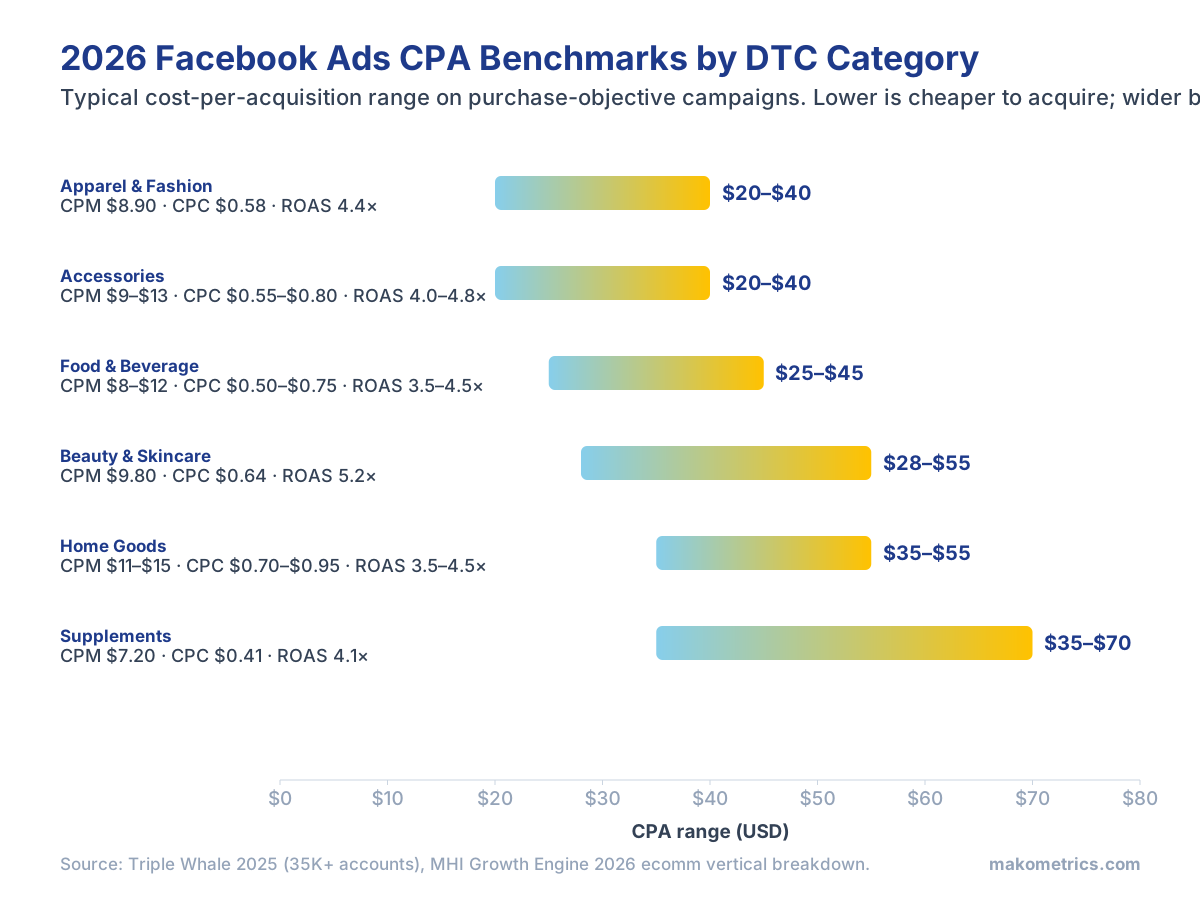
| DTC Category | Typical CPA Range | CPM | CPC | Typical ROAS |
|---|---|---|---|---|
| Apparel & Fashion | $20–$40 | $8.90 | $0.58 | 4.4× |
| Beauty & Skincare | $28–$55 | $9.80 | $0.64 | 5.2× |
| Supplements | $35–$70 | $7.20 | $0.41 | 4.1× |
| Home Goods | $35–$55 | $11–$15 | $0.70–$0.95 | 3.5–4.5× |
| Food & Beverage | $25–$45 | $8–$12 | $0.50–$0.75 | 3.5–4.5× |
| Accessories | $20–$40 | $9–$13 | $0.55–$0.80 | 4.0–4.8× |
A few notes on each.
Skincare and Beauty
Skincare lands in the middle on CPA but punches above its weight on conversion rate (around 7.10% per MHI). Buyers come to the ad ready to solve a specific problem (acne, aging, dryness) rather than browsing. That intent supports a higher CPA because the ROAS, around 5.2x, is also higher. CPM runs slightly elevated at $9.80 because every other beauty brand is bidding on the same lookalikes.
Apparel and Fashion
Apparel has the lowest CPC of any DTC category at $0.58 and one of the lowest CPMs at $8.90. The ad auction here is competitive but the creative is visual-native, which keeps CPMs honest. The catch: tight gross margins compress your profitable CPA ceiling. A $30 CPA is great until you're selling $35 t-shirts at 40% margin and realize you're losing $16 on every first order.
Supplements
Supplements run the highest CPA range ($35–$70) but it's misleading on its own. Subscription and repeat-purchase economics carry the LTV. A brand happily losing $10 on a $50 first-order CPA can still earn $200+ over 12 months. Per Flighted's 2026 supplement breakdown, educational long-form video (60–90 seconds explaining ingredients) outperforms short product showcases by ~43% on conversion rate, which is why supplement CPMs run lower ($7.20) despite the higher CPA.
Home Goods
Home goods CPA tracks AOV closely. Higher-AOV brands ($150+) tolerate $50+ CPAs because the gross profit per order supports it. Lower-AOV brands ($40–80 décor) need to keep CPA closer to $25–$35 to stay profitable. The category isn't well covered in vertical benchmark reports, so the numbers above are estimated from Triple Whale's broader Home & Garden bucket and Stackmatix industry data.
Food and Beverage
Similar repeat dynamics to supplements but lower AOV. Subscription brands tolerate the higher first-order CPA because LTV math works out by month four. One-time DTC food (snacks, gourmet) plays a different game and needs to keep CPA tight, closer to $25.
Accessories
Sits next to apparel on most metrics. Lower AOV than home goods, higher conversion intent than fashion (people buy a phone case because they need one, not because they're browsing). CPA ceiling depends entirely on whether you have a repeat-purchase motion or not.
What's Changing in 2026
Three trends matter, and one of them is going to confuse you if you only look at headline numbers.
1. CPA is up roughly 8.5% year over year. Per Stackmatix's 2026 cost benchmarks, median CPA climbed about 8.5% across their dataset year over year. If your CPA looks higher than last year and you haven't changed anything, you're not crazy. The auction got more expensive.
2. CPMs are up 20%, from $11.82 to $14.19. This is the bigger driver of CPA inflation. More advertisers are crowding into Meta and Reels inventory is filling up, which means you're paying more per impression. CPA goes up unless your conversion rate or AOV is also climbing.
3. The CPP volatility nobody's talking about. Superads tracks cost per purchase across thousands of accounts and the 2025 average was $51.65. January 2026 dropped to $25.15, a 53% year-over-year swing. Don't take that single month and assume costs are crashing. Holiday rebound, attribution windows, and dataset composition all move that number around. Trend lines over 90 days mean more than any single month.
The takeaway: budget for 5–10% CPA inflation on a like-for-like basis, and watch your CPM trend more closely than you watch CPA. A flat CPA on a rising CPM means your creative is doing more work, which is good. A rising CPA on a flat CPM means something else is broken.
How to Calculate Your Target CPA
Now the part that turns benchmarks into decisions. You don't optimize against the industry average. You optimize against your own ceiling.
Three layers of math, each one tighter than the last.
Layer 1: Maximum profitable CPA (break-even on first order)
Formula: Max CPA = AOV × Gross Margin %
Worked example: $85 AOV, 55% gross margin → max CPA of $46.75. Spend more than that to acquire a customer and you're losing money on the first order. This is your absolute ceiling assuming no repeat purchases and no LTV.
Layer 2: Target CPA (with operating costs and profit)
You don't want to spend your entire contribution margin on ads, you need some left for overhead and actual profit. Per Common Thread Co's CPA framework and Top Growth Marketing's CPA calculator, a defensible target sits at 30% to 50% of gross profit per order.
Same example: gross profit per order is $46.75. Target CPA at 30% = $14, at 50% = $23. Conservative brands aim for $14, aggressive scaling brands push toward $23.
Layer 3: LTV-adjusted CPA (for repeat / subscription)
If your category sees real repeat purchases (supplements, skincare refills, food subscription, consumables), you can stretch your first-order CPA above the break-even number because you'll recoup it on order 2, 3, and 4.
A supplement brand with $200 LTV over 12 months can confidently spend $60+ on a first-order CPA against a $50 first-order AOV, knowing the second and third orders cover the loss with margin to spare. Most successful DTC subscription brands run intentionally negative on first-order CPA for exactly this reason.
Your AOV drifts. Your margin drifts. Your repeat rate drifts. Run this math once, write down your target CPA, and recalculate every quarter. We've seen brands defending a $25 target CPA from a calculation done two years ago when their AOV has since climbed 30%. They're leaving acquisition headroom on the table.
CPA and ROAS are two views of the same equation, so if you want to cross-check your number against ROAS-based targets, see our Facebook ads ROAS benchmark guide.
Why Same-Category Brands Have Wildly Different CPAs
Two skincare brands targeting the same audience can run at $28 and $58 CPA respectively. Same category, same auction, double the cost. Five reasons this happens:
- Creative quality. UGC outperforms brand-shot creative by ~26% on CPA per MHI's DTC analysis. The brand running iPhone-shot customer testimonials almost always beats the brand running studio product photography on cold traffic.
- AOV and bundling. A brand that bundles 3-month supplies has a higher CPA but better unit economics than the brand selling single units. Same channel, different game.
- Repeat rate and LTV horizon. Brands with strong subscription motions tolerate (and benefit from) higher first-order CPAs.
- Advantage+ vs manual campaigns. Stackmatix's 2026 data shows Advantage+ Shopping campaigns deliver about 32% lower CPA than manual campaign structures. Brands that haven't tested it are leaving easy efficiency on the floor. See our Advantage+ Shopping breakdown for the full setup.
- Audience fragmentation. Five overlapping ad sets cannibalize each other and bleed budget into the learning phase. Consolidation almost always lowers CPA.
Industry benchmarks are calibration. Your prior 90 days is the real comparison. Your business changes faster than benchmark reports do. If your CPA is $40 against a $30 industry median but it was $55 last quarter, you're winning. The benchmark doesn't know that.
How to Lower Your Facebook Ads CPA
Five concrete moves, ranked by how much CPA they typically take out:
- Switch eligible campaigns to Advantage+ Shopping. Easiest single win in 2026. Stackmatix's dataset puts the CPA delta at 32%. Test it on one campaign for two weeks against your manual baseline before committing the whole account.
- Replace 3 brand-shot ads with 3 UGC variants. The +26% CPA improvement from UGC is the difference between profitable and not. iPhone-shot testimonials. Pet videos. Kitchen-counter unboxings. Stop running studio shots on cold traffic.
- Fix the conversion-rate leak before buying more traffic. A landing page that converts 1% better can drop your CPA more than any bid strategy tweak. Audit your PDP, your checkout, your mobile load time. If you're losing 60% of add-to-carts at checkout, no amount of Meta optimization fixes that.
- Consolidate ad sets. Five ad sets with $20/day each rarely beat one ad set at $100/day. The algorithm needs signal volume to optimize. Fragmentation is the most common silent CPA killer in mid-sized accounts.
- Watch CPM, not just CPA. If CPM is climbing and CPA is flat, your creative is doing more work to hold the line. Good. If CPA is climbing on a flat CPM, look at landing page performance and creative fatigue first.
See What Your Top 3 Competitors Are Running
If you don't know which creatives, formats, and copy angles your competitors are testing right now, you're benchmarking blind. Browse our sample competitor reports and see the format in seconds.
How to Estimate What Competitors Pay Per Purchase
You can't see your competitor's CPA. Meta won't show it, no third-party scraper has it, and any tool claiming an exact number is guessing. But you can estimate the pressure they're under from what's visible in the Meta Ad Library, and that's almost always more useful than a single number anyway.
Four signals to read:
- Creative volume. Brands running 30+ active ads are testing aggressively, which usually means they haven't found a winning CPA yet. Brands running 3 long-running ads have found something that works.
- Ad longevity. An ad that's been running 60+ days is profitable. Meta would not keep serving it otherwise. Long-runners tell you which angles, formats, and offers are converting in your category.
- Format mix. Heavy Reels rotation suggests they're chasing cheaper inventory to bring CPA down. Heavy carousel and static suggests higher AOV with established creative.
- Copy themes. Heavy retargeting copy ("still thinking about it?", urgency language, discount stacks) signals they have a healthy traffic flow and are working CPA down with bottom-funnel pressure. Heavy top-funnel education copy means they're rebuilding pipeline.
Triangulate those four and you have a defensible read on whether a competitor is acquiring efficiently or struggling, even though Meta will never show you their actual CPA.
Get a Full Competitor CPA Read in a Snapshot Report
A Mako Metrics Snapshot report ($24.99) analyzes one competitor's Meta Ad Library footprint, including creative volume, format mix, ad longevity, and copy themes. You get a practical read on the acquisition pressure they're operating under, without pretending Meta exposes their actual CPA. See pricing.
FAQ
What is a good CPA for ecommerce on Facebook ads?
It depends on your DTC category and your margin. As benchmarks: apparel runs $20–40, beauty and skincare $28–55, supplements $35–70. Compare to your max profitable CPA, which is your AOV multiplied by your gross margin percentage. If your benchmark and your max CPA agree, you're in good shape.
What's the difference between CPA and CPP?
None. CPP (cost per purchase) is the term DTC operators use. CPA (cost per acquisition) is what Ads Manager and most analytics platforms call it. On a purchase-objective campaign, they refer to the same conversion event and the same number.
Why is my Facebook ads CPA higher than the benchmark?
Five common reasons: weaker creative (especially missing UGC), AOV that's lower than the category average, audience overlap or fragmentation across too many ad sets, attribution window mismatch (7-day click vs. 1-day click reports very different CPAs), and not running Advantage+ Shopping. Walk through the five drivers in the "why brands diverge" section above to diagnose.
Does Advantage+ Shopping actually lower CPA?
Yes, by about 32% on average per Stackmatix's 2026 dataset. It's not a guaranteed win for every account (some niche audiences underperform on Advantage+) but it's worth a 2-week test against your manual baseline if you're not already running it.
What to remember
- The all-industry median ecomm CPA is around $38, but your DTC category matters more than the average.
- Apparel runs $20–40 CPA, beauty $28–55, supplements $35–70. Your category sets the realistic ceiling.
- CPA is up 8.5% YoY and CPMs are up 20%. Expect your numbers to drift up unless creative or efficiency improves. At smaller agency budgets ($1k–$10k/mo per client), CPA drift is too noisy to trigger creative refreshes on its own. See the creative fatigue detection playbook for the upstream signals (frequency, CTR decay, CPM rise) you should watch first.
- Your real target CPA = (AOV × gross margin) × 0.30 to 0.50, adjusted for LTV if you have repeat-purchase economics.
- Same-category brands diverge 2–3x on CPA, mostly because of creative, Advantage+ adoption, and conversion-rate leaks.
- Fastest CPA wins in 2026: Advantage+ Shopping (32% lower) and UGC creative (26% lower).
-
You can't see competitor CPA directly, but Ad Library signals (volume, longevity, format mix, copy themes) tell you what's working in your category.
Mako Metrics gives ecommerce brands competitive intelligence on Meta ads. Our Snapshot reports analyze competitor creatives, copy, formats, and Ad Library footprint to estimate the performance pressure they're under, so you can benchmark against the brands you actually compete with, not industry averages. See pricing or browse sample reports.