
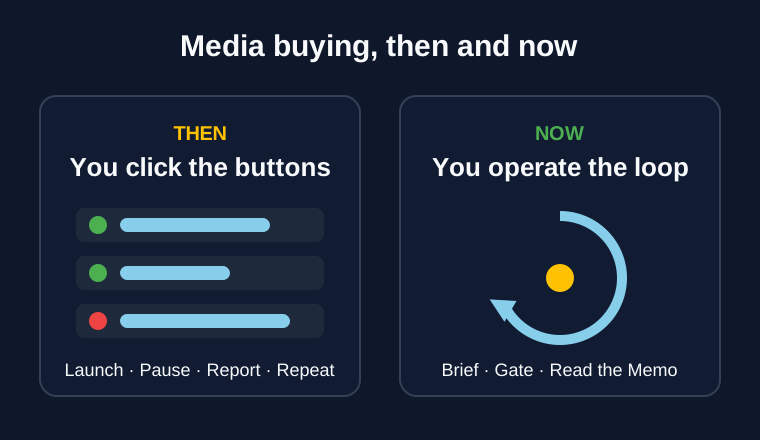
Every week another tool promises an AI media buyer that runs your Facebook ads while you sleep. Meta is on the other side of the same pitch: its new Ads AI connectors let an AI agent create campaigns, edit ad sets, and move budgets in your account. The pitch is autonomy. The subtext is that you're the bottleneck.
Here's what the pitch gets wrong, and what it gets right. The real version of this isn't a chatbot you type prompts into all day. Picture a loop instead: an agent that prompts itself through a creative sprint, writes what happened into memory, and starts the next sprint smarter than the last one. Once you see the loop shape, the "will AI take my job" question changes into a more useful one: who operates the loop?
I run one of these loops in production right now. It writes for search instead of buying media, and it has shipped over 20 published articles, including the one you're reading. This post breaks down its anatomy, maps the same architecture onto Meta ads, and kicks off a series where I build the ads version in public: real skills, real costs, real failure modes.
The short version
- An AI media buyer isn't a prompt box. It's a self-prompting loop: skills produce artifacts, artifacts pass human gates, results write back to memory that briefs the next run.
- Machine learning already took the auction. The new shift is AI operating the layer around it: creative, analytics, and ops.
- The real scale at a real budget is 5-8 creatives a day, not the "20+ a day" the vendor headlines sell.
- Full autonomy wrecks ad accounts in four specific, predictable ways. Each one has a design answer.
- This is Post 1 of a 7-part build-in-public series. The ads loop gets built next, and everything gets shown.
Every vendor is selling an AI media buyer. Meta is too.
Search "ai agents for facebook ads" and page one is a vendor lineup: platforms selling agentic Meta ads management, "AI that runs your ads," AI media buyers for lean teams. Meta itself now sells an AI Business Agent and ships MCP connectors so third-party agents can manage campaigns directly. The category is funded, crowded, and moving fast.
Most takes on this are either hype or denial, so here is my position. AI in media buying is not new. Auto-bidding, lookalike modeling, and Advantage+ shopping campaigns are a decade of machine learning already running the auction. If your mental model is "AI is coming to Facebook ads," you're about ten years late. The auction has been machine-run for years, and you've been feeding it.
What's actually new is the layer AI is coming for now: the work around the auction. Writing the copy. Generating the creative. Reading the performance data. Deciding what to kill, what to scale, and what to test next week. That layer has always been human, and it's the layer the new agent wave is built to operate. That shift is bigger than bidding automation ever was, because it touches the part of the job that was supposed to be yours.
But there's a gap between what's being sold and what's being built. Most of what wears the "AI media buyer" label today is a tool waiting for your prompt: you ask, it answers, you ask again. The version that matters runs without you standing in the middle of every step. Practitioners can smell the difference, which is why the threads on r/FacebookAds about AI tools for media buying run heavy on skepticism and account-ban stories. The skeptics are right about the risks and wrong that the risks are the end of the story.
I already run one of these loops. Here's its anatomy.
The reason I'm confident about the loop shape is that I run one. My SEO pipeline is an AI agent that carries an article from keyword research through publication, and it has shipped every post on this blog for months, including this one. Nobody re-prompts it between steps. It reads its own instructions, does the work, and hands each stage's output to the next stage.
People hear "AI loops for performance marketing" and picture something exotic: model fine-tuning, custom training runs, a data science team. Mine is none of that. It's structured files. Four kinds of them.
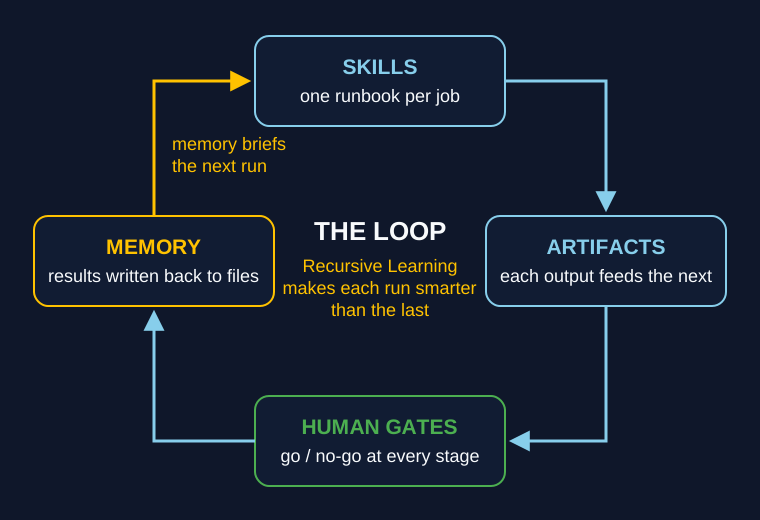
The loop: skills, artifacts, gates, memory
Skills are runbooks, one per job. Research is a skill. Writing is a skill. Image production, SEO review, editorial, publishing: each one is a file that tells the agent exactly how to do that job and nothing else. The agent loads the skill it needs, when it needs it.
Artifacts are how skills talk to each other. The research skill produces a research brief. The brief feeds an outline, the outline feeds a draft, the draft feeds a review. No step starts from a blank page, and no step depends on anyone remembering what happened earlier. The state lives in files, not in a chat history.
Gates are where I show up. Between every stage, the agent stops and asks for approval. It cannot publish, cannot skip ahead, cannot decide its own work is good enough. More on why that one rule matters even more in an ad account in a minute.
Memory is what turns the pipeline into a loop. After every published post, the agent updates its own context files: a running log of mistakes it's been caught making, an inventory of what's been published, notes on what worked. The next run reads those files before it starts. That write-back step is the whole trick. Run 30 doesn't repeat the mistakes of run 5, not because the model got retrained, but because the mistake is written down where run 30 has to read it.
That's what "self-improving" means here, stripped of the mystique. The agent prompts itself, and the recursion lives in the files. Every loop through the cycle deposits a little more judgment into the system. After 20+ posts, the mistake log reads like a senior editor's checklist, and none of it existed when the loop first ran.
The same loop transfers to ads. Swap "research, write, review, publish" for "research, create, launch, analyze," and swap the mistake log for a record of which hooks and formats performed. Same shape, different payload. That's a Facebook ads AI agent worth building, and it's what I'm building next.
The ads version: a 9-skill loop I'm building in public
Here's the design. Nine skills, each producing an artifact the next one consumes, running as a daily creative sprint.
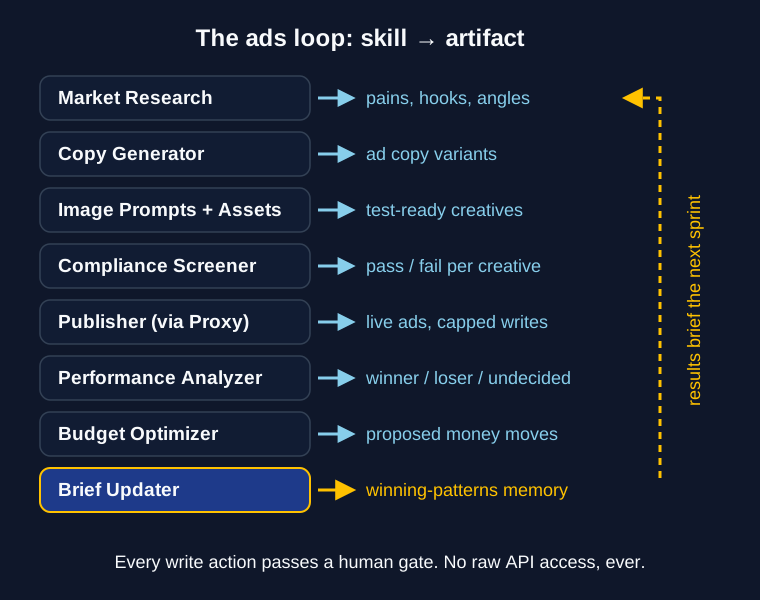
Market research produces angles: pains, hooks, desired outcomes. Copy generation turns angles into ad copy variants. An image-prompt builder turns the briefs into generation prompts, an asset generator renders the creatives, and a compliance screener checks everything against Meta's ad policies before anything is publishable. A publisher pushes approved ads live. Then the read side: a performance analyzer classifies every ad as winner, loser, or undecided, and a budget optimizer proposes the money moves.
The ninth skill is the one that closes the loop. Once a week, it takes what the analyzer learned and rewrites the creative brief itself: which patterns are winning, which hooks are saturated, what died on arrival. The next sprint's copy and creative skills read that updated brief before they generate anything. Last week's results become this week's starting point, automatically. This is the same write-back move that powers the SEO loop, pointed at creative instead of content, and it's why the machine gets smarter every week without anyone retraining a model.
If you've built a Meta ads testing framework by hand, you'll recognize what the analyzer and optimizer skills encode: one-variable discipline, kill rules, promote criteria. The agent runs that framework, every day, without getting bored.
I'm building this in the open, in deliberate phases: read-only access first, a sandbox ad account second, live spend last. As of this post, no live dollar has moved, and that's deliberate. You'll see why in the next section.
The real math: 5-8 creatives a day, not 20+
The vendor headline for tools like this is "20+ creatives a day." Generation-wise, that's trivially true. Current image models produce a test-grade creative for a fraction of a cent, and I'll publish the exact cost math later in this series.
But generating creatives was never the constraint. Judging them is. Every creative you launch needs enough impressions to earn a verdict, and impressions cost money. At $1,000 to $2,000 a month, which is a real budget for a small DTC brand or a single client account, the spend can feed roughly 5 to 8 new creatives a day with enough data to classify them. Launch 20 a day on that budget and you get 20 unreadable results. Any AI media buyer pitch that quotes creative volume without asking your budget is selling you the printer, not the factory.
Why a fully autonomous ad agent will wreck your account
The gates in my loop exist because an unsupervised loop compounds its mistakes exactly the way it compounds its wins. Recursion cuts both ways: the same write-back that stacks judgment can stack a bad lesson into every future sprint. And in a live ad account, bad lessons cost real money before you catch them.
Four traps do most of the damage. Every one of them is predictable, and every one has a design answer.
Trap 1: learning-phase resets. Meta's delivery system needs about 50 optimization events within 7 days to exit the learning phase and stabilize. An agent tuned to "kill losers fast" will pause and restructure ad sets every 48 hours, which resets learning each time, which keeps costs erratic, which triggers more kills. The account ends up trapped in permanent learning by its own diligence. The design answer: two separate decision surfaces. Creative kills happen at the ad level with a statistical floor. Ad-set changes clear a much higher bar and ship in weekly batches.
Trap 2: handing the agent raw API access
The documented horror stories, the "an agent nuked my ad account overnight" posts, share one root cause: the agent held the keys. An agent with direct Marketing API access can burn a month's budget or trip Meta's automation flags before a human sees anything. The design answer is a proxy layer between the agent and Meta: hard spend caps, a human-approval threshold above a set budget size, a cap on structural edits per hour. The agent never touches the raw token. It requests; the proxy decides.
Trap 3: pruning on noise. Sort a day's ads by CTR and kill the bottom half, and you're mostly executing statistical noise. Small samples produce fake losers and fake winners constantly. The design answer: a minimum impression floor before any verdict, comparison against the ad set's own baseline rather than raw rank, and a third category the vendor demos never show you: "undecided." Most young ads are undecided. An agent that's allowed to say so kills far fewer future winners.
Trap 4: creative convergence. A loop that only feeds winners back into its own brief will, within weeks, generate variations of one ad. The copy homogenizes, and a library where every ad says the same thing is exactly the creative monoculture you can read from the outside in a fatiguing competitor's account. The machine does to itself what tired brands do to themselves, just faster. The design answer: reserve 20-30% of every sprint's creative slots as an explore quota that deliberately ignores the winning-patterns brief. It's a hard rule in the copy and image skills, not a suggestion.
Notice what all four answers have in common: they're constraints on the loop, not upgrades to the model. The skeptics are right that an autonomous agent will wreck an account. But that's a case for building the constraints, not for abandoning the loop. The constraints are the product.
Will AI replace media buyers?
No, but it will replace what most media buyers spend their day doing. The clicking layer of the job automates; the judgment layer concentrates.
Be specific about the split. Launching variants, pausing losers, pulling performance reports, nudging budgets between ad sets: that work was already loop-shaped, a human executing rules a machine can execute faster and without fatigue. That layer goes to the agent, and I don't think it's worth mourning.
What's left is what was always the actual job. Deciding what the brand should say next. Feeding the machine the right market context. Owning the kill call on a creative the founder loves. Standing in front of a CMO or a client and explaining why performance moved and what you're doing about it. None of that automates, because none of it is a rules problem. It concentrates into the person running the loop.
So the at-risk profile isn't "media buyer." It's the media buyer whose entire value is the clicking layer. If your week is launching, pausing, and reporting, the loop is coming for your week. The buyers who come out ahead are the ones who move up a level and treat the agent the way a director treats a team: brief it well, check its work at the gates, and own the judgment it isn't allowed to exercise. AI-first media buying is still media buying. It just stops paying for hands and starts paying for taste.
What operating the loop actually looks like
Concretely, the job on the other side of this shift has four motions.
You brief the sprint. The loop generates from what it knows, and what it knows is what you feed it. The highest-signal input is market context: what competitors are running right now, which hooks are saturated in your category, where the whitespace is. When I pulled 240 ads across Gymshark, Alo, and Hoka for the fitness benchmark, the read was exactly the kind of thing a sprint brief is made of: who's testing hard, who's coasting on old winners, which CTA every brand leans on. Feed that to the copy skill and the explore quota has real targets instead of random swings.
The loop is only as good as its brief
Competitor intel is the sprint brief's raw material, and pulling it by hand takes an afternoon per brand. A Mako report runs a rival's entire Meta Ad Library for you: every live ad, hook patterns, format mix, CTA distribution, and how fast their creative engine is shipping.
See a finished example first. No login, no card.
You clear the gates. A queue of proposed launches, kills, and budget moves, each with the agent's reasoning attached. Most of the approvals take seconds. The ones that don't are precisely the decisions that deserved a human anyway.
You read the memo. Once a week the loop writes down what it learned: which patterns won, what it killed and why, what it wants to try next sprint. Fifteen minutes of reading replaces the hours you used to spend assembling that picture from Ads Manager exports.
You make the calls the agent is banned from making. Raising the spend cap. Approving a structural change. Overruling a kill because you know something the data doesn't. The gates exist so those calls stay yours.
That's the answer to "what does an AI media buyer actually do." The machine buys the media. You run the machine.
What ships next
This post is the thesis. The build is the proof, and it ships as a series:
- Anatomy of an ads agent: the skill stack. The real folder structure, what a skill actually is, and how the artifacts flow. Live now, including the creative the compliance gate refused to publish.
- The image factory. Generating test-grade ad creative with current image models, with the actual cost-per-creative math at real volume. Live now: five models, one brief, one usable.
- Why your ad agent will kill your account. The four traps in full depth, plus the proxy middleware that keeps the agent's hands off the raw API. Published.
- Real ad ops work out of an agent. Which stations of your process an agent can hold, the Meta delivery rules it has to encode, and what it waits for before calling a winner. Live now, including the four rules of ours that turned out not to be rules.
- The recursive loop. How the winning-patterns brief evolves week over week, and the pruning statistics that decide what feeds it.
- Full stack breakdown. The complete architecture, the schedule, the data layer, and the repo, public.
The order of operations is fixed: architecture first, sandbox second, live spend last. Some of it will fail in public, and the failures ship too, because the failure modes are half of what makes this series worth reading.
The auction stopped being your job a decade ago. The creative, the analysis, and the ops are next, and I'd rather be the person who built the loop than the person who got looped. Follow along.
The loop this post maps is now running. You can see where it got to on the Meta Ads Agent page, and have it draft five ads for a brand of your choosing while you're there.
FAQ
Will AI replace media buyers?
Not the role, but a large share of its tasks. Launching variants, pausing losers, pulling reports, and shifting budgets automate well because they're rules-based. Briefing the system, creative judgment, kill-call accountability, and explaining performance to leadership don't. The job shifts from executing the loop to operating it.
What is an AI media buyer?
In practice, an AI media buyer is a loop of narrow skills rather than a single model or a chat tool you prompt: research, copy, creative generation, compliance, publishing, analysis, and budget moves, each producing an artifact the next skill consumes, with results written back to a memory file that briefs the next cycle. The human sets the inputs and approves the actions at gates.
What is an AI loop in performance marketing?
An AI loop is an agent system that prompts itself through a recurring workflow and improves by writing its results back into its own context. In performance marketing, that means every creative sprint is briefed by the last sprint's actual performance data, so the system compounds learning in files rather than requiring model retraining.
Can an AI agent run Facebook ads safely?
Yes, with constraints it cannot override: ad-level kills only (never rapid ad-set churn that resets the learning phase), all writes routed through a rate-limited proxy with spend caps and human-approval thresholds, minimum impression floors before any verdict, and an explore quota that prevents creative convergence. An agent with raw Marketing API access and none of those guardrails is how accounts get wrecked.
By the Mako Metrics team. We pull Meta Ad Library data, turn it into operator-ready reports, and write the occasional guide when the method is worth sharing.