
Every demo of an AI ads agent shows you the same thing: creatives appearing, campaigns launching, budgets shifting while the operator sips coffee. What the demo never shows you is the account attached to a real card, entering its fourth week of a learning phase it will never exit, because the agent "optimized" it into the ground at 2am. I've spent the last month building a Facebook ads AI agent, and I now believe AI agent guardrails are the interesting engineering, not the generation. This is Post 4 of the build series, the one Post 2 promised three times: the six ways an autonomous agent kills an ad account or a brand, and the guardrail that blocks each one. Our version has already published complete campaigns to Meta through those guardrails. Every one of them arrived paused, and that's the design working.
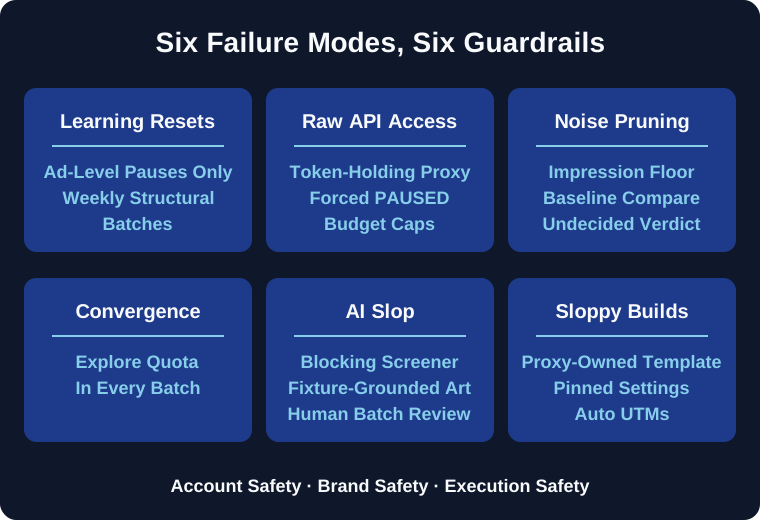
The six failure modes, in one box
- Learning-phase resets: aggressive ad-set kills trap the account in permanent learning.
- Raw API access: an agent holding the Marketing API token can do anything, including go live.
- Pruning on noise: CTR sorts on small samples kill future winners.
- Creative convergence: reinforcing winners homogenizes copy until Meta stops delivering it.
- AI slop: the account survives while the brand ships hallucinated visuals at machine volume.
- Sloppy campaign builds: missing UTMs and default settings that blind your attribution.
The design principle behind every fix: a guardrail the agent can argue with is a suggestion. Build the kind that returns an error instead.
AI agent guardrails: policy vs. structure
The enterprise AI world already has a definition for AI agent guardrails. IBM's version covers validation layers, content filters, and governance policies: systems that check what a model consumes and produces. Useful framing, and almost entirely untested by consequence, because in most of those deployments the worst case is an embarrassing chatbot transcript.
An ads agent has a different worst case. It touches an ad account with a payment method on file, a pixel full of customer data, and an ad history that Meta's automated systems use to decide whether you're trustworthy. So I'd split guardrails into two kinds, and the split matters more than any taxonomy:
A policy guardrail is a sentence in a prompt. "Never set a budget above $50." The agent reads it, and on a good day it complies. On a bad day it reasons its way around it, or a malformed context file drops the sentence entirely, and nothing in the system even notices.
A structural guardrail is a system that returns an error. The write reaches a layer the agent doesn't control, the layer checks it, and the bad write dies with a 4xx. There's no arguing with it, because there's nothing to argue with. The refusal happens in code the model never sees.
Everything below is the second kind. The loop we mapped in Post 1 runs on skills, artifacts, and human gates; the guardrails are what make it safe to let that loop near a real account.
The four traps we designed against on day one
The build roadmap named four account-killing traps before any code existed, because all four are documented failure modes of ads automation generally. Ask anyone who has wondered "why did my Facebook ad account get disabled" after wiring up an aggressive rules engine. Here's each one: how the account dies, and the structure that prevents it.
Trap 1: Kills that reset the learning phase
Meta's delivery system needs roughly 50 optimization events within a 7-day window before an ad set exits the learning phase and delivery stabilizes. An agent that "decisively" kills underperformers every 48 hours at the ad-set level keeps resetting that clock. The account ends up in permanent learning: volatile costs, unpredictable delivery, and every fresh restart burning budget to re-teach Meta what it already knew.
The structural answer is two decision surfaces with very different bars. Killing a creative means pausing the ad, and even that requires a statistical floor first (more in Trap 3). Killing an ad set requires at least seven days of data plus a budget floor, and structural changes batch weekly rather than firing the moment a metric twitches. The same discipline applies to humans, which is why our testing framework guide makes the same argument without an agent anywhere in sight. The rule predates the agent; the build just moved it somewhere it can't be skipped.
Trap 2: Handing the agent the API token
The single most dangerous design decision in ads automation: giving the agent the raw Marketing API token. With the token, every capability Meta grants your app belongs to the model, including creating live campaigns with live budgets. Whatever the prompt says, the capability is there, waiting for one bad completion.
Our agent has never seen the token. Every write goes through a proxy that holds the credentials, checks the request, and refuses anything outside a narrow allowlist. That proxy is the centerpiece of this post, and it gets its own section below.
Trap 3: Pruning on noise
Sort a day's ads by CTR, kill the bottom half: it feels like optimization and it's mostly executing statistical noise. At a few hundred impressions per ad, the difference between your "winner" and your "loser" is often sampling error. An agent that prunes on raw rank kills future winners constantly, and it does so with the confidence of a system that has never heard of variance.
The structure: no verdict of any kind below a minimum impression floor (1,000 to 2,000 impressions depending on the metric), comparison against the ad set's own baseline rather than a raw sort, and a third verdict class the vendor demos never show you. "Undecided" is the answer most dashboards refuse to give, and it's the verdict most young ads deserve. An agent that's allowed to say "undecided" kills far fewer things it shouldn't.
Trap 4: Creative convergence
If the loop only reinforces winners, every generation looks more like the last one. Copy homogenizes, visuals collapse toward one template, and Meta's delivery system, which rewards creative diversity, deprioritizes the whole account's output. The loop eats itself.
The structure: 20 to 30 percent of every creative batch is reserved as an explore quota that deliberately tests angles outside the current winning-patterns brief. That quota lives as a hard rule inside the copy and image generation skills, so the agent can't satisfy a batch by cloning the winner eight times. And in the spirit of honest reporting from Post 2: our winning-patterns.md file is still empty, because no live spend has happened yet. The explore quota is currently protecting us from converging on patterns we haven't earned.
The two traps the build taught us
The roadmap predicted four traps. Building the thing surfaced two more, and they're the two nobody's demo mentions, because neither one kills the account. One kills the brand. The other kills the data.
Trap 5: AI slop with your logo on it
The account is healthy, delivery is fine, and the brand is shipping generic machine-written copy and hallucinated product shots at a volume no human team would ever produce. Every individual ad is defensible. The aggregate is a brand that looks like it was generated, because it was. No automation pitch prices this in, because the damage never shows up in Ads Manager.
This one needs guardrails on the creative itself, and ours are structural in the same sense as the API proxy:
- A blocking compliance screen before anything can publish. Every creative variant passes through a screener skill that checks Meta ad policy, checks every claim against the brand context file, and scans copy against a banned-phrase list. A fail blocks that variant from the publish queue, with no override path in the agent's hands. This screen has a real block on record: in the first full sprint, 10 creatives went in, 9 cleared, and 1 was blocked for inventing performance metrics that appeared in no source data.
- Copy guardrails encoded as bans, enforced per batch. The brand context file bans specific AI writing patterns outright, including the "not X, it's Y" contrast frame that generated copy overproduces, along with sales-y filler vocabulary. The screener enforces the list on every batch, so the standard holds at machine volume. Judgment about voice happens once, in the file; the enforcement repeats forever.
- Image generation grounded in real assets. The image pipeline composites actual brand fixtures (the real logo, the real palette, real product screenshots) through an edit endpoint, and model-invented product UI or report text is banned outright. That ban has teeth because of what we found in the image model bake-off: only one of five models could put a correct headline and a real logo on an ad without inventing something. Grounding in fixtures is what makes machine-volume image generation compatible with having a brand.
- A human still reviews every batch at a gate. The automated screens catch broken. They don't catch boring, and they don't catch subtly off-brand. A human looking at the batch is the only guardrail for the failure modes you haven't named yet.
The competitor data feeding those creative gates
The agent's research and copy stages get briefed from real competitor ad data: which hooks rivals run, how long their creatives last, what offers they lead with. It's the same read a Mako Metrics report gives a human team before a creative round, and it's what keeps generated creative anchored to a market instead of a model's imagination. Want to see what that brief looks like? The sample reports are free to view, no login.
Trap 6: A campaign built wrong (bidding and settings)
The quietest trap of the six. Nothing gets banned, nothing looks off-brand, and the campaign is still wrong underneath: no UTM parameters, so attribution is blind from day one. A bid strategy that doesn't match the objective. Advantage+ audience expansion left on a default nobody chose. The wrong objective for the goal. A human media buyer makes these mistakes occasionally; an agent that builds campaigns freehand makes them at scale, identically, forever.
The structure: the agent never builds a campaign freehand. It fills in a template the proxy owns. In our build, the proxy hard-codes the campaign scaffold. The objective is pinned. The bid strategy is pinned to lowest cost without a cap, because a cost cap is a judgment call that deserves data we don't have yet. Advantage+ audience expansion is explicitly off. Any field that could enable delivery is rejected at the proxy, whatever the agent asks for. And UTM tags (source, medium, campaign, content, using Meta's dynamic macros) are injected automatically on every single ad creative, so tracking never depends on the agent remembering.
That last one comes with a receipt: our first test publish went out with a bare landing-page URL, because UTMs lived in a skill instruction at the time and the publish path simply didn't apply them. The fix moved UTM injection into the proxy itself. Forgetting is now structurally impossible, which is the correct fate for every mistake this build makes: it gets one occurrence, then it gets architecture.
Bidding judgment stays behind the human gate. The agent proposes budget moves, the proxy caps what any single write can do, and a human approves the batch. When cost caps eventually enter the picture at the live-spend phase, they'll arrive as another proxy rule, with a human owning the number.
Inside the proxy: what the agent is actually allowed to do
Time to open the box that Trap 2 pointed at. The proxy is a small service that sits between the agent and the Meta Marketing API, holds the access token, and treats every incoming write as hostile until proven boring. Here's what one write looks like end to end.
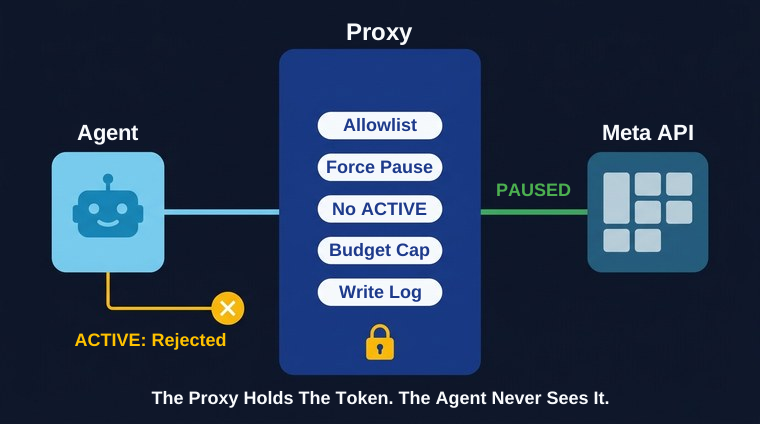
The publisher skill finishes a batch and asks the proxy to create a campaign, an ad set, and an ad. The proxy then runs five checks, in order:
- Allowlist. The create path has to match a short list of permitted object types. Anything else, including endpoints the agent has no business calling, is refused by name.
- Forced PAUSED. Every create payload has its status set to PAUSED by the proxy, whatever the agent sent. This happens on the way through; the agent's opinion is overwritten.
- ACTIVE rejected. A payload that explicitly asks for ACTIVE status errors out, loudly. An agent asking to go live is a signal worth surfacing, and a silent correction would bury it.
- Budget cap. Ad-set daily budget is hard-capped at $1. Meta requires a budget field on the object; paused status means it will never spend. The cap exists so that even a paused object carries no meaningful liability if every other guardrail somehow failed.
- Write log. Every call is appended to a log before and after it executes. When a human reviews the batch, the log is the record of what the agent actually did, as opposed to what it says it did.
What has this proven so far? One full test publish has gone through the entire chain: real campaign, real ad set, real ad, created on the real account through the proxy, every object arriving paused, $0 spent, with the agent never holding the token at any point. That's the crawl step of a deliberate crawl, walk, run sequence: paused writes first, sandboxed evaluation second, live spend last, each step gated on the previous one behaving.
I want to be precise about scope, because this is where automation content usually overclaims: these guardrails have never been tested by real money. No live spend has happened, by design. What I can say is that the refusal paths work (we've watched ACTIVE writes die at the proxy), the paused path works end to end, and the order of operations means the first dollar of live spend will pass through guardrails that have months of paused reps behind them. Can an AI agent manage Facebook ads safely? My current answer: an agent plus a proxy it doesn't control, plus a human gate per batch, has a credible path to yes. An agent with the token has a documented path to no.
The App Review gauntlet: earning the right to make those calls
Before the proxy can make any of those calls, Meta has to let your app make them at all, and this is the part of the build that generated the most swearing. Facebook Marketing API app review is the process by which Meta decides your app deserves more than baseline access, and it works nothing like flipping a switch.
Here is how the tier system works. A new app starts in the Marketing API's development tier, recently renamed Limited Access: heavily rate-limited, enough to build against your own account and not much more. Upgrading to Full Access is earned with usage metrics: currently 500+ successful Marketing API calls in the trailing 15 days, with an error rate below 15% over your last 500 calls. Separate from tiers, App Review governs which permissions your app can use with the public, and Advanced Access on sensitive permissions can also require business verification. Three different gates, documented in three different places, discovered in whatever order maximizes your confusion.
Our receipt: we ground out 554 successful API calls at a 5.8% lifetime error rate, call by call, against read endpoints, to clear the tier thresholds. The review submission itself is currently waiting on Meta's dashboard metrics to refresh. Weeks of elapsed time, for the right to make API calls that a human with the same account could make in Ads Manager immediately.
I'll say something unfashionable: the gauntlet is annoying and basically correct. Meta is rationing programmatic access to a system that moves money, using proof-of-work and review. That's Meta running structural guardrails on us, and the logic is identical to the proxy's logic with the trust direction flipped. The developer ecosystem mostly disagrees, loudly: there's a whole genre of war stories about the Advanced Access trap, a dev.to post titled "Facebook API: avoid at all costs", and enough pain that vendors now sell App Review "accelerator" services. Budget for the gauntlet in weeks, read the requirements before you write code, and treat it as the first guardrail your agent has to pass rather than an obstacle to route around.
If you're buying instead of building: seven questions
Most people reading this will never build an ads agent. You'll be sold one, probably this year. Post 2 gave you four questions to ask that vendor; the two traps this post added earn three more. Each question maps to a trap above, and a vendor who's thought about the problem will have a fast, specific answer.
- "Does the agent hold the API token, or does a proxy hold it?" (Trap 2.) If the model can technically go live, someday it will.
- "What's your minimum sample size before the system calls a winner or a loser?" (Trap 3.) No floor means it's pruning on noise.
- "Does it pause ads or restructure ad sets?" (Trap 1.) Ad-set churn resets the learning phase; you're paying for those resets.
- "What forces creative variety over time?" (Trap 4.) If nothing does, expect month three to look like month one, eight times.
- "Show me a creative your system blocked, and why." (Trap 5.) A vendor with a real compliance screen has blocked things and can show you one in seconds. A vendor without one will describe a philosophy.
- "Who owns the campaign template: settings, bid strategy, UTMs?" (Trap 6.) If the answer is "the AI configures everything," your attribution is one forgotten parameter from blind.
- "What does a human approve, and how often?" (Every trap.) "Fully autonomous" is a pitch, and what it describes is an agent nobody is watching.
The agent earns autonomy one guardrail at a time
The pattern across all six traps is the same test applied six times: for every capability the agent has, name the structure that stops its failure mode. If the answer is a prompt, you have a policy, and policies lose exactly once per disaster. Our build's current trust ledger: writes proxied, status forced to PAUSED, budgets capped, creatives screened by a gate with one block already on record, UTMs injected by architecture, and a human approving every batch. $0 spent, on purpose, while each guardrail collects reps. That ledger is what the Meta Ads Agent ships with today.
Next in the series is how to get real ad ops work out of an agent: where it fits in a process you already run, which of Meta's delivery rules have to be written down as code, and what it has to wait for before it can call anything a winner. After that comes the recursive loop, where performance data starts writing back into winning-patterns.md and the agent's briefs begin to learn. That post ships when there's live data worth writing back, and the guardrails above are what make turning that data on a calculated risk instead of a gamble.
FAQ
Can an AI agent manage Facebook ads safely?
With structure, I think so. The specific structure: a proxy that holds the API token and forces every created object to PAUSED, a human approval gate on every batch, minimum impression floors before any performance verdict, an explore quota that prevents creative convergence, and a blocking compliance screen on creative output. Remove those and you're trusting a language model's compliance on a system that spends money.
How long does Meta App Review take?
Plan in weeks, and treat any specific number skeptically because it varies by permission set and app history. The commonly reported range runs from a few days to several weeks, business verification (when required) adds its own timeline, and the usage thresholds for a Marketing API tier upgrade (500+ successful calls in 15 days, under 15% error) take however long your call volume takes. Ours is still in progress: metrics cleared, submission pending Meta's dashboard refresh. Meta's App Review documentation is the source worth reading before you architect anything.
Do you need App Review to use the Marketing API?
To start building against your own ad account, no: a new app gets development-tier (Limited) access with tight rate limits. You need the tier upgrade for real call volume, and you need App Review with Advanced Access, sometimes plus business verification, to use sensitive permissions or work with accounts beyond your own. Managing only your own account keeps you on the lighter path; anything client-facing crosses into the heavier one.
How do you keep AI-generated ads on-brand?
Ground the generation and gate the output. Grounding: Composite real brand fixtures (logo, palette, product screenshots) instead of letting a model imagine your product, and ban invented UI or metrics outright. Gating: A compliance screener that checks every variant against ad policy, brand claims, and a banned-phrase list before it can publish, plus a human reviewing every batch. The screen catches rule-breakers; the human catches the ads that pass every rule and still feel wrong.