
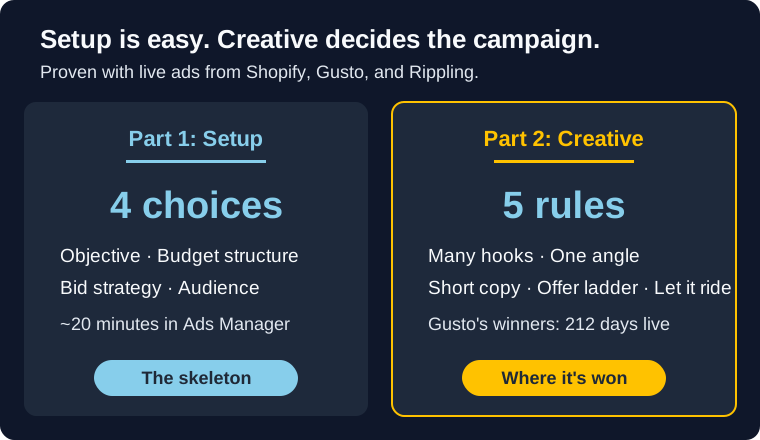
You can click through every screen in Meta Ads Manager in about 20 minutes. That part isn't hard, and it isn't where campaigns are won or lost. The accounts that scale and the accounts that stall usually use the same objective, the same budget type, the same bid strategy. What separates them is creative discipline, and that's the part most setup guides skip.
So this guide covers both: how to create a Meta ad campaign in Ads Manager, step by step, and how to build the creative that decides whether it performs. Part 1 walks the four decisions that form the campaign skeleton. Part 2 is the longer half, because it's the half that matters: five creative rules, each one proven with verbatim ad copy pulled from the Meta Ad Library this month. The examples come from Shopify (80 active image ads in the scrape), Gusto (50), and Rippling (50). Real headlines, real body copy, real flight times.
Public Ad Library data applies to everything below: it is a creative read, not a performance read. It shows you what a brand is willing to defend with sustained spend. It cannot show you their CPA or ROAS. It still beats what most brands say on a panel, but treat it as evidence of intent, not proof of profit.
TL;DR: setup is four choices, creative is five rules
- Setup (Part 1): objective, budget structure (CBO vs ABO), bid strategy, and audience. Four deliberate decisions, not defaults to click past.
- Rule 1: test many hooks. Gusto runs an 80% headline diversity ratio; Rippling runs 44% and repeats one headline across the set.
- Rule 2: pick one dominant angle and commit. Shopify bets on outcomes (34 of 80 ads), Gusto bets on speed and ease (16 of 50).
- Rule 3 and 4: write short, mobile-first body copy, and build an offer ladder with more than one CTA. Rippling runs three CTAs; Gusto runs essentially two.
- Rule 5: find a winner and let it ride. Gusto has five creatives live for 212 days; Shopify has 24 ads past 90 days.
Part 1: Set up the campaign in Meta Ads Manager
A Meta campaign is built from four choices. Each one is a decision you should make on purpose, because each one constrains everything downstream. Get these right and the campaign has a fair chance. Get them wrong and the best creative in your account can't save it.
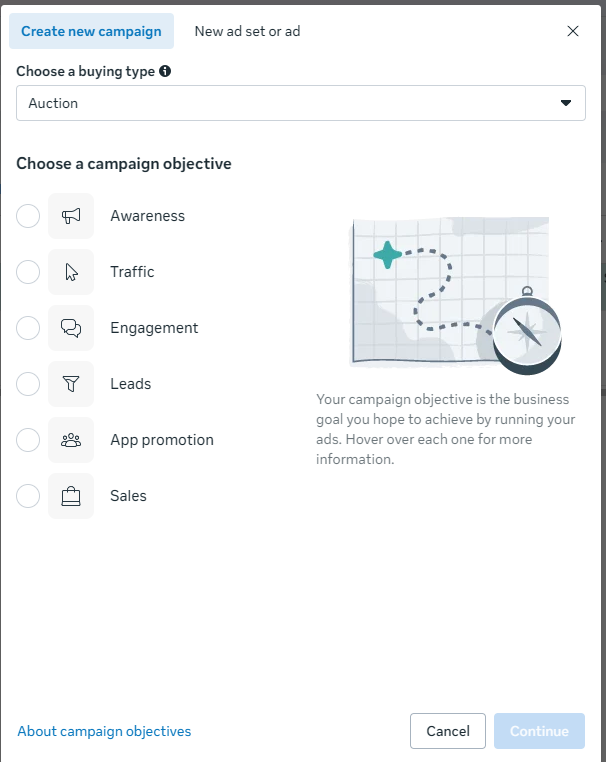
Step 1: Pick the campaign objective
When you create a new campaign, the first thing Meta asks for is the objective. The objective does more than label the campaign. It tells Meta which auction to enter you in and which event to optimize delivery toward.
For an ecommerce store, that's almost always Sales. You want Meta optimizing toward purchases, and you want it building an audience of people likely to buy. For most B2B, it's Leads, optimizing toward a form fill or a demo booking.
The common mistake is reaching for Awareness or Traffic because they're cheaper per click and the dashboard numbers look better. They look better because they're measuring the wrong thing. A Traffic campaign optimizes for people who click, not people who convert, and those are different audiences. If your goal is revenue, pick the objective that names revenue.
Step 2: Choose your budget structure
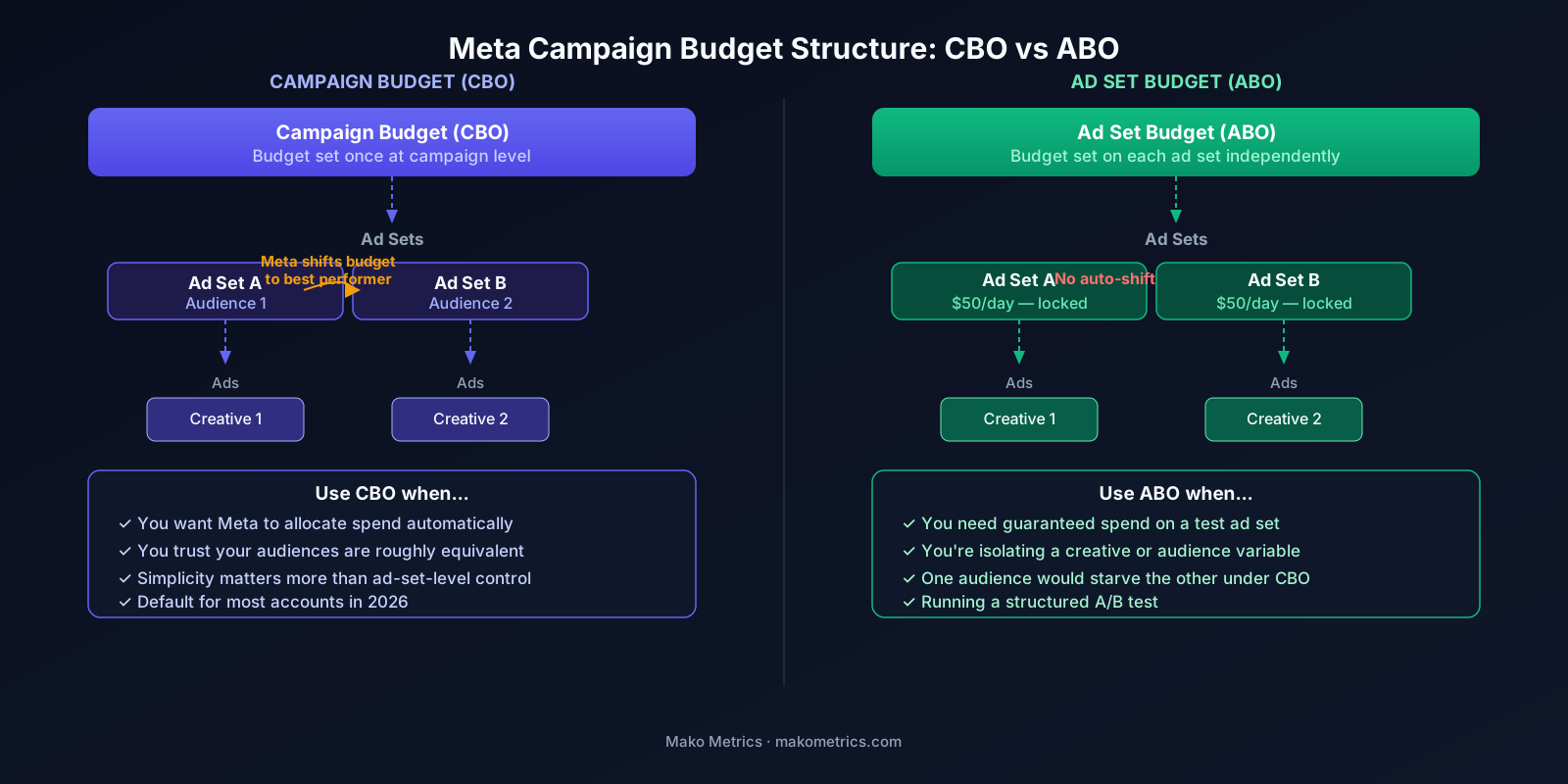
Next, decide where the budget lives. You have two options.
Campaign budget, which Meta now calls Advantage campaign budget and most operators still call CBO, puts one budget at the campaign level. Meta then distributes that spend across your ad sets in real time, sending more to whatever is performing.
Ad-set budget, or ABO, puts a separate budget on each ad set. You control exactly how much each one gets, regardless of how Meta scores them.
The rule of thumb: use CBO when you trust Meta to move money toward the winner and you want simplicity. Use ABO when you are running a deliberate test and you need to protect spend on something Meta might otherwise starve before it has data. New accounts with one or two ad sets are usually fine on CBO. Testing five distinct audiences where you need each to get a fair sample is an ABO job. ABO only earns that label if the test is fair: one variable, even budgets, and a no-touch window until you have enough conversions to judge. Our Meta ads testing framework walks through how to run that so the winner is a verdict, not a 48-hour hunch.
Daily vs lifetime budget is the smaller decision inside this one. Daily is simpler and fine for always-on campaigns. Lifetime is worth it when you need spend to follow a schedule, like a promotion with a hard end date.
Step 3: Pick a bid strategy
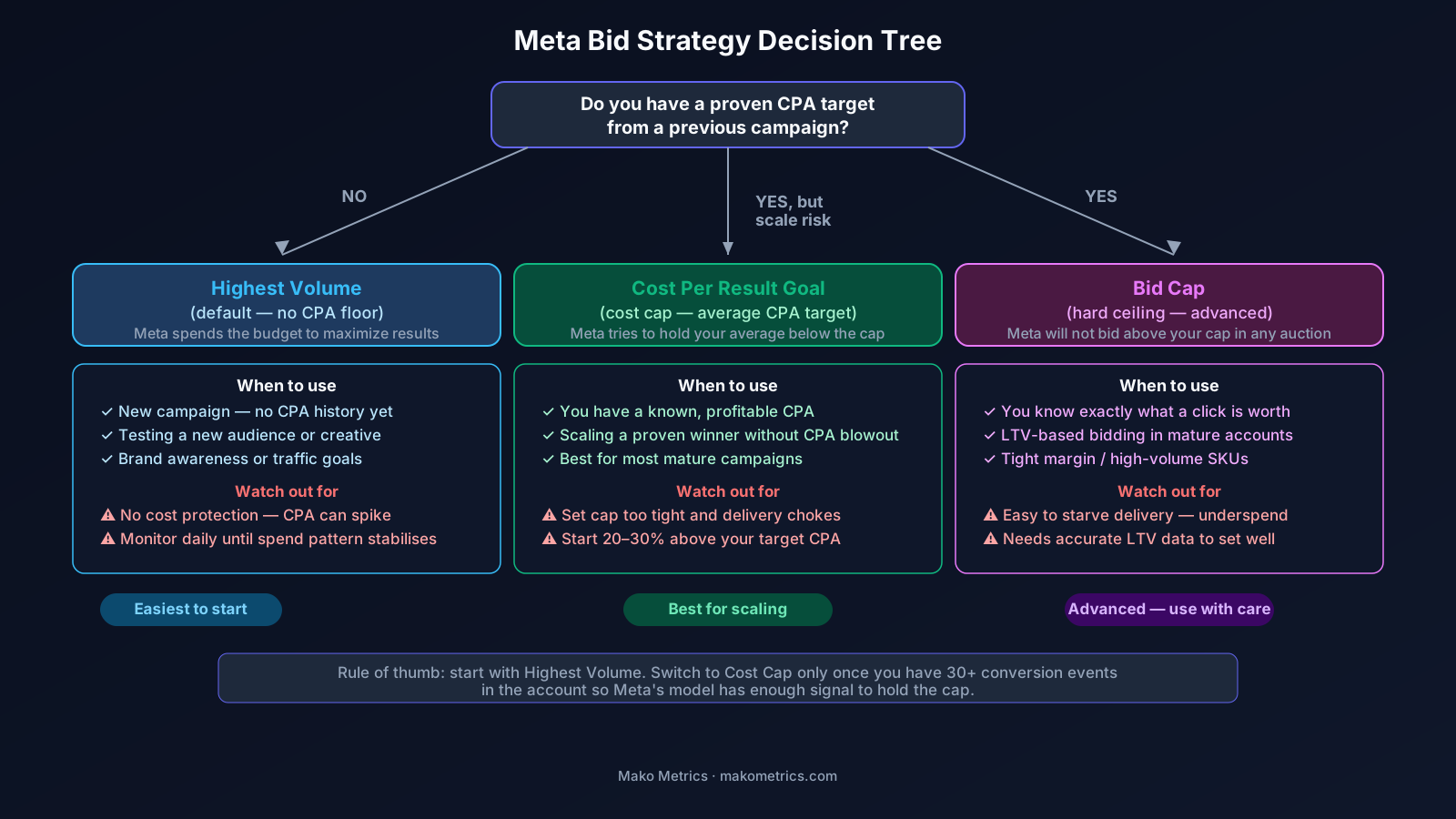
The bid strategy tells Meta how aggressively to chase results against your budget. There are three you'll actually use.
Highest Volume is the default. Meta spends the full budget to get you as many results as possible, with no constraint on cost per result. Use it when you're starting out and don't yet know what a good CPA looks like for this campaign. You need that data before you can constrain anything.
Cost Per Result Goal, the cost cap, tells Meta to keep your average cost per result around a number you set. It won't hit it on every conversion, but it aims for that average. This is the strategy for scaling a campaign you already know works, because you have a CPA target worth defending.
Bid Cap sets a hard ceiling on what Meta will bid in the auction. It's the advanced option and the easiest one to get wrong. Set it too low and delivery chokes, your ads barely spend, and you conclude the campaign failed when really the bid was strangling it. Leave this one alone until you have a clear reason and auction experience.
Step 4: Set audience and placements
Audience targeting used to be where operators spent most of their setup time. In 2026 it's the shortest step. Broad targeting plus Advantage+ placements is the sane default for most accounts. Meta's delivery system finds the buyers inside a broad audience faster than a hand-built stack of interests does, and stacked interests increasingly just narrow your reach without improving quality.
Let the placements run everywhere by default and let the creative do the filtering. The deeper argument is in our piece on Advantage+ shopping campaigns.
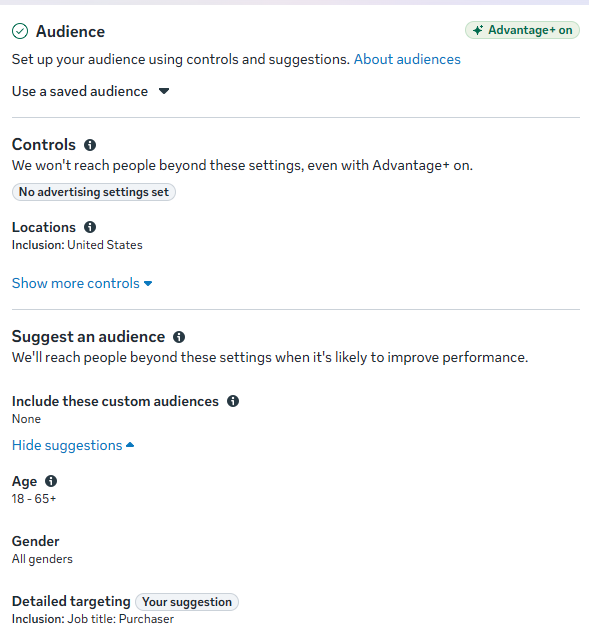
That's the skeleton. Objective, budget structure, bid strategy, audience. You can have it built in under half an hour. Now the part that actually decides whether it works.
Part 2: Build creative and copy that performs
Here's the uncomfortable truth about the setup you just finished: your competitors have the same setup. The objective isn't a secret. The bid strategy isn't a moat. What you put in the ad is the variable that moves results, and it's the variable most accounts treat carelessly.
The five rules below are not opinions. Each comes from the live Meta Ad Library footprints of Shopify, Gusto, and Rippling, pulled this month. If you want to see how that data gets pulled, our Meta Ad Library guide covers the method. Here, we go straight to the rules.
Rule 1: Test many hooks, do not stamp copies
The single clearest signal of a healthy creative program is headline diversity: the share of your active ads that have a distinct headline. If 40 of your 50 ads say roughly the same thing, you're not testing. You're stamping copies of last quarter's idea and hoping.
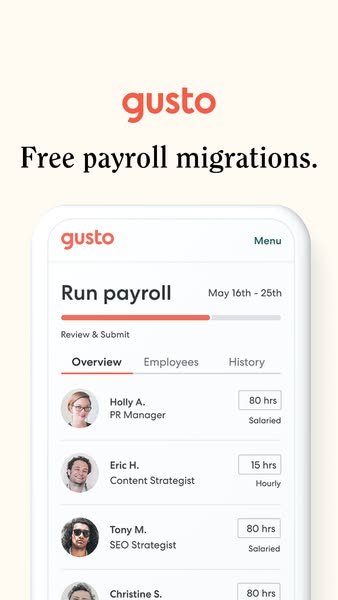
Gusto runs a headline diversity ratio of 80%. Roughly four out of every five of its 50 active ads have a distinct headline. Rippling, in the same week, runs 44%, and Shopify runs 38%.
You can see Rippling's low number in the raw set. The headline "See Rippling In Action" repeats across many of its ads with only the body copy changing underneath. Body-copy testing counts, but the hook is the first thing a scrolling user sees, and Rippling is largely testing everything except the hook.
Gusto does the opposite. Look at three of its active headlines:
- "Switch to Gusto today. Join 400k businesses" (Library ID 1615189103079575)
- "One login. Everything HR" (Library ID 951519160591767)
- "No more Frankenstack." (Library ID 956629500627054)
Three different doors into the same product. One leads with social proof and a switching nudge, one leads with consolidation, one leads with a memorable jab at tool sprawl. That variety is what produces winners, because you can't find a breakout hook you never tried.
The move for your account: when you build your first creative batch, write at least three to five distinct headlines, not three rewordings of one. Different angle, different first line, different promise.
Rule 2: Pick one dominant angle and commit
Diversity of hooks doesn't mean spraying in every direction at once. The brands that win pick one core objection to beat and point most of their budget at it. The diversity lives in how they say it, not in what they're arguing.
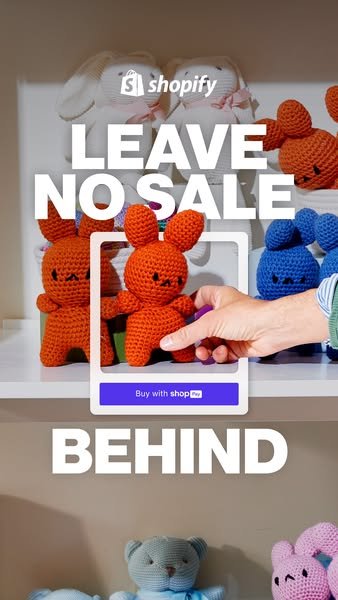
Shopify's footprint leans hard on results. Of its 80 active ads, 34 sit in the outcome cluster. The copy reaches for the finish line, not the feature list:
- "Go from launch to legendary See why millions of businesses grow with Shopify." (Library ID 949848234621517)
Gusto made a different bet. Its largest cluster, 16 of 50 ads, is speed and ease. Gusto decided the biggest thing standing between a prospect and a sale is the fear that switching payroll providers is painful. So most of its spend argues against that one fear:
- Body copy on "Switch to Gusto today": "Switching is easy! Join Gusto to seamlessly pay, insure, and support your team today." (Library ID 1615189103079575)
- "And compliance you can count on.." with body copy promising "Switch in seven days or less." (Library ID 1680405946726857)
Neither brand is running a grab bag. Each one named the buyer's blocker and committed budget to it. Your job in setup is to answer one question honestly: what's the single biggest reason a qualified prospect doesn't buy? Then make that objection the through-line of your campaign, and let your headline diversity be variations on beating it.
Rule 3: Write short, mobile-first body copy
Almost everyone sees your ad on a phone, mid-scroll, with low attention. Body copy that survives that context is short and specific. Body copy that doesn't is scrolled past.
The three brands sort cleanly on length. Shopify's average primary text is 88.8 characters. Gusto's is 110.1. Rippling's is 121.0.
Shopify's compression is the model. Look at this body copy in full: "When it's time to start your business, it's time for Shopify." (Library ID 1238141341576372). One sentence. No throat-clearing. It reads in the time it takes a thumb to move.
Compare Rippling's longer style: "See how Rippling IT puts your entire security ecosystem at your fingertips. Manage every device, control every access point, and track every asset, all from a single dashboard." (Library ID 946531311204590). It's well written. It's also asking for a lot of attention from a cold scroller.
The caveat: the goal is short and specific. A vague six-word line is worse than a precise twenty-word one. But if you find yourself padding, cut. The discipline is to say the one useful thing and stop.
Rule 4: Build an offer ladder and vary your CTA
This is where Rippling, which lagged on the first three rules, pulls ahead. Rippling runs an aggressive offer ladder, and it varies its call to action across the funnel.
The offers are concrete and material:
- "Book a Demo & Get Free AirPods" (Library ID 1410003447102731)
- "Demo Rippling -> Choose Your Free Gift" with body copy: "A FREE Ninja CREAMi or SodaStream is yours after your first Rippling demo!" (Library ID 1646280209835877)
- "Claim Your 6 Free Templates" (Library ID 873946602357294)
- "Sign Up To Demo & Get $100 Gift Card" (Library ID 1719615625686814)

That ladder shows up in the CTA mix. Across Rippling's set, "Learn More" appears 88 times, but "Download" appears 11 times and "Book a Demo" appears 6. Three CTAs means three funnel stages: Download captures a lead in exchange for a template, Book a Demo is for high intent, Learn More handles the rest.
Gusto, by contrast, runs close to a CTA monoculture. "Learn More" appears 62 times and "Sign Up" 40, with "Get started" showing up just twice. There's no Download, no lead-magnet layer. For a brand with otherwise strong creative, that's a real gap: nothing sits between "tell me more" and "give me your payroll."
Neither approach is wrong on its own, but a one-CTA account has no funnel. Build at least one soft offer that asks for an email instead of a credit card.
The ecommerce nuance: your offer ladder looks different. Ecommerce offers skew toward discounts, free shipping, and bundles rather than lead magnets and gift cards. The principle holds, the currency changes.
Before you write a single ad, it's worth seeing what your competitors are already running. Our sample competitor reports show a brand's full Meta Ad Library footprint, the same scrape behind every example in this post, so you start your creative from evidence instead of a blank page.
Rule 5: Find a winner and let it ride
Flight time, how long an ad has been continuously running, is the most honest public signal you can read. A brand doesn't keep paying to run an ad for half a year unless that ad is earning its keep.
Gusto's clearest example is its accountant referral campaign. Five different creatives in the "Add clients. Earn cash. Simple!" family have each been live for 212 days:
- "Your year-end cash reward is waiting Add clients. Earn cash. Simple!" (Library ID 1910838382811269)
- "Turn year-end pain into a big cash gain Add clients. Earn cash. Simple!" with body copy quoting the offer directly: "Help clients switch to Gusto this season and enjoy streamlined reporting, automation, and rewards up to $600 per client." (Library ID 1143283027268338)
- "Your big payout for adding new clients Add clients. Earn cash. Simple!" (Library ID 3240707089431993)

A 212-day flight signals a real offer, a tight audience, and a creative durable enough that Meta's auction can keep serving it. Shopify shows the same discipline at scale: 24 of its 80 active ads have been running more than 90 days.
Most teams do the opposite. They kill winners early, spooked by frequency or bored by a creative they have seen too many times in their own dashboard. The skill is knowing the difference between a winner you're tired of and a winner that has actually decayed. We covered how to tell those apart in our creative fatigue detection playbook. The short version: let the data, not your boredom, decide when a winner is done.
Part 3: Ecommerce vs B2B, how the playbook shifts
The five rules hold for everyone. The settings under them change depending on what you sell. Reading Shopify next to Gusto and Rippling makes the split easy to see.
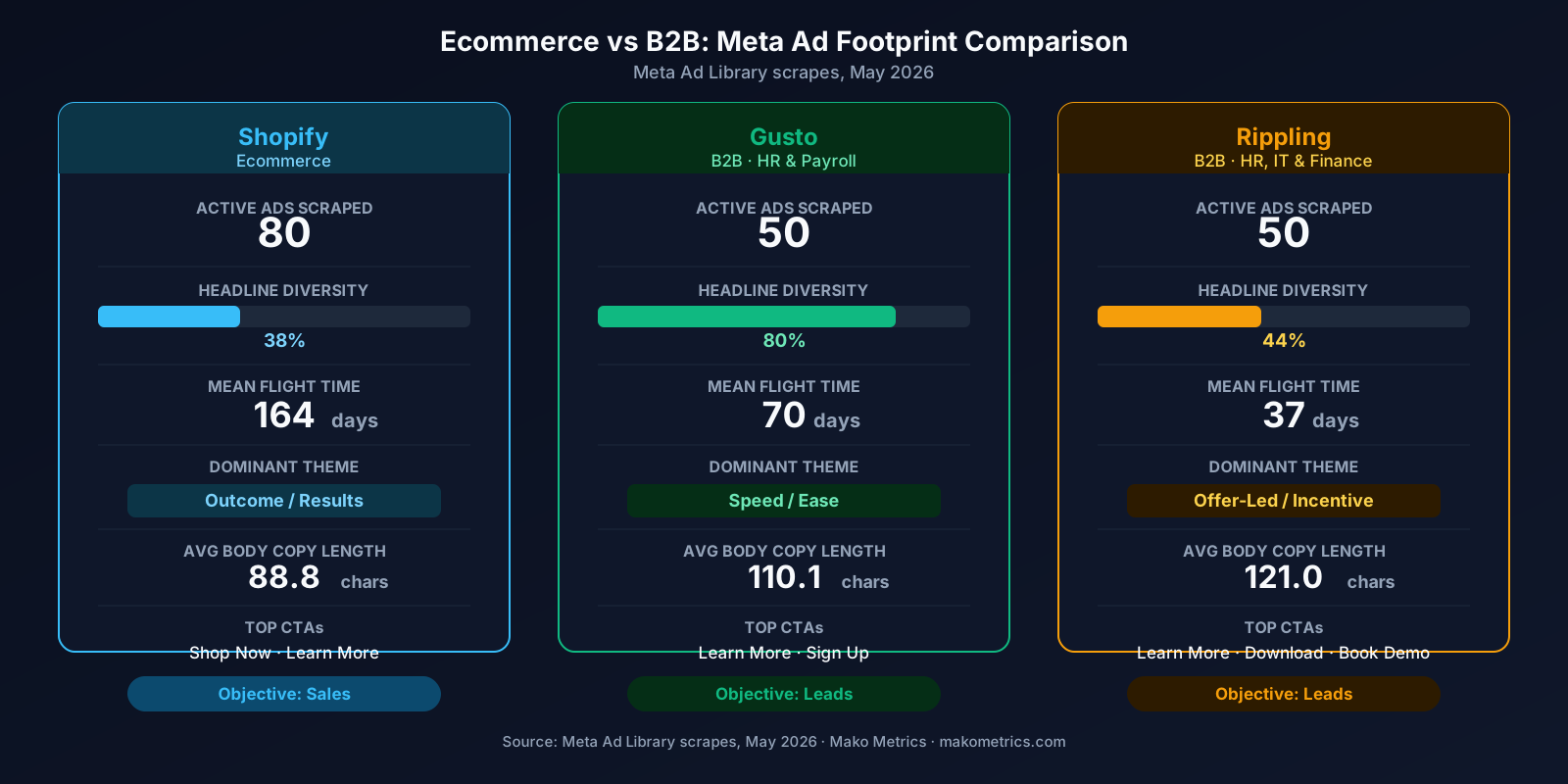
| Brand | Type | Active ads | Headline diversity | Mean flight (days) | Dominant theme | Top CTAs |
|---|---|---|---|---|---|---|
| Shopify | Ecommerce | 80 | 38% | 164 | Outcome / results | Learn More (126), Sign Up (28) |
| Gusto | B2B | 50 | 80% | 70 | Speed / ease | Learn More (62), Sign Up (40) |
| Rippling | B2B | 50 | 44% | 37 | Offer / promotion | Learn More (88), Download (11), Book a Demo (6) |
For ecommerce, the campaign optimizes for Sales. Offers skew toward discounts, free shipping, and bundles. Copy runs short, as Shopify's 88.8-character average shows, and the dominant angle is usually the outcome the product delivers. Shopify also shows what scale looks like: 80 ads in rotation and a 164-day mean flight, because there's enough budget to keep many winners alive. If you sell to consumers, our guide to full-funnel Facebook ads for ecommerce covers how those stages connect.
For B2B, the campaign optimizes for Leads. Offers skew toward lead magnets, demos, and incentives, the AirPods-and-templates ladder Rippling runs. Copy can run a little longer because the buyer is more considered, and the CTA mix matters more because the funnel has more stages. For the deeper reads on these two, see our Gusto Meta ads teardown and Shopify Meta ads teardown.
Your pre-launch checklist
Before you hit Publish, seven checks:
- Objective matches the business model. Sales for ecommerce, Leads for B2B. Not Traffic, not Awareness, unless that is the goal.
- Budget structure chosen deliberately. CBO for trust-Meta simplicity, ABO to protect a specific test. Not whatever was pre-selected.
- Bid strategy chosen deliberately. Highest Volume until you know your CPA, cost cap to scale a known winner, bid cap only with a reason.
- At least three distinct creative angles built. Three different hooks, not three rewordings of one.
- Headline diversity above roughly 65%. If most of your ads share a headline, you are not testing.
- At least two CTAs in rotation. One soft offer that asks for an email, one harder offer for high intent.
- Tracking confirmed live. Your pixel is installed and your conversion events are firing before a dollar goes out. A campaign optimizing against broken tracking is spending blind, and Meta cannot optimize toward an event it never receives.
That last check is the one most worth slowing down for. See our full walkthrough on how to set up the Meta Pixel for the complete installation steps and event configuration for both ecommerce and lead-gen. If you're past the pixel and deciding how to add server-side tracking, our guide to setting up the Meta Conversions API compares the five methods and shows how to verify it fires before launch.
Closing
Setup is the easy, learnable part. Objective, budget structure, bid strategy, audience: four decisions, half an hour, and your competitors made the same four. Creative discipline is the moat. Test many hooks, commit to one dominant angle, keep the copy short, build an offer ladder with more than one CTA, and let your winners run.
Every number in this post is a creative read, not a performance read. The Meta Ad Library shows you what Shopify, Gusto, and Rippling are willing to defend with sustained spend. It doesn't show their CPA or their ROAS, and you shouldn't infer them. Performance answers need account access. Creative reads are the public layer of the strategy, and they're usually more honest than what a brand will tell you directly.
Mako Metrics' Competitor Snapshot ($24.99) gives you the same Meta Ad Library scrape, theme scoring, and editable brief behind the Shopify, Gusto, and Rippling examples here. Hand us a competitor, get back a teardown. See pricing or see sample reports on a few brands first.