
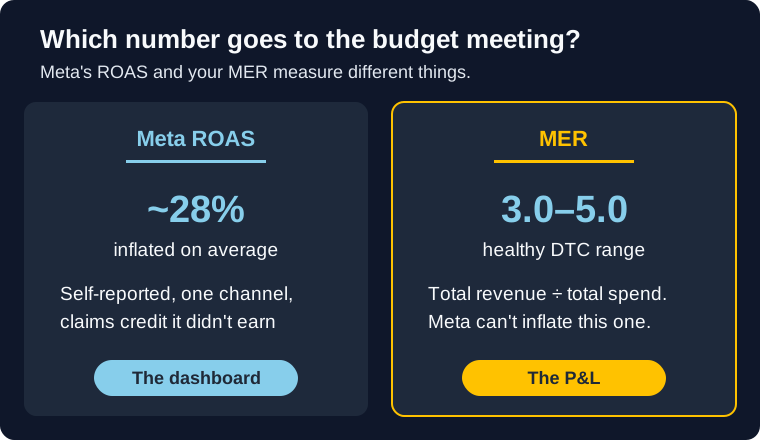
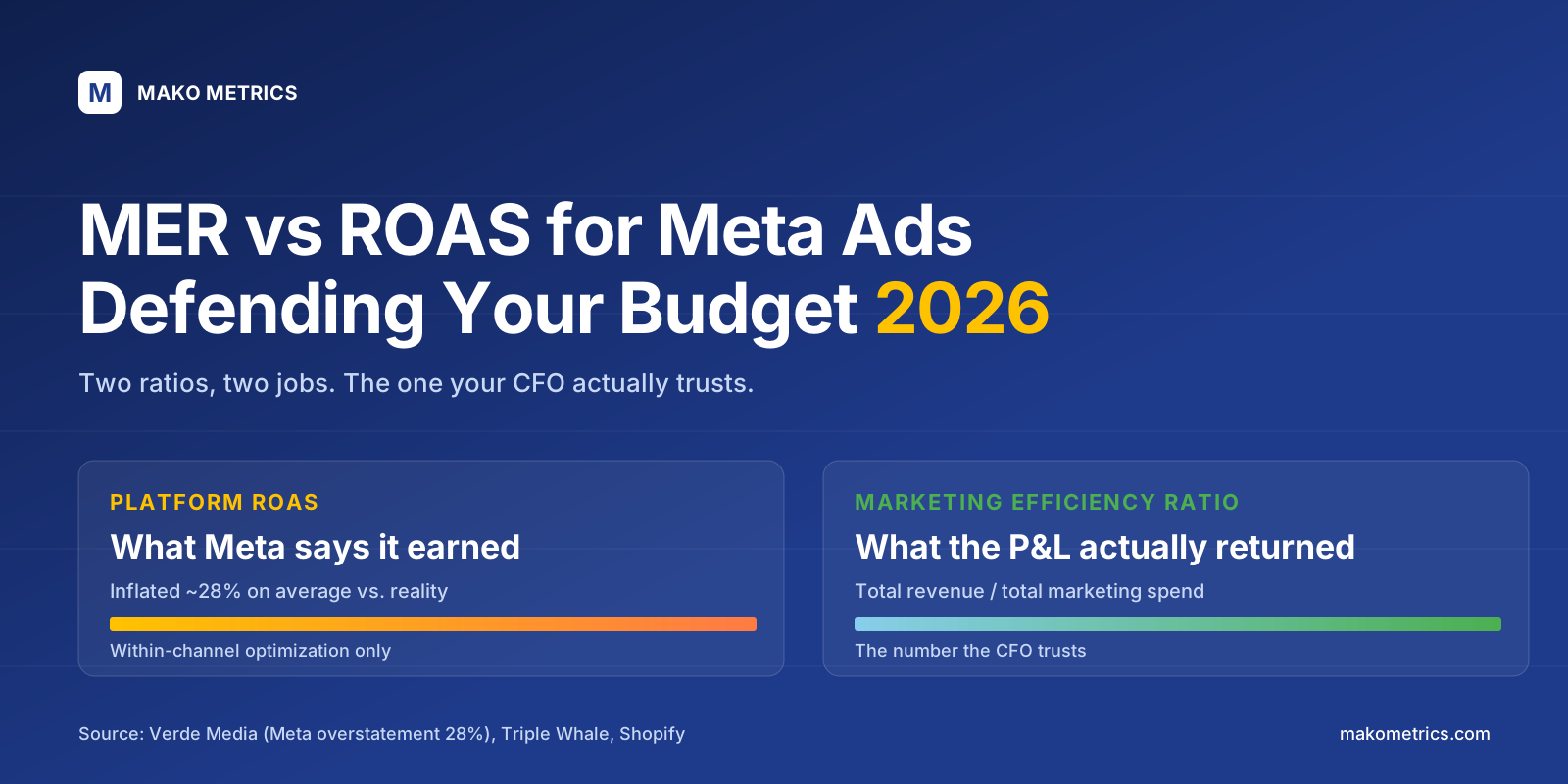
You opened Ads Manager. Meta says your last 30 days returned 4.2x ROAS. Your CFO opens the P&L. Revenue is flat. You're not lying. Meta isn't lying. The two numbers measure different things, and one of them is the wrong answer to bring to the budget meeting.
That gap is the whole reason Marketing Efficiency Ratio exists. On average, Meta inflates reported ROAS by about 28%, Google by 18%, and TikTok by 35% (Verde Media). When a platform takes credit for a sale that email or organic search would have won anyway, your dashboard looks healthier than your bank account. MER strips attribution out of the equation: total business revenue divided by total marketing spend. The number Meta can't inflate because Meta isn't doing the math.
This guide is for the ecommerce operator who has to justify a Meta budget to a CFO, an owner who reads the P&L every Monday, or a client who has started questioning the retainer. We'll cover what each metric actually measures, why the spread between them matters, which number belongs on the board deck, and how to use both together so you don't get fooled by attribution overlap or by your own pessimism on a slow week. By the end you'll walk into the next budget conversation with the right number on the slide and the right answer when leadership pushes back.
Bottom line
- ROAS measures one channel's self-reported return. MER measures the whole marketing program against total revenue.
- Meta overstates ROAS by ~28% on average (Verde Media); blended platform inflation runs 30 to 40% across channels.
- Healthy DTC MER sits between 3.0 and 5.0, depending on margin structure. A 3x at 70% gross margin is comfortable; a 3x at 40% margin is bleeding cash.
- For the boardroom: lead with MER (it ties to the P&L). Bring channel ROAS as supporting detail.
- The MER Reality Check: if Meta ROAS is 5x but MER is 2.5x, your channels are claiming credit for sales they didn't cause.
- Competitor angle: ad longevity and refresh cadence in Meta Ad Library work as inferred competitor MER signals. Worth tracking before a budget meeting.
- Run the math: a live MER Reality Check calculator sits inside the post. Drop in your numbers, get your MER and overlap gap in one click.
ROAS and MER Measure Different Things
Both ratios divide revenue by spend. Everything else is different.
ROAS (Return on Ad Spend) is platform-attributed revenue divided by channel spend. Meta ROAS uses Meta's attribution windows (typically 7-day click, 1-day view), Meta's pixel and Conversions API signal, and Meta's modeling for the iOS users it can't see directly. The number tells you what Meta thinks it earned you, judged by Meta's own rulebook.
MER (Marketing Efficiency Ratio), sometimes called blended ROAS, is total business revenue divided by total marketing spend over the same period. No attribution. No platform logic. The numerator is what your Shopify or NetSuite dashboard reports as revenue. The denominator is every dollar you spent trying to drive that revenue, including ads, creative production, influencer fees, agency retainers, and the marketing-side software bills.
ROAS  = Channel revenue (per platform attribution) / Channel ad spend
MER   = Total business revenue / Total marketing spend
Those formulas look similar. They answer completely different questions. ROAS asks "is this channel pulling its weight under its own attribution model?" MER asks "is my marketing program returning enough revenue to keep the business profitable?" Both are useful for the job they were designed for. Mixing them up is what costs you budget arguments.
For a deeper look at what counts as a good Meta ROAS by industry, our Facebook Ads ROAS benchmark guide breaks the channel-level number down by vertical. This post is about what to do when that ROAS argues with reality.
Why Meta's ROAS Is Inflated by ~28%
Meta is following its own attribution rules, and those rules systematically over-claim credit for sales that other channels (or organic intent) would have driven anyway. Three failure modes account for most of the damage.
View-through over-attribution. A 1-day view-through window means a user who scrolled past your video ad, never clicked, and later bought after seeing your email or googling the product still gets attributed to Meta. For retargeting campaigns aimed at warm audiences, this effect is enormous. Customers in retargeting were already in-market.
Channel overlap double-counting. A customer who clicked a Meta ad and also clicked a branded Google search before checking out gets counted by both platforms. Add up the platform-reported revenue across Meta, Google, TikTok, and email, and you can easily exceed your actual revenue.
Modeled iOS conversions. Since iOS 14.5, Meta models conversions for iOS users who opted out of tracking. The modeling has improved, but it's an estimate, and it tends to be optimistic on warm-audience campaigns. If iOS opt-out is hurting your real signal, see our iOS attribution guide for Meta ads for the fixes.
The data is consistent across providers. Verde Media puts Meta's overstatement at 28%. PodVector's POD audit work found cases where a dashboard ROAS of 4.0x dropped to a true contribution ROAS of 0.9 to 1.1x. Stella's incrementality study found no consistent relationship between platform ROAS and true incrementality. Some accounts with 4.0x reported ROAS had incremental contribution below 1.0. Others at 2.0x had incrementality above 1.5.
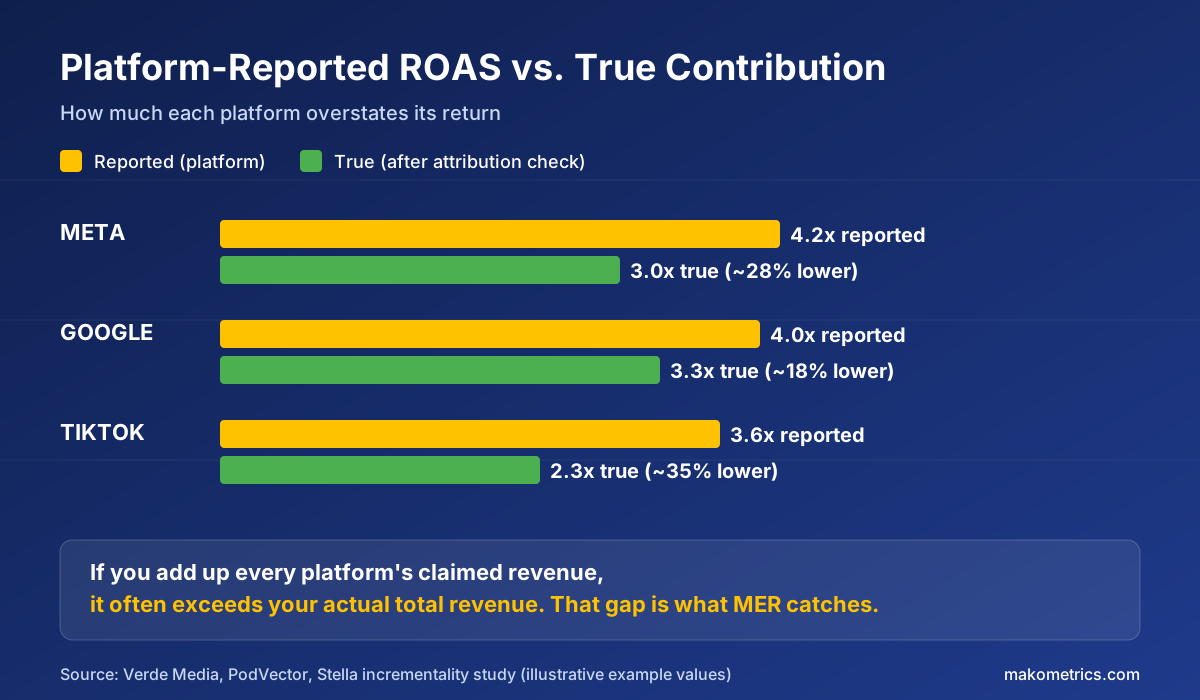
The point is that the number is doing a specific job (within-channel optimization) and it's the wrong number to use for total-business decisions.
Which Number Belongs in the Board Meeting
The CFO has one question: "We spent $X on marketing this quarter. What did we get for it?" That question maps directly to MER. It does not map to Meta-reported ROAS, for three reasons:
- Meta ROAS doesn't include the email platform fee, the influencer deal, or the brand-side agency retainer.
- Meta ROAS includes revenue Meta thinks it caused, including sales that came from email and organic too.
- Meta ROAS uses an attribution window your finance team didn't agree to.
Bring Meta ROAS to a marketing meeting, where the question is "should we scale this ad set?" Bring MER to a budget meeting, where the question is "is the marketing program returning enough to justify next quarter's spend?"
The framing that works in practice is short. One slide, three numbers.
The Three-Number Budget Slide
- MER (trailing 90 days): total revenue divided by total marketing spend. Tie to a target you've agreed with finance.
- Contribution margin after marketing: gross margin minus marketing as a percent of revenue. This is the "did we actually make money" number.
- Channel ROAS summary: Meta, Google, anything else, listed alongside MER as supporting detail, not as the headline.
The conversation changes when you lead with the number that ties to the P&L. You're not defending a metric Meta calculates. You're showing the CFO the same view they already see, framed in your favor.
Want a faster way to benchmark your spend against competitors before that meeting? See a sample competitor report to preview the read, then order a Competitor Snapshot on a rival in your market for the "what does our market look like" context that turns a defensive budget conversation into a comparative one.
The MER Reality Check (Quarterly Audit)
The most useful thing MER does is catch attribution overlap before it costs you a wrong decision. Run this every quarter, ideally before the board prep cycle.
Step 1: Calculate trailing 90-day MER. Pull total revenue from your commerce platform. Pull total marketing spend from your ledger, including ads, creative, influencer fees, agency retainers, and the marketing-side software stack. Divide revenue by spend.
Q1 example
Total revenue:           $2,450,000
Meta ad spend:             $510,000
Google ad spend:           $180,000
TikTok ad spend:            $60,000
Influencer & creative:      $95,000
Email & SMS platform:       $14,000
Agency retainer:            $36,000
Total marketing spend:     $895,000

MER = 2,450,000 / 895,000 = 2.74x
Step 2: Sum your platform-reported ROAS. Multiply each channel's reported ROAS by its spend to get attributed revenue. Add them up.
Meta:   4.2x × $510,000 = $2,142,000
Google: 6.1x × $180,000 = $1,098,000
TikTok: 3.5x × $60,000  =   $210,000
Sum of attributed revenue:  $3,450,000
Step 3: Compare attributed revenue to total revenue. In the example above, platforms claim $3.45M in attributed revenue against $2.45M in actual total revenue. The platforms are over-claiming by about $1M, or 41% of real revenue.
That overlap is the gap between platform ROAS and reality. Track this number over time. A widening gap means the platforms are taking credit for an even larger share of sales that other channels (or organic intent) would have driven. A narrowing gap, especially after you cut a channel and MER held steady, tells you that channel was less incremental than the dashboard suggested.
The point of the audit isn't to "prove ROAS wrong." It's to know which decisions you should anchor to MER (budget, channel allocation, growth-stage planning) and which you can still anchor to ROAS (which ad set to kill, which creative to scale).
Full-screen tool: MER Reality Check Calculator
How to Use Both Together: 4 Decision Rules
The "either/or" framing (ROAS is dead, only MER matters) is wrong. Both metrics have a job. The framework that works is decision-driven.
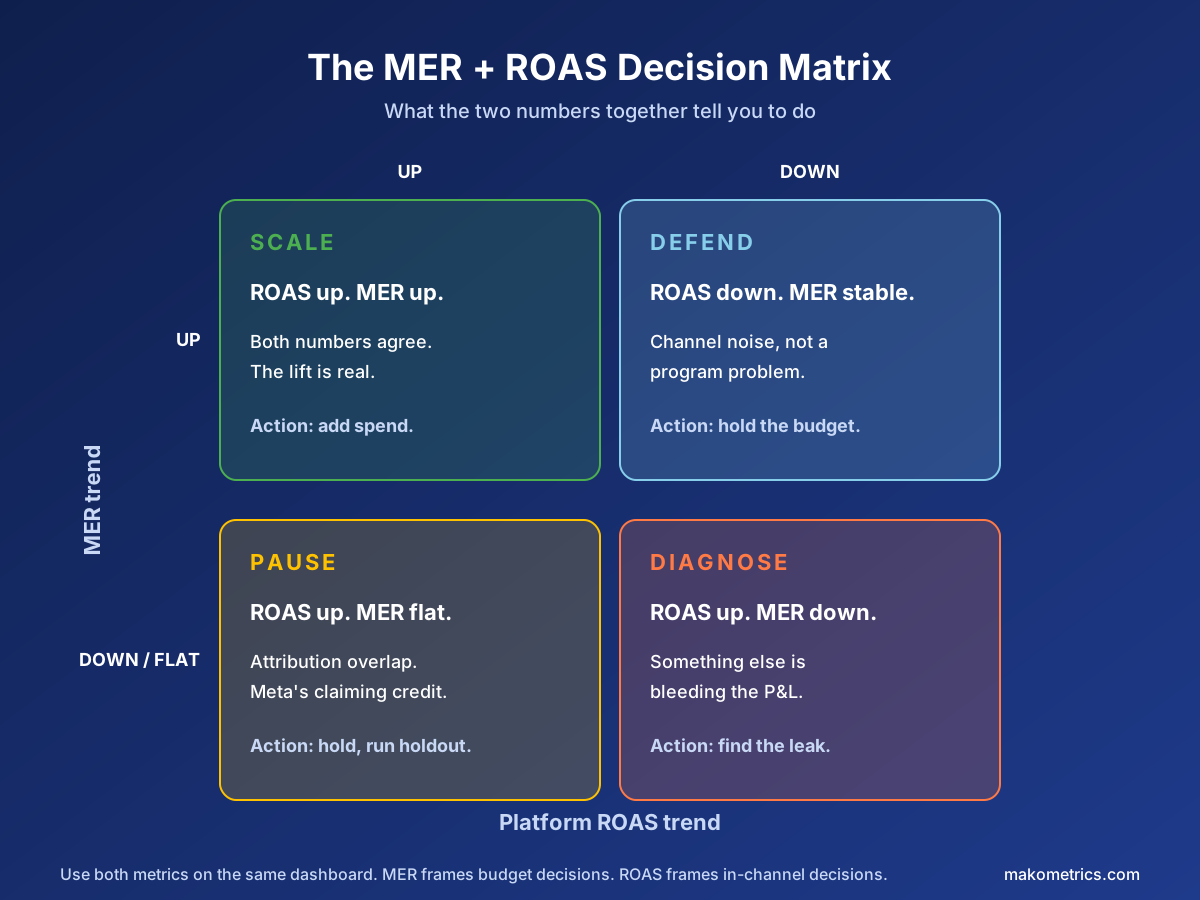
Scenario 1: ROAS up, MER up. Scale.
Both numbers moving the same direction means the lift holds up. New customers, new revenue, no obvious attribution illusion. This is when scaling Meta spend is defensible to leadership.
Scenario 2: ROAS up, MER flat. Don't scale.
Meta says it's winning. Total revenue says it isn't. This is the classic attribution-overlap signature: Meta is claiming credit for sales that would have happened anyway (email, organic, retargeting bias). Scaling spend here often produces the same flat MER at a higher cost. Hold spend, run a holdout test before adding budget.
Scenario 3: ROAS down, MER stable. Defend the budget.
A bad month on Meta dashboard doesn't always mean a bad month for the business. If MER held while channel ROAS dipped, the program is fine and the channel is noisy. This is the case where you answer a budget-cut conversation with the data on your side. Show MER, show the channel ROAS noise context, and don't let one platform's bad week drag the whole program.
Scenario 4: ROAS up, MER down. Diagnose, don't scale.
The most dangerous quadrant. Meta dashboard looks great. Total marketing efficiency is dropping. Something outside the ad channels is bleeding cash (a discounting program eating margin, returns climbing, a new agency retainer that hasn't paid back yet). Stop arguing about Meta and find the leak.
These four rules cover almost every quarterly conversation you'll have with finance. They also kill the "ROAS is dead" narrative cleanly. ROAS is just the wrong question for three of these four quadrants.
Reading Competitor MER Signals From Meta Ad Library
You can't see a competitor's MER. You can see signals in the Meta Ad Library that correlate with it. These are inference, not proof. Combined, they help you guess whether a competitor is running an efficient program or burning cash for growth.
Ad longevity. Ads that run for 60+ days without rotation are usually winners. Brands kill bad ads fast. A competitor with a small library of long-running ads is almost certainly running an efficient program. A competitor cycling 80 new ads a month is either well-funded, in a heavy testing phase, or running a low-MER spray-and-pray.
Format diversity. Brands at scale test multiple formats simultaneously: static, UGC, demo, founder-talking-head. A library that's 90% one format is either a brand-stage limitation or an underfunded test budget. Both correlate with MER pressure.
Refresh cadence. Net-new ads per month divided by total active ads gives you a rough refresh rate. In our experience, healthy DTC brands refresh roughly 15 to 25% of their active library per month. Above 40% is either heavy growth investment or fatigue panic. Below 10% is either an evergreen winner or stagnation. Pair this with funding announcements, hiring trends, or press coverage to read the signal correctly.
CTA and offer stability. Competitors who keep the same offer running for months are almost always running a profitable evergreen. Frequent offer changes (every 2 to 3 weeks) often signal a brand chasing a number it can't hit, which is what a falling MER pressure looks like from the outside.
None of these is conclusive on its own. Together, they let you triangulate whether the competitor is running an efficient program or burning cash for growth. That's the kind of read that turns a budget conversation from "give me more money" into "here's where the category is moving and here's where we should sit."
Common MER Mistakes
A few traps that show up in nearly every MER deployment we see.
Comparing MER across brands with different margin structures. A 3x MER with 70% gross margin leaves plenty of room. A 3x MER with 40% margin means you're losing money once fixed costs hit. Two brands at the same MER can be on completely different P&L trajectories. Always pair MER with contribution margin context. Bennett Financials makes this case well and it's worth reading if you're building the finance side of your reporting.
Only including paid spend in the denominator. If you exclude creative production, influencer fees, agency retainers, and marketing software, you're calculating a flattering number that isn't really MER. MER earns its keep by being harder to game. Strip the discipline out and you've reinvented a slightly bigger ROAS.
Setting target MER without growth-stage context. A brand in heavy acquisition mode should accept a lower MER than a brand at scale, because new-customer payback comes from LTV. Northbeam's benchmark work breaks this down by stage, and Eightx's framework ties MER targets back to contribution margin so the target is grounded in unit economics.
Treating it as either/or. The right setup is both metrics on the same dashboard, with clearly different jobs. MER for the budget conversation. Channel ROAS for the within-channel optimization. Anyone telling you to ignore one entirely is selling you a simpler story than the math supports.
For more context on how channel benchmarks shift in 2026, our Facebook ads cost benchmarks and CPA benchmarks for ecommerce cover the unit-cost trends that feed into both ROAS and MER calculations.
FAQ
What's a good MER for ecommerce?
A useful rule of thumb is 3.0 to 5.0, with margin structure setting the right target. Beauty and supplements tend to live closer to 3.0 because of repeat-purchase economics, while apparel and accessories often need 4.0+ to clear thin gross margins. Shopify's benchmark guidance lines up with this range. Anything below 2.0 typically means the marketing program is unprofitable at current cost structure.
Is MER the same as blended ROAS?
Effectively yes, with one nuance. Blended ROAS sometimes refers only to paid-attributed revenue divided by paid spend across all channels. Pure MER uses total revenue (paid, organic, direct, email, affiliate) divided by total marketing spend. Most ecommerce teams use the terms interchangeably, but if a vendor talks about "blended ROAS," ask what's in the numerator before you compare it to your MER.
Is ROAS dead?
No. ROAS is the right metric for within-channel decisions: which ad set to scale, which creative to kill, which audience to test next. It's the wrong metric for total-business decisions because of the attribution-overlap problem. The "ROAS is dead" framing makes for good headlines but mostly causes operators to abandon a useful tool for the wrong reason.
How often should I check MER?
Calculate it monthly for trending and quarterly for board reporting. The quarterly view smooths out the day-to-day noise that makes Meta dashboards swing 30% week to week. If you're seeing your MER swing more than a few tenths quarter over quarter, the cause is usually a seasonal shift, a margin change, or a new spend category that wasn't in the denominator last time.
What's the relationship between MER and contribution margin?
MER is upstream of contribution margin. A 4.0x MER means 25% of revenue went to marketing. Combine that with your gross margin and your other variable costs (shipping, fulfillment, returns, transaction fees) to land on contribution margin. If you're targeting a 25% contribution margin, your MER needs to be high enough that after all variable costs hit, you still clear that target. Saras Analytics' breakdown is a good primer if your team needs a finance-side translation.
The Bottom Line
Meta-reported ROAS is a within-channel metric being asked to do a total-business job, and it overstates by about 28% on average when used that way. MER is the metric that matches the question your CFO is actually asking. Bring MER to the budget meeting, keep channel ROAS for the tactical work, and run the quarterly reality check so you know which decisions to anchor where.
If you're also shopping tools that claim to run Meta for the store, start from the job each one owns, not the homepage word "agent." We compared ten of them for ecommerce buyers, including which ones put your real product in the ad.
If you want a faster read on what your category looks like before that next budget conversation, our Mako Metrics competitor reports pull a competitor's full Meta presence (creative, copy, longevity, refresh cadence) so you can walk into the meeting with category context, not just your own numbers. Operators who frame budget conversations comparatively win more of them.