
You refresh your Meta creative on a cadence someone handed you once: swap the ads every two weeks, or leave the winners alone until they break. You measure this month's churn against last month's, and that tells you whether you're getting faster. It doesn't tell you whether the cadence itself is right.
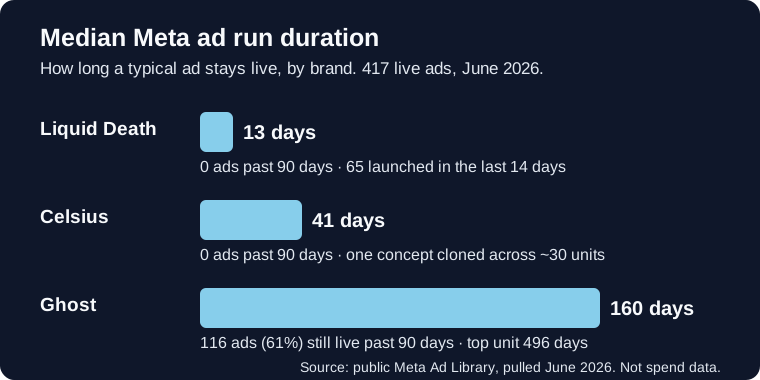
So we pulled the live Meta libraries of three category-leading DTC beverage brands and measured how long their ads actually stay up. Liquid Death runs a 13-day median. Celsius runs 41. Ghost runs 160. Same shelf at the grocery store, and their typical ad lifespan differs by more than twelve times. "How often should I refresh?" has no universal answer, because these three brands are running three different creative operating systems, not one beverage playbook at different speeds, and each system is a bet on what wins the feed. This post gives you the numbers behind all three, plus a way to place your own account on the spectrum and decide which system you're actually built for.
The benchmark, up front (417 live ads, pulled June 2026):
- Liquid Death runs a fast-churn brand-world machine: 156 ads, 13-day median run, 65 launched in the last 14 days, heavy merch drops, "Shop Now" on 91%.
- Celsius runs concentrated concept-scaling: 72 ads, 41-day median, one "Electric Vibe" concept cloned across roughly 30 ad units, soft "Learn More" on 81%.
- Ghost runs a durable evergreen catalog: 189 ads, 160-day median, 116 ads still live past 90 days, 95% static, "Shop Now" on 99%.
- The disagreement that matters: their median ad lifespan differs by 12x. Churn rate is a choice, not a best practice.
How we benchmarked 417 DTC beverage Facebook ads
Everything below comes from the public Meta Ad Library, the same place you can check our work. We pulled the active ads for each brand, then captured the body copy, link card, CTA button, started-running date, days running, media type, and the creative file itself for every one.
Run details, so the read is reproducible:
- Sources: the Ad Library pages for Liquid Death, Celsius, and Ghost, country set to ALL.
- Pulled: Liquid Death on 2026-06-26, Celsius and Ghost on 2026-06-25.
- Sample: 156, 72, and 189 active ads respectively. 417 total.
What this data can't show: spend, ROAS, CPA, or targeting. Public Ad Library data covers creative, copy, format, and how long each ad has run, and that's what we benchmark. Every quoted line below is verbatim from a live ad, and every Library ID links to the ad itself so you can read the full unit.
The headline finding: three creative tempos
Before the brand-by-brand read, here's the whole picture in one table. These are not three versions of one DTC beverage strategy. Read the median-run row and the systems name themselves.
| Metric | Liquid Death | Celsius | Ghost |
|---|---|---|---|
| Ads in sample | 156 | 72 | 189 |
| Median run (days) | 13 | 41 | 160 |
| Ads live past 90 days | 0 | 0 | 116 |
| Launched in last 14 days | 65 | 2 | 19 |
| Video share | 38% (59/156) | 25% (18/72) | 5% (10/189) |
| Dominant CTA | Shop Now 91% | Learn More 81% | Shop Now 99% |
Read down the columns. Liquid Death treats the feed like a content channel: launch constantly, kill fast, sell the brand world. Celsius finds one concept and scales it wide instead of testing many new ones. Ghost builds a few evergreen winners per product line and lets them run for the better part of a year. Three tempos, three cost structures, three different risks.
For context from our own data: when we benchmarked three fitness brands on these same dimensions, their median runs spanned 19 days (Alo) to 57 days (Hoka). Beverage stretches that range at both ends. Liquid Death out-churns even Alo's high-velocity system, and Ghost is close to three times more durable than Hoka's long-running hero creative. The idea that there's a "normal" refresh rate gets harder to defend the more libraries you actually count.
Liquid Death: the fast-churn brand-world machine
Liquid Death's 156 ads carry a 13-day median run and not a single ad alive past 90 days. In the last 14 days before our pull, 65 new ads went live. That is a brand refreshing more than a third of its visible library every two weeks.
The tempo makes sense once you see what the ads sell. Plenty of them are selling merch rather than water. "Eternal Death Zip Hoodie," "Exclusive Death Tee," and "Murderhole Game Set" all ran as six-variant units, with copy like "Congratulations! Our marketing algorithm has determined you are alive enough to own Liquid Death merch. Browse our fine collection today." (Library ID 1917003015684275). One campaign gives away a house: "We're giving away a killer house with the ultimate luxury: Liquid Death coming out of every faucet" (Library ID 859897953830168), one of the few ads that swaps the dominant "Shop Now" for "Sign Up."

The product ads push the newer energy line hard. One of its steadiest performers, live 58 days, reads "With unextreme caffeine and clean refreshing taste, it's the energy drink for when you want more than one energy drink." (Library ID 1331357658841194). Roughly 27% of the library is influencer co-posts rather than brand-only creative, which is part of how you feed a machine that burns through this many ads: you don't produce all of it in-house.
The whole system runs on "Shop Now," which appears on 142 of 156 ads. Format splits 62% static to 38% video. This is a brand that has decided volume and freshness win, and staffed a content operation to match.
Where do you sit? (Liquid Death system)
If your median run is under about 20 days and you launch more than a third of your library every two weeks, you're in Liquid Death territory. That only pays when you have brand-world or merch revenue to justify the output and a creative pipeline (in-house plus creators) that can feed it. If you're a three-SKU brand running this tempo on product ads alone, you're not being aggressive. You're burning the team.
Celsius: concentrated concept-scaling
Celsius sits in the middle at a 41-day median across 72 ads, and its system is the most concentrated of the three. Instead of testing many new concepts, it finds one and scales it wide. The "Electric Vibe" limited-edition launch is the clearest example: the same concept ran as a group of roughly 30 ad units, with copy like "CELSIUS Electric Vibe delivers a refreshing burst of vibrant flavor" (Library ID 4404732773118846).
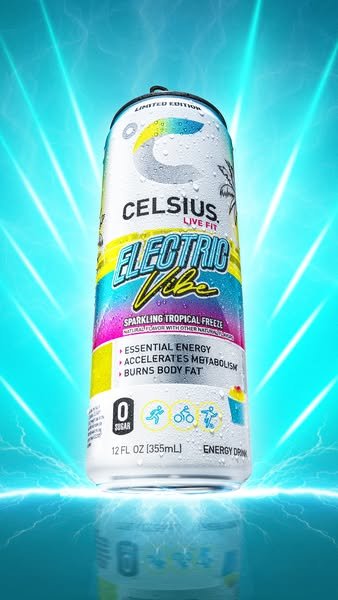
The flavor-drop concepts follow the same shape. New launches for Peach Mango, Grape Rush, and Sparkling Orange each rolled out with six to eleven variants or duplicates in their first month. Celsius also runs Spanish-language variants ("Cero azucar. LIVE. FIT. GO.") to widen the same concept across audiences rather than invent new ones. The copy stays short: an 83-character average body, against Liquid Death's 147 and Ghost's 154, with lines like "Composed under pressure. Essential energy that keeps you sharp from start to finish."
The tell is the CTA. Celsius runs "Learn More" on 81% of ads, where the other two brands run "Shop Now." That fits an energy drink sold mostly off a cooler shelf, not a landing page: the ad builds the flavor and the vibe, and the actual purchase happens at retail. The format mix is 75% static, matching a system that scales proven concepts wide rather than producing heavy new video every cycle.
Where do you sit? (Celsius system)
If one hero concept is doing most of your work and you're cloning it across placements, flavors, and languages rather than launching new angles, you're running the Celsius system. It's efficient while the concept is strong, because you amortize one creative idea across dozens of units. The risk is concentration: when the market moves or the concept ages, you don't have a bench of tested alternatives ready to take over.
Ghost: the durable evergreen catalog
Ghost is the outlier that reframes the whole benchmark. The brand is best known for Ghost Energy, its zero-sugar energy drink, but the Ghost energy ads in this sample are outnumbered by its supplement catalog. Its 189 ads carry a 160-day median run, and 116 of them (61%) have been live past 90 days. One WHEY unit has been live 496 days (Library ID 502777742507303). Where Liquid Death refreshes a third of its library every two weeks, Ghost keeps most of its library running for months, and its longest-lived units for well over a year.
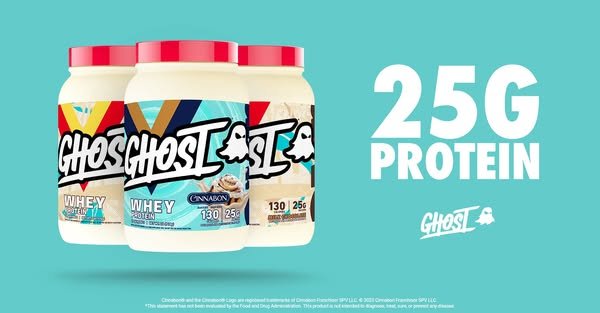
The system is a product-line catalog. The ads map to specific product pages: WHEY, GREENS, INTRA, LEGEND, CLEAR WHEY, VEGAN. The flagship WHEY unit reads "Each scoop packs 25G of a transparent, premium whey protein blend" (Library ID 1370231150656784), a straight direct-response pitch with a discount code, and it carries roughly a dozen creative variants. This is what durability looks like up close: not one ad that never changes, but a proven concept that gets refreshed at the variant level while the core unit stays live for months. Longevity like this is a signal worth studying, and we've written about what the longest-running ecommerce creative has in common.
Ghost commits to the pattern completely. "Shop Now" appears on 188 of 189 ads, and the format mix is 95% static (10 videos in the entire sample). That last number is the one soft spot in an otherwise disciplined system: a catalog this static leaves the motion formats wide open. Durability and fatigue are different diagnoses, and near-zero video is a wide-open gap of the kind a creative-fatigue read is built to separate from healthy longevity.
Where do you sit? (Ghost system)
If you have a broad SKU catalog and a handful of ads that have run for months without you touching them, you're a Ghost. Your risk is complacency. Ghost's near-zero video share shows how it happens: a system tuned for durable static winners stops testing the formats a motion-first competitor can use to flank it in Reels. Durable is good. Untested is the trap.
This is one afternoon of reading three public libraries.
A Mako Metrics report does it for any competitor set you name and hands you the finished read: every live ad with run duration, format, CTA, and the creative files, plus the openings laid out for a brief or a client deck.
Look at a finished example before you spend the afternoon yourself. No login, no card.
What they're famous for vs what they actually advertise
One more read the Ad Library hands you for free: the gap between a brand's public identity and what it actually pays to say on Meta.
Liquid Death is famous as a water brand. Skulls, heavy metal, "murder your thirst," death to plastic bottles. Its Meta copy tells a wider story. Across the 156 ads, "energy" appears in 27% of them, "sparkling" in 26%, "sugar" in 25%, "tea" in 21%, and "iced" in 20%. The word "water" shows up in 22%. The brand built on canned water advertises its energy, tea, and sparkling lines at least as hard as the thing it's known for. It's using a famous identity to sell a much bigger cart.
Ghost and Celsius run on-brand by comparison: a supplement brand selling supplements, an energy drink selling energy. Neither shows the same gap between reputation and ad spend.
That gap is worth checking on any competitor you track. What a brand is known for and what it funds in the feed can be two different things. If you only watch their flagship product, you miss the expansion they're paying to push, and the copy frequencies that expose it are sitting in the public library.
So how often should you refresh? Match tempo to model
There is no universal refresh rate, and these three brands prove it by disagreeing so completely. Your churn should follow four things: how broad your catalog is, how much of your revenue comes from brand-world or merch, how much creative your team can actually produce, and how often your offers change.
Match Liquid Death's velocity when you have brand-world or merch revenue that justifies constant new creative and a pipeline (in-house plus creators) to produce it. Match Celsius's concentration when you have one or two concepts strong enough to scale across placements and geographies. Match Ghost's durability when you sell a broad catalog of products that each need a steady, always-on ad more than a weekly refresh.
The expensive mistake is the accidental middle: paying for heavy video and then killing it in two weeks, or running cheap static that sits untouched for a quarter because no one owns the refresh. Pick the system on purpose. Copying Liquid Death's tempo as a Ghost-shaped business drains the budget on production you don't need. Running Ghost's tempo as a brand-world business lets your creative go stale while a faster rival owns the feed.
One more cross-category note. In our fitness read, all three brands agreed on "Shop Now," every captured button. Beverage breaks that agreement: Celsius runs "Learn More" on 81% of its ads. The CTA follows where the purchase happens, and reading it tells you whether a competitor is running direct-response or building demand for the retail shelf.
The scorecard: three systems, three openings
| Dimension | Liquid Death | Celsius | Ghost |
|---|---|---|---|
| Tempo (median run) | 13 days, high churn | 41 days, mid | 160 days, durable |
| Format | 62% static / 38% video | 75% static | 95% static |
| CTA | Shop Now (91%) | Learn More (81%) | Shop Now (99%) |
| Variant strategy | Constant new units + merch | One concept cloned wide | Few evergreen units, refreshed |
| Operating system | Brand-world machine | Concentrated concept-scaling | Durable product catalog |
| The opening it leaves | Shop Now monoculture | Single-concept concentration | Near-zero video |
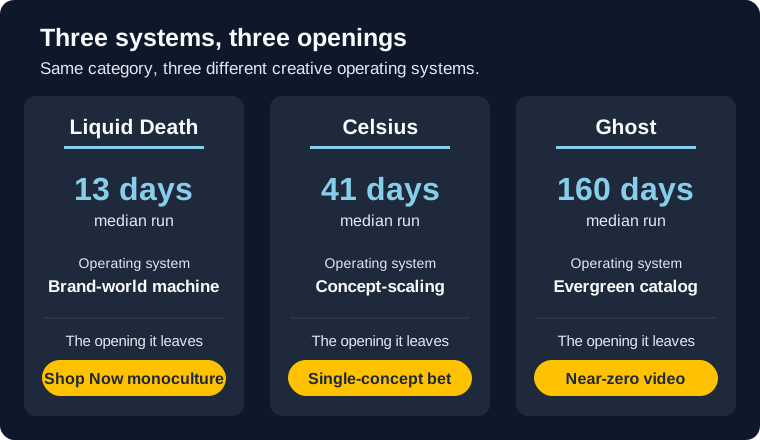
Every system leaves an opening, and that's where a counter-position starts. Against Liquid Death, an action-specific CTA and a real offer stand out in a feed where everything says "Shop Now." Against Celsius, a bench of tested angles beats a brand betting everything on one concept the month it starts to age. Against Ghost, motion in Reels reaches buyers a 95%-static catalog isn't built to hold. None of that is guesswork. It's a read of what the competitor's own live ads already tell you, which is the same read an agency can turn into a creative brief before the next shoot.
Your churn rate is a strategy, not a setting
Three category leaders on the same grocery shelf agree on almost nothing about how to run Meta creative. Liquid Death churns in under two weeks, Ghost lets winners run for over a year, and Celsius scales one idea across thirty units. The lesson is that the refresh cadence you inherited from a blog post or an old employer is a setting you can actually choose, and the right choice depends on your model, not theirs.
So read your own account against the spectrum first. Then read your actual competitors, the ones on your shelf, not the category giants, the same way. The tempo, format, and CTA they run in public tell you which system they've committed to and where they've left the door open.