
You're about to greenlight a new round of creative, and you want to know one thing first: is the competitor everyone in your category copies actually running tired ads?
So you open their Meta Ad Library page and hit a wall. No frequency. No click-through rate. No CPM. Those are the numbers creative fatigue usually shows up in, and every one of them lives inside the advertiser's own Ads Manager. You can't see them. This is by design, not an oversight: Meta's Ad Library API reference lists what the archive returns, and no performance metric appears anywhere in it.
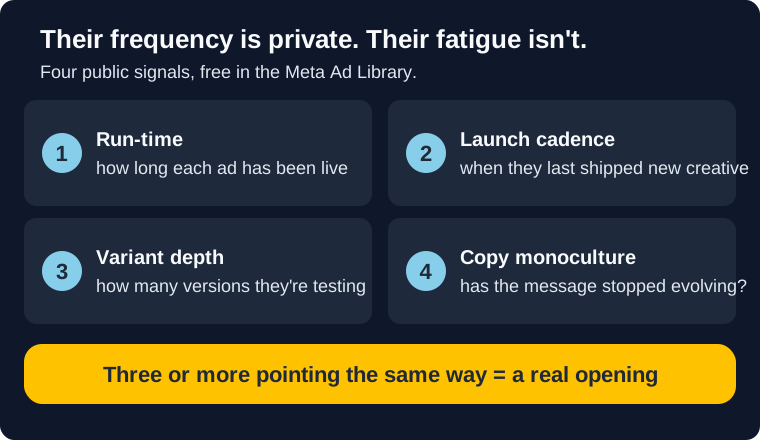
That wall stops most people. It shouldn't. Fatigue changes how a brand behaves, and behavior is public. How long an ad has run, when they last launched something new, how many versions they're testing, what their copy and CTAs look like across the whole library: all of it is visible to you, for free, without an account. Read those signals together and you can tell whether a rival's creative engine is still humming or coasting.
This post gives you four public signals for reading a competitor's Facebook ad fatigue, plus a scorecard to combine them, with real numbers from brands you already know. If you're trying to diagnose fatigue in your own account instead, that's a different job with different tools, and the 7 signs of Facebook ads creative fatigue covers it.
The short version
You can't see a competitor's frequency, CTR, or CPM. You can see four public signals that move when their creative fatigues:
- Run-time: how long each ad has been live (with one big caveat below).
- Launch cadence: when they last shipped something new.
- Variant depth: how many versions they're actively testing.
- Copy and CTA monoculture: whether the message has stopped evolving.
No single signal proves fatigue. Three or more pointing the same way is an opening.
What you can (and can't) see in a competitor's Meta ads
Start by drawing the line between what's private and what's public. Get this clear and every signal that follows is defensible, because it rests only on data anyone can pull.
The whole left column below is the advertiser's. The right column is yours.
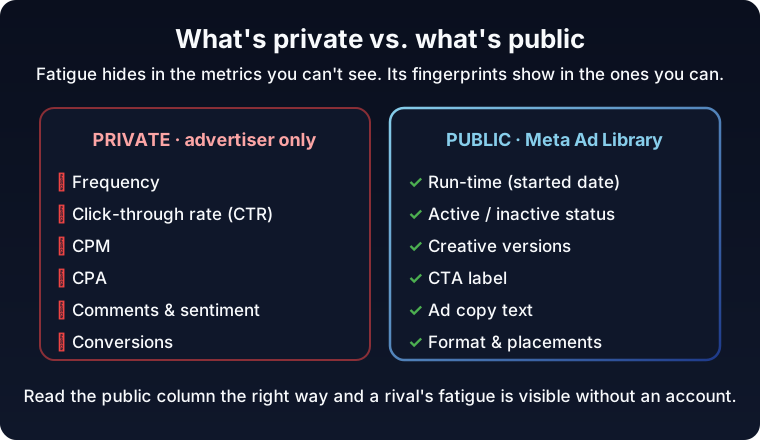
Creative fatigue is usually defined by the private column. Frequency climbs, click-through rate decays, CPM rises, the conversion rate slips. You will never see those numbers for a brand you don't run. But fatigue also shows up as a change in how the team operates: they stop launching, they stop testing, they let the same winners ride, they reach for the same CTA every time. Every one of those behaviors prints in the public Meta Ad Library.
If you haven't pulled a competitor's ads before, start with the free ways to find competitor Facebook ads and come back. The four signals below assume you've got their library open in front of you.
One more boundary. This is the outside read. Diagnosing your own account's fatigue uses frequency caps, CTR decay windows, and refresh cadence, which is what the creative fatigue playbook for small-spend accounts is for. Don't mix the two methods. You can't apply frequency thresholds to a brand whose frequency you can't see.
Signal 1: How long the ad has been running
Every ad in the Library carries a "Started running" date. The gap between that date and today is the ad's run-time, and it's the most visible signal you have. An old creative that's still live is a candidate fatigue flag: the brand has been showing the same thing to the same market for weeks or months.
Before you read anything into a long run-time, weigh the caveat below.
A long-running ad is not automatically a tired one
Run-time cuts both ways. A creative that has run for two months might be exhausted, or it might be a proven winner the brand keeps live precisely because it still works. When we ranked brands by run-time in the longest-running ecommerce ads, Hoka's library carried a median run-time near 57 days, and that was a deliberate durable-video strategy, not fatigue. Read run-time against the brand's own median, never as a standalone verdict.
So what does run-time actually tell you on its own? Maturity, not fatigue. When we pulled 200 of Stripe's top ads for the Stripe teardown, the median run-time was 48 days, and 151 of the 200 sat in the 30-to-89-day band. By itself that says Stripe runs a mature, settled library. Whether that maturity has curdled into fatigue is a question the next three signals answer. Run-time sets the table. It doesn't serve the meal.
Signal 2: Are they still launching new creative?
This is the strongest behavioral tell you get, and the easiest to check. A healthy creative team is always shipping. New hooks, new formats, new angles enter the library every week. When that flow stops, the testing engine has stalled, and stalled testing is what fatigue looks like from the outside.
To check it, sort the brand's ads by newest and look at the "Started running" dates on the top few. A cluster of recent dates means they're still iterating. A wall of dates from a month or more ago means they're coasting on what they already have.
The numbers make the contrast obvious. In the Stripe pull, only 6 of 200 ads had launched in the previous 14 days, and just 2 in the previous week. Gymshark looked similar in the fitness benchmark: roughly 6 of 80 ads launched in the last two weeks, with 53 sitting past the 31-day mark. Now compare that to Olipop, where 21 of 66 ads, almost a third of the library, had launched inside the previous fortnight. One of those engines is running hot. The other two are idling.
The 30-second version
Open the competitor's Library page, set it to the brand's active ads, and read the newest "Started running" date. If the freshest thing they've launched is three weeks old, their iteration has slowed, and you're looking at a brand riding its existing creative instead of pushing new bets.
Signal 3: How many variants are they testing?
Run-time and cadence tell you whether new ads are arriving. Variant depth tells you whether the brand is still experimenting inside the ads it has. Click "See ad details" on an ad and you'll often see several creative versions grouped under it. The count, and the kind, is the signal.
There's a distinction worth getting right here, because it separates a brand that's testing from one that's just scaling.
Testing versus scaling
Testing looks like several distinct creative versions under one ad: different hooks, different opening frames, different copy. The brand is sampling the message space to find what lands.
Scaling looks like the same creative repeated across many separate ads, pointed at different audiences or placements. That's a brand pushing volume behind a bet it has already made, not searching for a new one.
A library that's all scaling and no testing, the same handful of creatives running everywhere with no fresh versions, is a brand that has stopped looking for its next winner. Pair that with old run-times and a stalled launch cadence and you're watching a creative engine in neutral.
You read variant depth by hand, ad by ad, because it's a per-ad detail rather than a library-wide stat. It's the same outside-in discipline behind reverse-engineering a competitor's targeting: the Library doesn't hand you the conclusion, but the structure is all there if you look.
Signal 4: Copy and CTA monoculture
The last signal is the message itself. A brand with healthy creative is varying its angles: different hooks, different value props, a mix of calls to action matched to different buyers. A fatigued one has collapsed into a single note. One CTA on nearly every ad, the same opening line over and over.
Alo is a clean example. When we pulled 80 of its ads for the fitness benchmark, every single one used "Shop Now," and the same body line, "Shop the best yoga wear & accessories for yoga and working out," ran across a stack of them. Stripe showed the same shape from the other end of the market: almost every captured call to action in the 200-ad cut was "Sign Up," with nothing pointing to "Learn More," "Get a Demo," or "Compare Plans."
One caveat keeps this honest. A single repeated CTA can be the right call for the objective. A pure ecommerce brand leaning on "Shop Now" is probably just selling. So weigh copy monoculture with the other three signals rather than convicting on it alone. What you're looking for is a brand that has stopped writing new angles, not one that has simply picked a lane. When the copy has flatlined and the launches have stopped and the run-times are long, the message has gone stale with the rest of it. That repeated angle is also your raw material: it's exactly what you'd build a creative brief against.
Want these four signals computed for you?
Reading one competitor by hand takes an afternoon. A Mako report runs all four signals across a rival's entire Meta library: run-time, launch cadence, variant depth, and every CTA and copy pattern, pulled and scored.
See a finished read first. No login, no card.
The competitor fatigue scorecard
No single signal is a verdict. Run-time can mean a proven winner. A single CTA can mean a focused seller. A quiet launch week can mean a holiday. The read comes from combining them: one signal is noise, two is a question, three or more pointing the same way is an opening you can act on.
Here's the whole framework on one page.
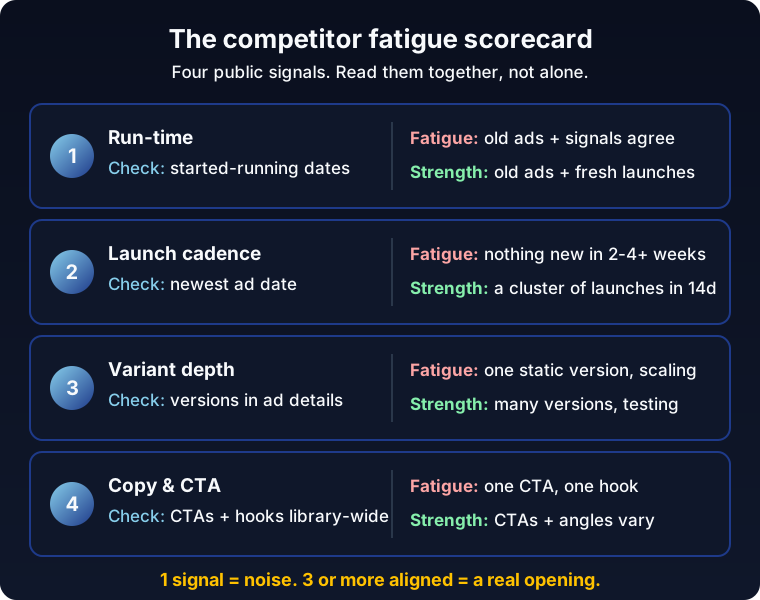
| Signal | What you check | Reads as fatigue when | Reads as strength when |
|---|---|---|---|
| Run-time | "Started running" dates vs the brand's own median | Old ads dominate AND the other signals agree | Old ads run alongside steady new launches (durable winners) |
| Launch cadence | Newest "Started running" date | Nothing new in 2 to 4+ weeks | A cluster of launches in the last 14 days |
| Variant depth | Versions under "See ad details" | One static version per ad, all scaling | Multiple distinct versions per ad, active testing |
| Copy and CTA | CTAs and opening lines across the library | One CTA and one hook everywhere | A spread of CTAs and angles by funnel stage |
Run a competitor through all four. If three or more land in the fatigue column, their creative engine has slowed, and that gap is yours to take.
What to do when a rival's creative is fatiguing
A read is only worth the time if it changes what you ship. When the scorecard says a competitor is coasting, you have three moves.
Time your launch into their gap. A brand that hasn't launched in a month is slow to answer new creative. That gap is your window to put a fresh angle into the market while their attention is elsewhere.
Counter-position on the worn-out angle. If they've run the same hook for two months, the market has heard it. Say the opposite, or name the thing their tired ad keeps avoiding. The contrast does the work.
Brief against the stale creative. Turn what you found into a one-page direction for your next shoot or UGC round. The signals you just read, the repeated CTA, the flat hook, the formats they've stopped refreshing, are the exact inputs for a competitor-driven creative brief.
FAQ
How can you tell if a competitor's Facebook ads are working without their data?
You can't measure their performance directly, because frequency, CTR, CPM, and conversions are private. What you can read is their behavior in the public Ad Library: how long ads run, how often they launch new ones, how many versions they test, and how varied their copy and CTAs are. Those four signals, read together, tell you whether their creative engine is active or stalled.
Does a long-running Facebook ad mean it's fatigued?
Not by itself. A long run-time can mean an ad is exhausted, or it can mean it's a proven winner the brand keeps live because it still performs. Read run-time against the brand's own median and alongside launch cadence, variant depth, and copy variety before drawing any conclusion.
How often should a competitor be launching new creative?
There's no universal number, but the comparison is what matters. Active brands in ecommerce often launch a meaningful share of their library inside any two-week window. When a competitor goes three or four weeks with nothing new, especially while their existing ads are aging, their testing has slowed.
Can you see a competitor's ad frequency or CTR in the Meta Ad Library?
No. Frequency, click-through rate, CPM, CPA, comments, and conversion data all live in the advertiser's own Ads Manager and are never exposed publicly. Meta's Ad Library API reference sets the boundary: the archive returns creative content, delivery start and end dates, publisher platforms, and the countries an ad ran in, and nothing about how the ad performed. Fatigue has to be inferred from those public signals, not measured from private metrics.
The Closing Take
The competitor you're worried about is probably running fewer fresh ideas than you think. You can't see their dashboards, but you don't need to. Run-time, launch cadence, variant depth, and copy variety are all sitting in the open, and when three of them point the same way, you're looking at a creative engine that has slowed down. Read that gap before your next creative round, and you stop guessing about whether the brand everyone copies is still pushing or just coasting.
By the Mako Metrics team. We pull Meta Ad Library data, turn it into operator-ready reports, and write the occasional guide when the method is worth sharing.