
Your Google Ads account works. Your demo page converts. And your Meta account has been running the same three ads since spring, because a four-person B2B software marketing team never has a spare afternoon for ad production.
So you go shopping, and every product that comes back calls itself an agent. One writes ad copy. One watches competitors. One changes budgets at 3am. One waits for you to tell it what to do. They share a word and share nothing else.
That word costs money. Pick the wrong layer and you spend $200 a month automating the step that already worked, while the step that stalled stays stalled.
Below are ten products, sorted by which part of a round each one owns. Every price comes from the vendor's own page this month and links out so you can check it. Two publish nothing at all, and I say so rather than guessing.
If you read one section, make it the one about your product interface. That is the constraint specific to selling software on Meta, and not one page-one result covers it.
The short version
- "Agent" hides four separate jobs. Some products read the market, some produce creative, some change settings in your ad account, and some sit there waiting for instructions. Work out which one you need before you compare a single price.
- You have no product to photograph. A software company's hero shot is its own interface, and a tool that cannot use your real screenshots will invent one with scrambled label text.
- Your pixel is fine. Your event volume is the problem. Meta wants roughly 50 of your chosen conversion each week per ad set, and B2B software rarely produces 50 qualified anything in a week.
- Ask whether round four beats round one. Most of these ten have no mechanism for carrying what happened last time into what gets made next time.
- Prices run from free to roughly $4,000 a month. Madgicx and Metadata publish nothing; Primer publishes a clean ladder including a free tier.
The four things people mean by "Meta ads agent"
Before comparing prices, work out what you are buying.
Every Meta round moves through the same six steps. Read the category, choose the angles, produce the creative, screen it against brand and policy rules. Then assemble the campaign in the ad account, read the results, and write the next brief. I have covered how that loop runs in practice at length elsewhere.
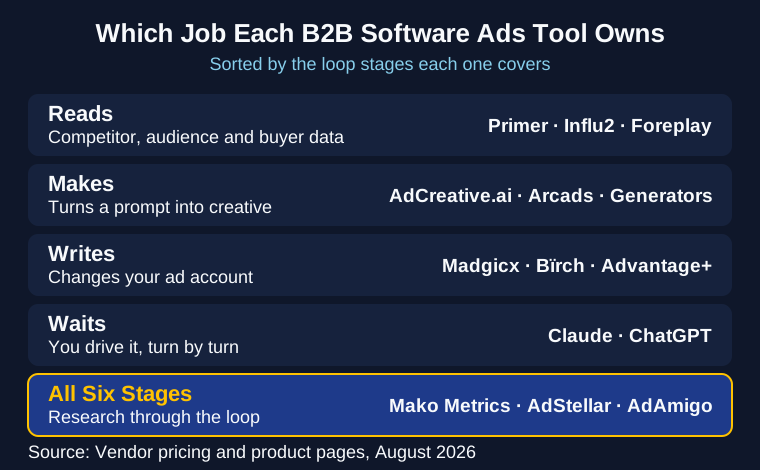
A product gets sold as an agent when it owns any one of those steps. The same software gets marketed as an AI media buyer, a Meta ads agent, or B2B SaaS Facebook ads tooling, depending on who is writing the landing page. Sort the ten by which steps they own and four groups fall out.
Tools that read. Foreplay, Atria and Influ2 watch competitor ads, creative performance, or buyer behavior, then hand you something to act on. They cover the first two steps and the last one well. The output is a brief, a report, or an audience list, and a human still has to make the ad.
Tools that make. AdCreative.ai, Arcads and the image models behind them turn a prompt into a static or a short video. They solve step three in isolation. For a software company this group has a specific failure mode, covered below.
Tools that write. Madgicx, Bïrch and Meta's own Advantage+ change objects inside an account that already exists: budgets, bids, rules, pauses. They own the back half of the loop and hold no opinion about what the creative should say.
Tools that wait. Claude or ChatGPT connected to your ad account through Meta's official connectors. They will do any step you name, in the order you name it, and stop the moment you stop typing.
Three products here cover most of the six steps end to end: Mako Metrics, AdStellar and AdAmigo. Metadata covers a different set of steps deeply, on channels beyond Meta. The rest own a station and own it well.
For a B2B software team, the stall is almost always at step three. You have positioning, you have a landing page, you probably have a designer who is busy with the product. What you lack is a supply of on-brand ads. Yet most shopping happens in the "tools that write" aisle, because bid automation demos beautifully and creative production does not. If your ad account has been running the same three creatives since spring, a smarter bidding rule will do nothing for you. Buying a competitor tracker instead is the same mistake wearing different clothes: both purchases feel productive on the day, and neither one ships a new ad.
Running an ecommerce catalog rather than a software product? The constraints change enough that the ecommerce version of this comparison is the better read.
Meta ads agents compared
Ten products sold as Meta ads software for B2B, side by side. Every price comes from the vendor's own pricing page, checked on 19 August 2026. Each one links out, so you can verify it before anyone gets you on a call.
The last two columns are the ones other roundups leave out. "Builds the campaign" asks whether the thing can assemble campaign, ad set and ads inside your ad account, or whether it hands you files. "Gets better round over round" asks whether anything carries forward, which is the question that decides how a tool feels in month six.
| Tool | Job | Best for | Starting price | Builds the campaign | Gets better round over round |
|---|---|---|---|---|---|
| Mako Metrics | Whole loop | Teams whose creative round never gets built | $100/mo per account | Yes, paused | Yes. Locked brand context plus a weekly read into the next brief |
| AdAmigo.ai | Whole loop | Lean teams wanting daily autopilot | $99/mo per ad account | Yes | Yes. Daily autopilot on the account |
| AdStellar | Whole loop | Shipping a first test this week | $100/mo, 50,000 credits | Yes | Within a workspace, via persistent memory |
| Metadata.io | Whole loop, B2B-native | Optimizing on pipeline, not clicks | Not published | Yes | Yes. Pipeline results drive the next experiment |
| Primer | Reads | Reaching your actual ICP on Meta | Free, then $800/mo billed yearly | No | Audience refresh only |
| Influ2 | Reads | Contact-level ABM across channels | Not published | No | Contact-level engagement feedback |
| Madgicx | Writes | Rules-driven spend management | Not published | Partly | Yes. Spend rules retune |
| Bïrch | Writes | Automation you write yourself | $49/mo | Partly | Only the rules you author |
| Meta Advantage+ | Writes | The free floor | Free | Inside Ads Manager | Yes, inside a campaign that already exists |
| Claude or ChatGPT via Meta's connectors | Waits | Driving it yourself | Free in open beta | Yes, when you ask | No memory across sessions |
The 10 best Meta ads agents for B2B software
Mako Metrics: Best for B2B software teams whose creative round is the bottleneck
Full disclosure before anything else: we build this one. Read the limits two paragraphs down before you read the pitch.
May, our Meta ads agent, takes a brief and runs the round. It reads what comparable companies are running on Meta and turns that into angles, with copy and image prompts you can edit. It builds eight concepts from the brand assets you uploaded and screens every one against your brand rules and Meta's policies. Then it assembles the campaign in your ad account with tracking attached. You pick the conversion event it optimizes toward. The campaign arrives paused. Turning it on is your call, every time.
Two things carry between runs. Your confirmed brand profile persists, so round two starts from the same locked positioning, proof points, voice and banned claims as round one. No blank document. And we read the results each week and write what we learn into the next brief. Most teams do that step in their heads and have forgotten it by the next quarter.
Now the limits. Meta only, so Facebook and Instagram and nothing else. Static images, no video. We stop at MQL: we do not push CRM stages back into Meta, and if pipeline attribution is your gap then buy Metadata instead. We claim no ROAS or CPA advantage, because we have no performance data to support one. Writes to the account run through a proxy with a hard spend cap, so a creative nobody approved has no route to your budget.
Pricing runs per client ad account. It is $100 a month per account while you run one to four. After that it moves to a bundle: $499 a month for up to five, $899 for up to ten, then $59 per active account beyond. Twenty or more gets sized on a call. The founding rate is locked for twelve months, and competitor reports are included on the roster tiers. The research layer also sells on its own from $24.99 a report. That is the cheapest way to judge our read before you hire anyone to act on it.
When to buy something else
- Your creative is fine and you cannot connect spend to pipeline. Buy Metadata.io. That is an attribution problem, and we do not sell attribution.
- You are reaching the wrong people, not writing the wrong ads. Buy Primer. Matching your target account list into a Meta audience is a data problem, and better creative aimed at the wrong ICP still misses.
- You cannot tell which creative worked. Buy Motion. That is measurement, and we do not sell measurement.
Curious what a round looks like before anyone asks you for a call? Watch May build one on your own brand, from the competitor read through to the paused campaign sitting in the account. No call, no card, and you get to judge the creative before you decide anything. Both the agent and the reports sit on the same pricing page.
AdAmigo.ai: Best for lean teams that want daily autopilot
AdAmigo is the closest competitor we have found, and at $99 a month per ad account it automates more of the daily operations than we do. Its Entry plan targets accounts spending under $2,000 a month. That buys two autopilot recommendations a day, two chat agent prompts, and 150 design credits. Unlimited Access runs $349 a month per ad account with 800 design credits. Agency rates are quoted on request.
The trade is review depth: recommendations that land daily get looked at less carefully than a round you sit down with once a week. Worth knowing for B2B specifically, autopilot logic tuned on ecommerce conversion volume behaves differently when your account produces six demo requests a week rather than six hundred purchases.
AdStellar: Best for shipping a first test this week
One plan, $100 a month, 50,000 credits, unlimited team members, ad accounts and workspaces, with $100 in free credits at signup and no annual contract. It creates and launches, and you can be inside it tonight without speaking to anyone. That beats us on friction and I am not going to argue with it.
Two limits. Credits are the ceiling, and video burns through them quickly. More important here, prompt-driven generation has no way of knowing what your interface looks like, which is the central problem in this category. AdStellar also publishes its own SaaS roundup that ranks itself first. Fair enough, so does this post; read both and check the prices yourself.
Metadata.io: Best for optimizing on pipeline, not clicks
Metadata is the only product on this list built for B2B from the ground up. It runs experiments across audience and creative combinations and ties the results back to pipeline and closed revenue rather than form fills. If your board asks about cost per opportunity and your Meta reporting stops at cost per lead, this is the category that closes that gap.
It publishes no price. The site says pricing "depends on the channels you run, the spend the agents manage, and how much of the execution work you hand over." The next step is a working session with one of your live campaigns. Third-party figures circulate; none of them come from Metadata, so I will not repeat them as verified. Treat this as an enterprise purchase with an enterprise sales cycle, and budget accordingly.
Primer: Best for reaching your actual ICP on Meta
Primer solves the targeting half. You sync a target account or contact list, it matches those people into audiences on Meta, Google and LinkedIn, and it publishes its match rates rather than implying them. The Grow tier claims 65% to 85% on Meta.
It is also the only vendor here that publishes every tier and every limit on one page. In a category full of "book a demo," that deserves credit. Free forever covers unlimited draft audiences and CRM sync up to a million records, though drafts cannot push to ad platforms. Grow is $800 a month billed yearly or $1,000 monthly, with six to eight active synced audiences. Scale is $1,250 billed yearly or $2,000 monthly.
The limit is simple: Primer makes your targeting sharper and produces no creative. Pair it with something from the "makes" group, and budget for both.
Influ2: Best for contact-level ABM across channels
Influ2 targets named individuals rather than audiences, then reports ad engagement per contact so sales can see which people at an account have been touched. For a company selling to a buying committee of six, that is a meaningfully different view from anything Ads Manager will show you.
Two limits. It publishes no price and routes everything through a demo. And it is a targeting and measurement layer, so the ads themselves remain your problem. Influ2 also publishes the one real software comparison that ranks on page one for this topic, sorted by whether a platform targets at contact, account or audience level. That framing sorts the market on an axis this post does not, and it is worth reading alongside this one.
Madgicx: Best for rules-driven spend management
Madgicx bundles automation, targeting, analytics and ad management, with a seven-day trial. The price is bracketed by monthly ad spend, from under $1,000 up to $30,000 and above.
The number itself is the problem: the pricing page says "see price inside the app." The only figure published anywhere on it is the $49 a month Tracking Pro add-on. Budgeting against a number you cannot see is difficult, and it is a fair reason to look elsewhere first. Its optimization logic also assumes a conversion volume most B2B software accounts will not produce.
Bïrch (formerly Revealbot): Best for automation you write yourself
Note the rename first, because half the roundups still index the old one. Revealbot is now Bïrch, at bir.ch. It executes conditional rules you author: pause when frequency crosses a threshold, shift budget when cost per result moves, and so on.
Essential is $49 a month covering up to $10,000 of monthly ad spend across connected accounts, with overages beyond that. Pro is $99 a month, Enterprise is custom, and there is a 14-day trial. Its separate Signals Gateway is priced by tracked events, starting free at 10,000 events a month.
Bïrch has no opinion about creative, which makes it a poor answer to a production bottleneck and a good answer once you have more ads than attention.
Meta Advantage+ and Ads Manager AI: Best free starting point
Already in your account, costs nothing beyond media, and improves delivery inside campaigns that already exist. It will not research your category and it will not produce an ad from nothing.
This is also where Meta's instant forms live, which matters for B2B. A form that opens inside Facebook rather than sending someone to your site will usually cost less per lead and qualify worse downstream. Test that trade rather than assuming it. Meta's own tooling is the free place to do it.
Claude or ChatGPT via Meta's Ads AI connectors: Best for driving it yourself
Meta shipped an official connector for AI assistants at mcp.facebook.com/ads on 29 April 2026,
exposing 29 tools through one Business OAuth connection. Setup takes about fifteen minutes and needs
no developer credentials. It is free during the open beta, with no announced end date.
Two things to know before you plan around it. Rollout is still gated per account: if the connector
reports is_ads_mcp_enabled: false, your ad account has not reached the rollout yet, and no amount
of configuration will change that. And you are the operator. The assistant holds no memory between
sessions, so the quality of the read depends entirely on the quality of your prompt, every single
time. If you want to understand what running it yourself actually involves,
we wrote up the architecture.
Named but not ranked. Foreplay and Motion both do their jobs well, and neither is B2B-specific. Motion starts at $750 a month, which is a lot to spend before you have made an ad. Smartly.io is aimed at spend levels well past this reader. HockeyStack and Dreamdata are attribution products rather than agents, and belong in a different comparison.
Your product is a screenshot, not a photograph
An ecommerce brand can put a can on a table and light it. Your product is an interface, and that one difference changes what AI creative can and cannot do for you.
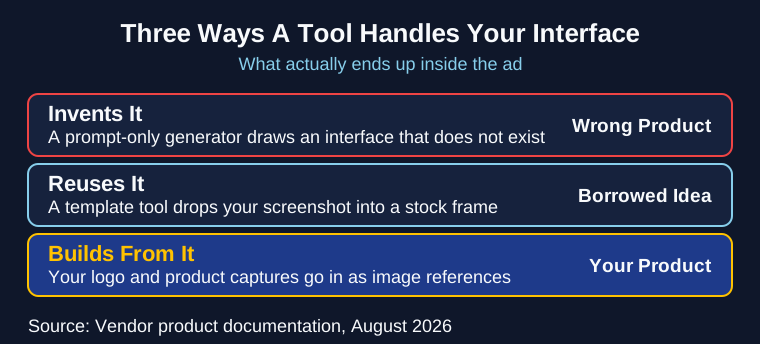
There are three ways a tool handles it, and the difference is the most useful sorting question in this whole category.
It invents an interface. Give a prompt-only generator "SaaS dashboard, clean, modern" and it produces something dashboard-shaped with scrambled label text, charts of nothing, and buttons that say almost-words. For a product your buyers can recognize on sight, an invented interface reads worse than a plain background. We ran five image models against a controlled brief and only one cleared the bar of correct headline, real logo, nothing invented.
It uses a screenshot you supply, inside a template. The interface is right and the idea is borrowed from a layout someone else designed. This works at volume and it works fastest, and it struggles in a category where the message is the differentiator. Every competitor can drop their screenshot into the same frame.
It builds from your real assets. Your logo and your product captures go to the image model as references rather than as descriptions, so the interface in the finished ad is the one you shipped. That is what May does. The logo goes in first, and your product screenshots rotate across the eight concepts, so the round shows more than one surface.
The evidence for why this matters is sitting in the Ad Library. We pulled 200 live Stripe ads for a full teardown and did the same for Gusto. Format splits are all over the place. In our own pulls, Adobe ran 43 of 58 sampled ads as video, while Figma ran 46 of 73 as static. Two design tools, opposite answers, so treat anyone selling you a universal format rule with suspicion. What stays constant is that the recognizable brands show you their actual product. Nobody serious runs an invented dashboard.
What happens past the click
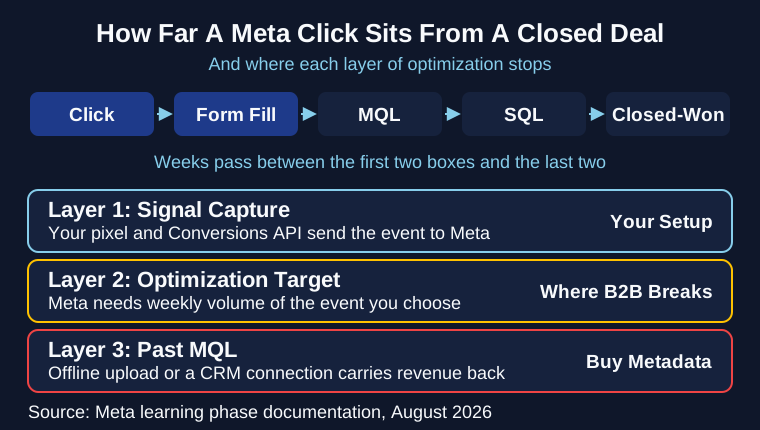
Three separate things get bundled together whenever someone says a tool "optimizes for conversions." Pulling them apart is the fastest way to work out what you are missing.
Layer one: Signal capture. Your pixel and the Conversions API send events to Meta when someone fills in a form or books a demo. Most B2B software accounts already have this wired, and it behaves the same regardless of which tool on this list you buy. If yours is patchy, fix that first; no agent compensates for missing signal.
Layer two: The optimization target. Which event the ad set is told to buy is a setting, and Meta needs volume of that specific event before delivery stabilizes. Its own documentation puts the floor at roughly 50 results in the week after the last significant edit.
Do the arithmetic for a B2B software account. LOCALiQ's benchmark data puts business services cost per lead around $16.95 for a raw form fill. 27Five, an agency reporting from its own managed accounts, puts a $25 in-platform lead at a $75 to $150 cost per qualified lead after CRM qualification. Optimizing directly on qualified leads at 50 a week therefore costs between $3,750 and $7,500 every week, per ad set, before you learn anything. For most B2B software companies that is a month of Meta budget, spent in a week, on one ad set.
So you buy a cheaper, more frequent event and reconcile later. Content downloads, trial starts and raw form fills all produce enough weekly volume for delivery to settle, and all of them let in people who will never buy. That trade is the actual B2B media buying decision, and no tool on this list makes it for you. The mechanics of the learning phase, including why editing an ad set restarts the clock, are covered in our piece on ad ops.
Layer three: Past MQL. Pushing MQL, SQL and closed-won back into Meta through offline uploads or a CRM connection, so the system optimizes toward revenue rather than toward form fills. This is where we stop. Mako does not do it, and Metadata is the product built for exactly this. If your problem is that Meta looks fine in-platform and invisible in the pipeline report, buy that layer, not ours.
Working out where you sit is a five-minute exercise. Write down the event your ad sets currently optimize for, count how many of them happened last week, and check whether that number clears 50. If it does, your delivery has something to learn from. If it does not, you are paying for a learning phase that never ends, and the fix is a different event rather than a different tool.
What this costs for a B2B software team
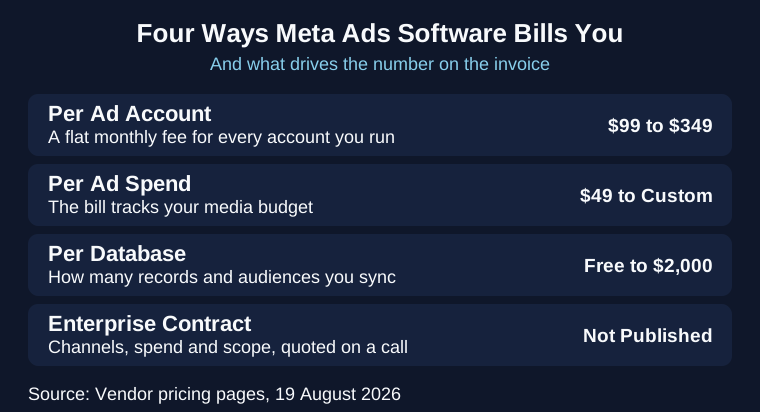
Four pricing shapes are represented here, and comparing the headline numbers across them will mislead you, because each one bills against a different thing.
Per ad account. Mako at $100 and AdAmigo at $99. Predictable while you run one or two accounts, and it scales badly the moment you run many. That model is ours, and on a large roster it is the most expensive shape in this post. For a single software company running one Meta account it is the cheapest to reason about; if you are an agency, the roster math is a different post.
Per ad spend. Madgicx and Bïrch. The bill tracks your media budget, which feels fair and means a successful quarter raises your software cost at the same time as your media cost.
Per database. Primer, and Influ2 by implication. The driver is how many records and audiences you sync, not how much you spend or how many ads you make. This is why the B2B ladder stretches so much wider than the ecommerce one: $800 a month buys audience matching that produces no ads at all.
Enterprise contract. Metadata, Smartly.io, and Influ2. Priced against channels, spend, and how much work you hand over. No public number, a sales cycle, and usually an onboarding fee.
Across the list the range runs from free to roughly $4,000 a month. Two vendors publish nothing. That is a legitimate business decision on their part and a legitimate reason for you to shortlist someone else while you wait for a quote.
How to choose, by company shape
Meta ads for software companies stall in six recognizable ways. Here is what I would buy in each.
No new creative has shipped this quarter? The most common shape here, and the most often misdiagnosed. Buy from the loop group: Mako, AdStellar or AdAmigo. Start with AdStellar if you want something running this week without a call.
Plenty of ads, wrong audience? Good creative aimed at the wrong ICP still misses, and no generator fixes that. Buy Primer. Buy Influ2 instead if you sell into a committee and want reporting per named contact.
Fine in Ads Manager, invisible in the pipeline report? Buy Metadata. Expect an enterprise sales cycle and budget for the onboarding as well as the license.
Testing Meta this quarter on a small budget? Start with Advantage+ and Meta's own tooling. They cost nothing beyond media. Add a creative layer once you know the channel works for you at all.
Already have a designer, and the queue is assembly? Your bottleneck sits after the artwork. Bïrch for rules you author yourself, or Madgicx if you can get a number out of them.
Want to run it yourself? Connect Claude or ChatGPT through Meta's connectors. It costs nothing today, and you will find out quickly whether you enjoy being the operator.
FAQ
Do Meta ads actually work for B2B software companies?
Yes, at the top and middle of the funnel. Meta CPMs for B2B run roughly $8 to $25 against LinkedIn rates that are multiples higher, so the reach is cheap. What Meta will not give you is LinkedIn's native job-title and company targeting, which is the gap products like Primer and Influ2 exist to fill.
What should I optimize for when I only get a handful of demos a week?
A cheaper, more frequent event upstream of the demo. Meta wants around 50 of your chosen event per ad set per week, and almost no B2B software account produces 50 demo requests in that window. Pick the earliest event that still correlates with real intent, then qualify downstream in your CRM.
Can an AI tool put my real product UI in the ad?
Yes, if it accepts your assets as image references rather than as a text description. Tools that work from a prompt alone will invent an interface, and invented interfaces have garbled label text. Ask any vendor to generate one concept using your actual screenshot before you pay them.
What does a Meta ads agent cost for a B2B software team?
Free to roughly $4,000 a month. Meta's own tooling and the AI connectors cost nothing. The self-serve creative and campaign tools run $49 to $349 a month. Audience matching starts around $800. Pipeline-level platforms are enterprise-priced and publish no rate card, as do Madgicx and Influ2.
Is Meta's Business AI the same as a Meta ads agent?
No. Meta Business AI is a customer-service assistant that answers messages from people who contact your Page. The Ads AI connectors are a separate thing entirely: an endpoint that lets Claude or ChatGPT read and operate your ad account. The names collide and the search results mix them constantly, so check which one a vendor means.
Should I buy software or hire a B2B Meta ads agency?
Hire the agency if you have no in-house media buyer and no appetite to become one, and if the retainer is small next to your media budget. Buy software if you have someone who knows Ads Manager and their week disappears into production work. Most of what ranks for this search is agency listicles. That tells you the retainer model still dominates the category, and nothing about which suits you.
Which one to actually buy
There is no single best Meta ads agent for B2B software, and any roundup naming one without asking what stalled first is guessing. Every product here uses the same word for four different jobs, and that ambiguity does the selling. Search for software to run your Meta ads and Google will mostly return agencies, which is a fair signal that the category has yet to decide what it is.
So work backwards from your own account rather than forwards from a feature list. Open Ads Manager and find the step that stopped. If the answer is that no new creative has shipped since spring, a bidding rule and a competitor tracker will both feel productive and neither will change anything. If the answer is that plenty of ads shipped and none of them reached the right accounts, better creative is the wrong purchase too.
Then ask the two questions specific to selling software. Can this tool use my real interface, or will it invent one? And is there anything here that makes round four better than round one?
If the round itself is the bottleneck, that is the problem we built Mako to take off your desk. Put your own brand through a round and look at what comes back before you commit to anything. Seven concepts, five finished creatives, no call, no card.