
You have a folder of competitor Facebook ads. You screenshotted them during a research afternoon, maybe tagged a few, and now they sit there. The problem is a screenshot tells you nothing about whether the ad actually works. A beautiful ad that got paused after nine days and an ugly one that has run for three months look identical in your folder.
There is one number in the Meta Ad Library that does tell you something: how long the advertiser has kept the ad live. Brands do not keep paying to run ads that lose money. So run-time is the closest thing to a free, public performance signal you can get on a competitor. Sort by it, and the ads that survive start to look very different from the ads that get the most likes.
I sorted three real consumer brands' active campaigns by run-time and pulled out what the longest-lived ads have in common. Here is what winning Facebook and Meta ad creative actually looks like when you let longevity, not taste, pick the winners.
The short version
- Longevity is the only free signal. Run-time is the one performance proxy the Ad Library gives you for free. It is not impressions or ROAS, but advertisers do not keep funding losers.
- Video wins volume, not automatically longevity. All three brands run mostly video (66 to 79 percent of active ads), but ad count is how much you test, not what survives.
- The longest-lived ads disagree on format. Ridge's 84-day winner is a creator-demo video. HexClad's 96-day winners are static, review-led product images. Format follows the job.
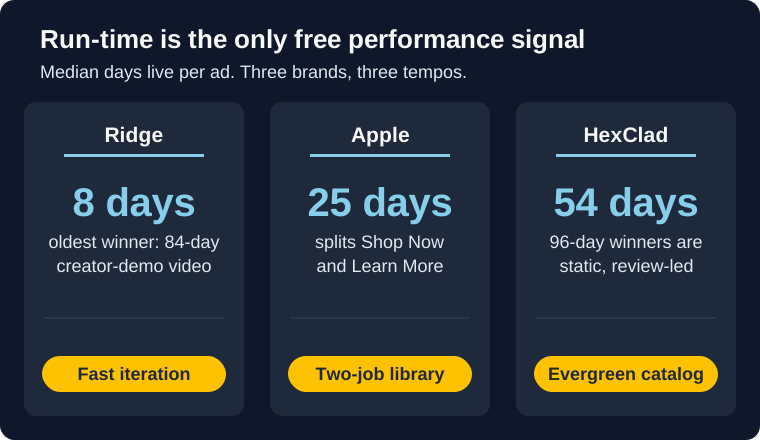
- Testing velocity is a choice. Ridge iterates fast (median ad live 8 days), HexClad runs evergreens (median 54), Apple sits in between (25). Pick the lane your team can feed.
- The CTA follows the objective. Ridge and HexClad run almost only "Shop Now" (100 and 98 percent). Apple splits between "Shop Now" and "Learn More" because its ads do two different jobs. Spend your creativity on the hook and the proof, not the button.
Method: three consumer brands' live Meta Ad Library campaigns, sorted by days running. Sampled (Ridge and HexClad about 200 ads, Apple about 80), not full libraries. Every number traces to a Mako Metrics report.
Why ad longevity is the only free signal that a Facebook ad is working
Here is the uncomfortable truth about competitor research: the Meta Ad Library shows you what your competitors are running, but it hides everything you want to know. No spend. No impressions. No click-through rate. No ROAS. You can see the creative, the copy, and the start date, and that is it.
Run-time is the exception. Every active ad in the Library carries the date it started running, which means you can calculate how many days it has been live. And that one number carries real information, because of how performance advertising works. A paid social team running an ad at a loss kills it. Budgets get reallocated to whatever is converting within days, not months. So an ad that has been live for 80 or 90 days is an ad that has survived dozens of internal kill decisions. Somebody keeps choosing to fund it.
That makes longevity a vote: imprecise, but a vote. When you sort a competitor's ads by run-time, the top of the list is the closest you will get, for free, to their list of proven winners. The best performing Facebook ad creative in most accounts is usually the oldest ad still running, not the flashiest one launched last week.
What longevity does and doesn't tell you
Run-time is a proxy, not a performance readout. Hold two limits in mind:
- It is not spend. A long-running ad could be a small always-on brand line, not a top performer. Longevity tells you "not a loser," not "biggest winner."
- It is not ROAS. The Library does not expose conversions. You are inferring quality from survival, so treat it as a strong hypothesis, not proof.
Used that way, it is still the best free filter you have. Vet by run-time first, then judge the creative.
How we ran this
I pulled the active Meta Ad Library campaigns for three consumer brands that sell physical products through Meta, then sorted every ad by how long it had been running:
- Ridge (slim wallets and everyday carry): a DTC brand with 480 active ads, sampled 200.
- HexClad (hybrid cookware): a DTC brand with 260 active ads, sampled 200.
- Apple (consumer electronics): the megabrand outlier, about 80 ads sampled.
A few honesty notes, because they matter for how much weight each finding can carry. These are samples, not the full libraries, and everything below is descriptive of what these brands are running today, not a controlled study. The Apple sample is smaller (about 80 ads), so treat its numbers as directional rather than precise. Mixing two DTC challengers with a global giant is deliberate: if a creative pattern shows up across all three, it is probably about the medium, not the brand.
One more thing worth saying plainly: every number in this post is one screen of a Mako Metrics competitor report. The same pull, format breakdown, CTA counts, and run-time ranking come standard for any brand you point it at. For a single-brand version of the same exercise, see the OLIPOP Meta ads teardown, which runs this method on one DTC library and ends in counter-positioning moves. For the multi-brand category version, the fitness brand Facebook ads benchmark compares Gymshark, Alo, and Hoka on the same longevity dimension plus format, cadence, and copy. You can also reproduce the basics by hand in the Meta Ad Library guide if you want to spot-check a single competitor.
Finding 1: Video wins volume, but volume isn't longevity
Start with the obvious pattern. All three brands lean hard on video.
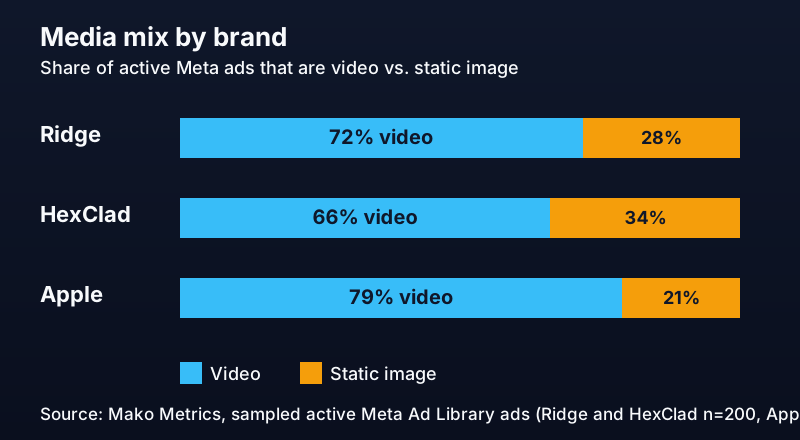
Ridge runs 72 percent video. HexClad runs 66 percent. Apple runs 79 percent. A small DTC wallet brand, a DTC cookware brand, and a global electronics giant, all landing in the same range. If you stopped here, you would write the same takeaway every other blog writes: "Meta is video-first, go make more video."
The problem is that ad count measures how much a brand tests a format, not how well that format survives. A brand can fire off a hundred video variants in a month, watch ninety of them die in a week, and the count still reads "mostly video." Volume is an input. Longevity is an output. They are not the same thing, and conflating them is how teams end up pouring budget into a format that fills their account without filling their cart.
So the real question is not "what are they running most." It is "what is still running after the kill decisions." That is Finding 2, and it breaks the video-first story.
Finding 2: The longest-lived ads don't agree on format
When you sort by run-time and look at what is at the top, the two DTC brands point in opposite directions on format.
Ridge: the 84-day creator-demo video
Ridge's longest-running ad in the sample has been live for 84 days, and it is video. Specifically, it is a creator-led demo: the frame is the YouTuber MKBHD with the on-screen line "MKBHD explains how the tracker card works," holding the product in his hands. The link card under it carries the standard wallet copy, verbatim: "Slim. Secure. Built to last. The Ridge Wallet redefines everyday carry with RFID-blocking technology and a sleek, minimalist design. Stop carrying bulk, start carrying better." The call to action is "Shop now." (Meta Ad Library ID 804447368635844.)
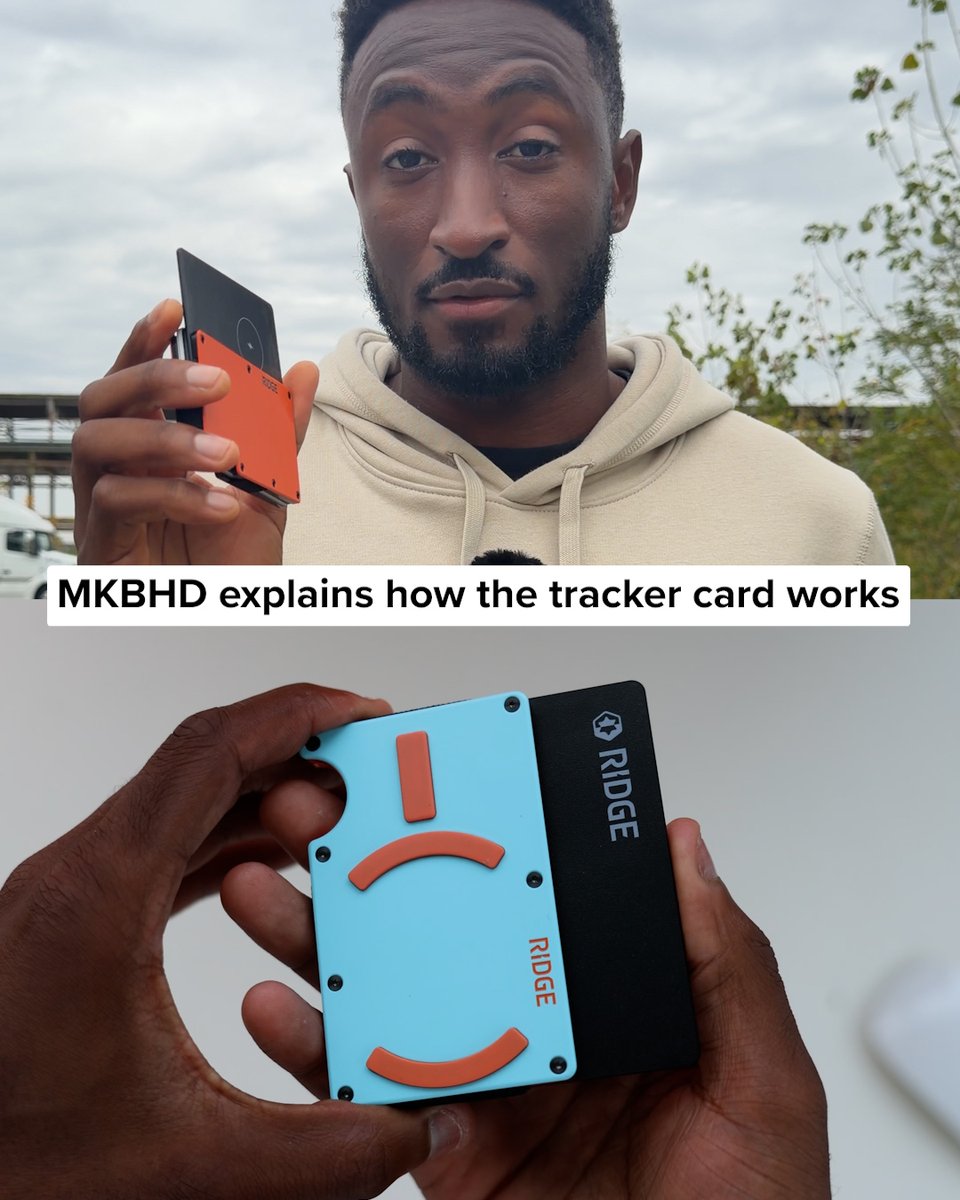
It makes sense that this lasts as video. The ad's job is demonstration plus borrowed trust: show a feature working (the tracker card) through a face the audience already believes. Both of those are hard to do in a static image. You need motion to demo the product and a recognizable person to carry the credibility. Video is the format that lets one ad do both at once.
HexClad: the 96-day static review ad
HexClad's longest-running ads have been live even longer, 96 days, and they are static images. Not video. The two oldest survivors are both proof-led product stills. One leads with a customer review, verbatim: "The best pots and pans we've ever owned! They are so easy to clean and heat evenly, and we've now started cooking every day because we enjoy using them so much." attributed to a five-star reviewer named Amanda G. (Library ID 1953820181879681). The other leads with specs and social proof: "There's a reason why HexClad hybrid cookware has over 50,000 5-star reviews. Its patented hybrid technology combines the ease of nonstick, the searing power of stainless steel, and the durability of cast iron into the most high-performing cookware on the planet." (Library ID 914756794467820.)
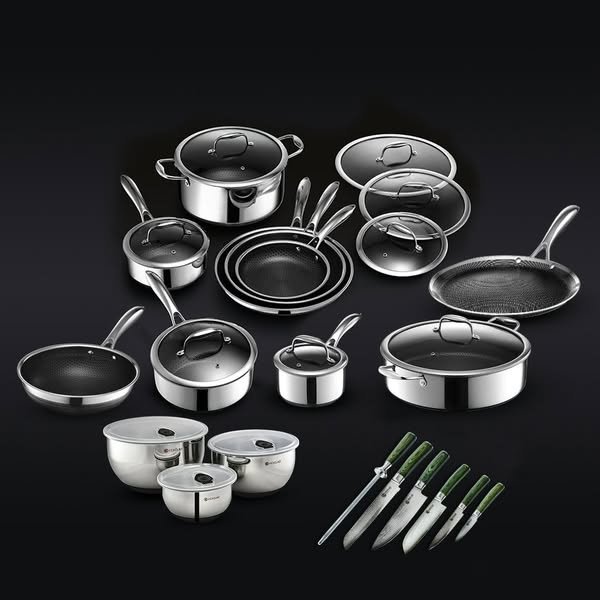
This also makes sense. HexClad sells a considered purchase. A cookware set is expensive and people read reviews before buying. The job of the ad is proof: reviews, star counts, material specs, "FREE from forever chemicals." Static images let a skimmer absorb a claim and a rating in one beat, no sound or watch-time required.
Same goal of selling a physical product to a cold audience, opposite winning format. The lesson is not "video wins" or "static wins." It is that the format follows the job the creative has to do. Ridge needs to demonstrate a feature and borrow a creator's credibility, so a creator-demo video survives. HexClad needs to make you trust an expensive cookware set at a glance, so proof-led statics survive. Before you copy a competitor's format, ask what job their creative is doing and whether yours is doing the same one. That question is exactly what a competitor ad creative brief is for.
Find your competitor's survivors without the scrolling
Everything in this post, the run-time ranking, the static-versus-video split, the CTA breakdown, the real ad pulls, is one report's worth of data on three brands. A Mako Metrics report runs that same pull on any competitor you name, so you skip the manual Ad Library scrolling and land straight on the ads that survived. The sample reports are free, no login. See Sample Reports, then sort a real brand's ads by how long each one has run.
Finding 3: Testing velocity is a strategy choice
Run-time also exposes how each team operates, and the three brands sit on a clear spectrum from fast iteration to evergreen.
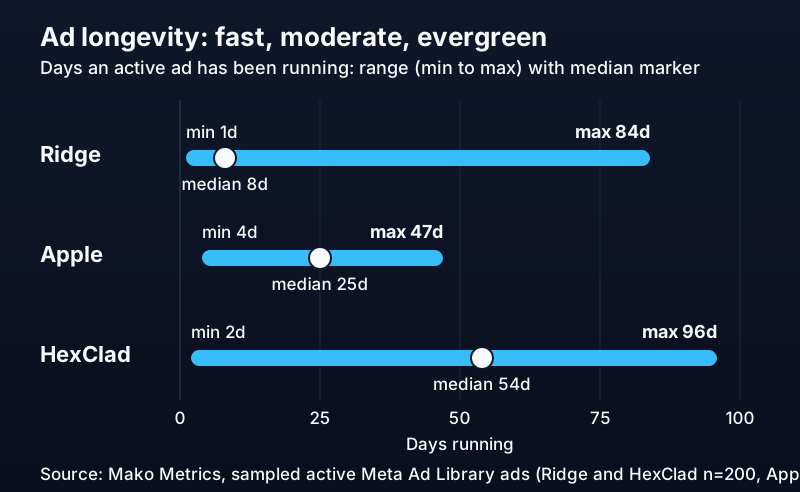
Ridge runs a high-velocity testing machine. It has 480 active ads, and the median ad has been live just 8 days. That is a team throwing a large volume of creative at the wall, killing fast, and keeping the rare survivor that reaches 84 days. The library is mostly fresh tests at any given moment.
HexClad runs the opposite play. It has 260 active ads, and the median ad has been live 54 days. Fewer ads, far longer lives. That is a team that finds a proof-led winner and rides it for months before refreshing.
Apple sits in the middle, with a median ad age of about 25 days. It refreshes faster than HexClad but lets winners breathe longer than Ridge, which fits a brand that ships in product cycles: a wave of new creative at launch, then a steady burn as each ad earns its keep.
None of these is the "right" answer. They are different bets that depend on what your team can actually sustain.
Pick your lane
Match the play to your creative production capacity, not to whichever brand you admire most:
- High velocity (Ridge style): only works if you can produce and edit a steady stream of new creative every week. The cost is production load. The payoff is fast learning and less reliance on any single ad.
- Evergreen (HexClad style): works when you have found a proof angle that converts and can resist the urge to fiddle. The cost is concentration risk if your one winner fatigues. The payoff is efficiency and low production overhead.
- The trap: running like HexClad (few ads) but with Ridge's hit rate (most die fast), so you are always under-fed. If your ads rarely cross 30 days, you need either better angles or more volume, not both halfway.
Finding 4: The CTA follows the objective, not your taste
For the two pure direct-response brands, the call to action is settled. Ridge uses "Shop Now" on 100 percent of its ads. HexClad uses it on about 98 percent, with a handful of "Watch More" and "Learn More" on softer creative. When every ad has the same job, sell the thing, the button is not where the creative decisions happen.
That is useful because it tells you where not to spend your energy. Testing "Shop Now" against "Buy Now" on a cold conversion ad is not where your gains live. The hook, the first three seconds of the video, the proof in a static, the offer: that is where long-lived ecommerce ads earn their run-time.
Apple is the brand that shows why. It splits its calls to action almost evenly, roughly 54 percent "Learn More" and 46 percent "Shop Now," because its ads are doing two different jobs. The "Learn More" ads sell a new capability: "The thinnest iPhone ever, powered by the ever capable A19 Pro chip." (Library ID 1418750029546423). The "Shop Now" ads push a transaction: "Trade In. Upgrade. Save. Save on a new iPhone by trading in your current phone." (Library ID 923507553752116). Same advertiser, same product, different objective, different button.
So match the CTA to the job each ad is doing, not to a habit. If you copy Apple's button mix, remember it can afford "Learn More" because demand already exists; people go looking for the new iPhone. If your brand does not have that pull yet, bias toward the direct "Shop Now" ask that Ridge and HexClad live on, and earn the softer call to action once you have the recognition to back it. That gap, between what a household name can run and what a challenger should run, is the difference most "copy the big brand" advice misses.
How to use this on your own creative
You do not need our data to act on this. You need to change how you read a competitor's Ad Library.
The four-step read
- Vet by run-time before you copy anything. Sort the competitor's ads by how long they have been live. Ignore the pretty ones that just launched. Study the ones that survived.
- Match format to the job, not the trend. Ask what the surviving ad needs to do: demonstrate a feature or borrow a creator's trust (lean video), or prove a considered purchase at a glance with reviews and specs (lean static). Copy the job, then choose your own format.
- Choose a velocity lane you can sustain. Decide whether you are running high-volume testing or riding evergreen winners, and staff your creative pipeline to match. Do not run an evergreen budget with a testing brand's expectations.
- Look for repeated patterns, not single screenshots. One long-running ad is a data point. Three long-running ads that share an angle is a brief. Build from the pattern.
And remember that none of these winners last forever. Even a 96-day ad is on a clock, which is why tracking when a competitor's long-runner finally drops off, or when your own does, matters as much as finding it. That is a different signal worth watching: creative fatigue in Meta ads shows up first in the survivors.
What winning ecommerce Meta ad creative has in common
Strip away the format debate and the takeaways are simple. Longevity is the signal: let run-time, not taste, tell you which competitor ads are working. Format follows the job: video to make a feeling, proof-led static to earn trust in a considered buy. Velocity is a deliberate choice between fast testing and evergreen winners, and you should pick the one your team can feed. And the CTA is mostly settled for direct response, so put your creative energy into the hook and the proof instead.
The next time you open a competitor's Facebook ads, sort by how long each one has run before you judge a single image. The list rearranges itself, and so does what you decide to build next.