
You open Meta Ads Library, type in a competitor that just took your category, and 200 cards load. You scroll. Five minutes later you've read four ads and learned nothing. That's the wrong way to read a giant's playbook. This OLIPOP Meta ads teardown does the read for you.
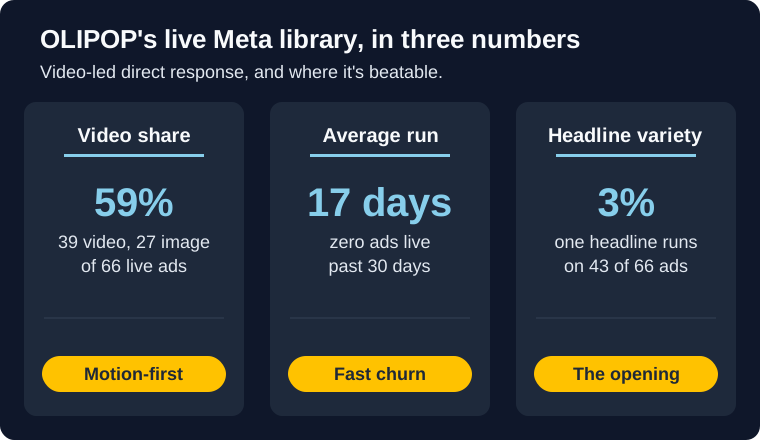
We pulled OLIPOP's full active library on May 25, 2026: 66 of 68 live ads, with copy, CTA, days running, and media files. Volume alone tells you almost nothing. The pattern inside the volume is the read worth paying for, and that pattern tells a challenger exactly what to do next. The short version: video-led, one theme on repeat (gut health), fast churn, single CTA. That stack works at OLIPOP's scale. It also leaves three clean openings any focused DTC brand can flank. This post walks each one with the actual ads and the moves to test against them.
The five findings, up front:
- Video is 59% of the mix (39 video / 27 image). Motion-first on Reels and Stories.
- One theme, repeated hard: gut health and fiber, 13 of 66 ads, with a memorable category-contrast line.
- Fast churn: avg 17 days, median 20, zero ads past 30 days, 24 launched in the last two weeks.
- The real opening: 3% headline diversity, "Shop Now" on every captured CTA, ~1 variant per ad.
- The plays: own an adjacent theme, add funnel-stage CTAs, out-iterate them on hooks.
How We Read OLIPOP's Library (The Method, In One Pass)
Most coverage of OLIPOP's marketing strategy recaps press releases. We did not. We hit the Meta Ad Library page for OLIPOP's Facebook ads, sorted by total impressions, and pulled every active ad. For each one we captured the body copy, the link card (display URL, headline, description, CTA), the started-running date, days running, and the actual creative file (image or video poster).
Run details, so the post is reproducible:
- Source: facebook.com/ads/library?view_all_page_id=162352551085006, country=ALL, active ads.
- Pulled: 2026-05-25.
- Captured: 66 of 68 active ads (97%).
- CTA capture gap: 23 ads show a blank captured CTA because the link card did not render in our pull. That is a scrape limitation, not a claim about OLIPOP's strategy.
Every number below traces to that pull. Every quoted line is verbatim. Every Library ID below links to the live ad.
Finding 1: OLIPOP Is a Video-First Advertiser (59% of the Mix)
Of the 66 active ads, 39 are video and 27 are static image. That's a 59/41 split tilted to motion.
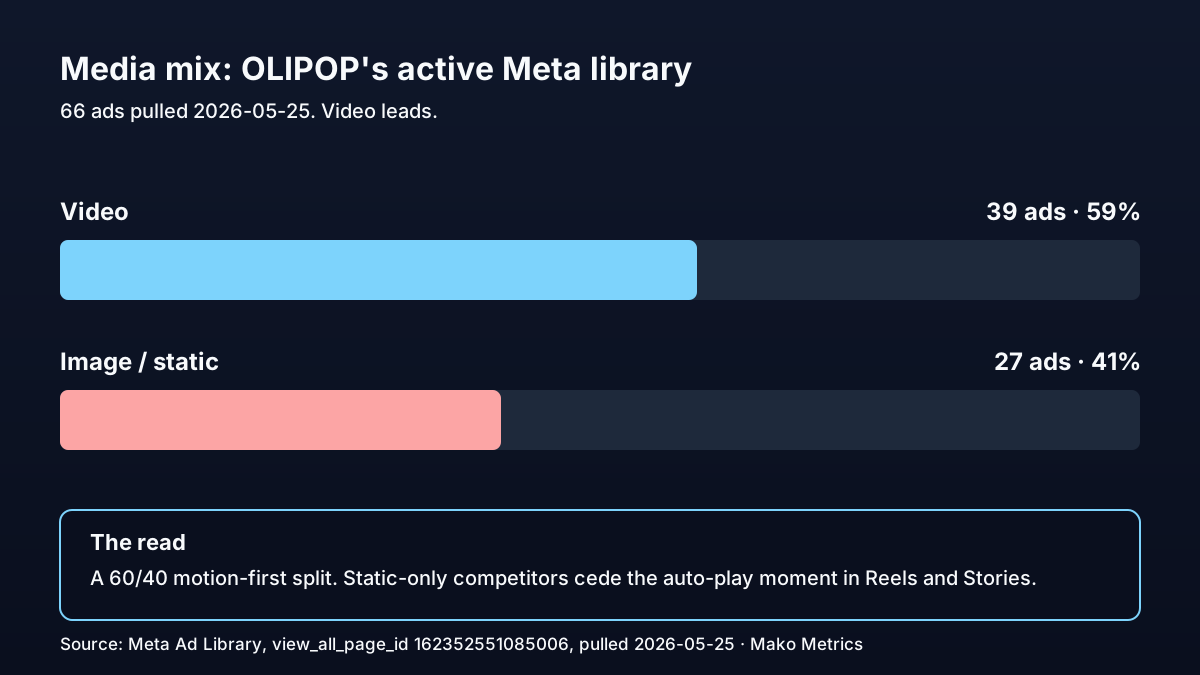
That tilt isn't a coincidence. Reels and Stories auto-play. Feed posts increasingly do too. A 59% video library tells you OLIPOP is buying attention in placements where motion wins by default, then letting the algorithm sort. This lines up with what we've seen across DTC libraries generally: video tends to dominate the volume side of any large advertiser's mix.
If you run static-only against a competitor with a 60/40 motion split, you are conceding the auto-play moment in their best placements. You do not need a film crew. You need one talking-head clip, one product-demo loop, and a willingness to let Meta find which one earns. The bar to enter motion is lower than the cost of being absent from it.
Look at the videos themselves. The longer-running ones lean UGC-style: a person holding the can, a casual voice-over, and a single stat overlay. They look operator-built, shot on a phone rather than in a studio. That matters for budget planning. A 30-second studio shoot can cost more than three months of UGC creator fees, and OLIPOP's longest-flighted ads suggest the cheaper format is also the one earning the longest impressions.
One last note on video before Finding 4 contradicts the easy reading: volume alone is not a moat. OLIPOP's video count hides a creative pattern that's anything but disciplined. Don't read this section as "video wins." Read it as "if you're not running any, that's your first leak."
Finding 2: One Theme, Repeated Hard. Gut Health.
The biggest creative signal in OLIPOP's library is the message concentration. Thirteen of 66 ads hit the gut-health and fiber angle directly, and the language is nearly identical across them. The runner-up themes (price/value, offer, category contrast) sit at one to three ads each. This is a single-bet creative strategy with one big idea.
Three lines worth studying, exactly as they run:
- "Don't be like the 90% of Americans who don't get their daily fiber." (Library ID 3758219174333727, video, 26 days running, "Shop Now")
- "Did you know 90% of Americans don't get enough fiber in their diet?" (Library ID 896050800150591, video, 26 days)
- "Other sodas focus on vibes. OLIPOP focuses on digestive health." (Library ID 951332841084120, video, 26 days)
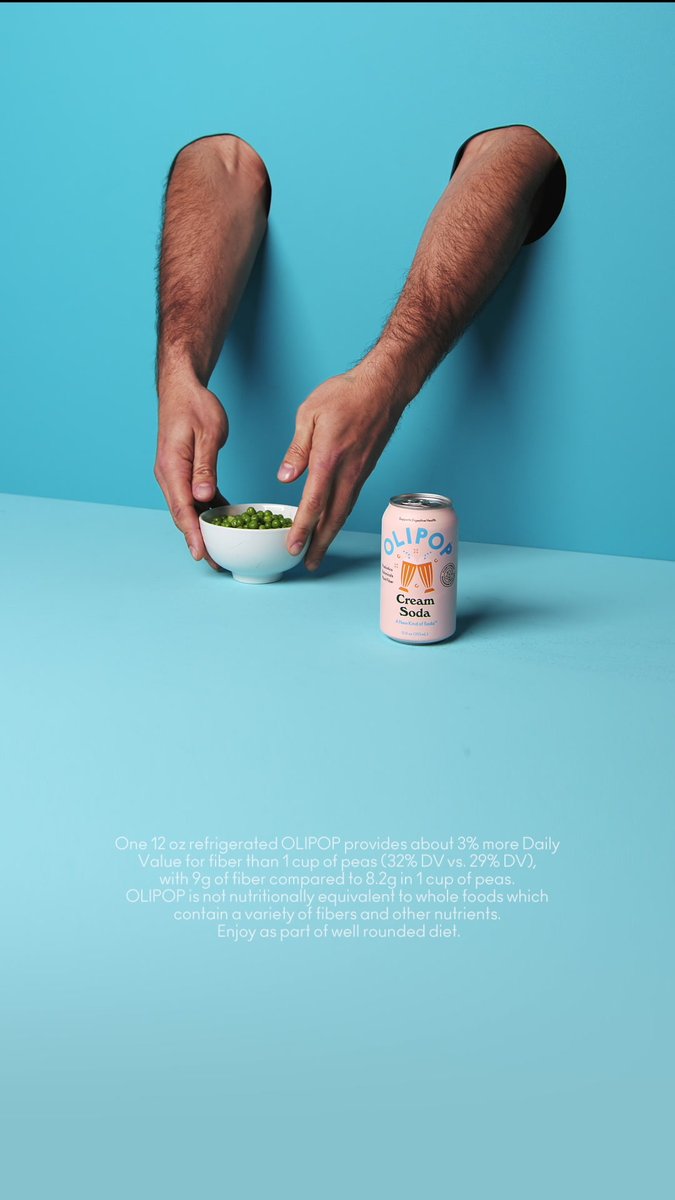
Two things stand out. First, a specific, urgent stat carries the load. "90% of Americans" is the number doing the persuasion, and it's a stat the reader half-believes before they read the ad. That's how good direct-response math works. Second, the third line is the most defensible positioning sentence in the library. "Other sodas focus on vibes. OLIPOP focuses on digestive health." That is a 10-word category claim. If you were briefing copy against them, that's the sentence you'd want to render obsolete.
Most brands at OLIPOP's volume would dilute across five angles. They picked one. You can disagree with that choice. You cannot say it isn't a choice. If you want the method for turning a competitor's repeated hooks into your own brief, we wrote that up separately.
The trap on this strategy shows up in Finding 4.
Finding 3: Fast Churn. Nothing Lives Past 30 Days.
OLIPOP refreshes their library quickly.
- Average days running: 17.
- Median days running: 20.
- Duration buckets: 9 ads under a week, 57 in the 7-29 day window, 0 past 30 days.
- Recent launches: 24 ads went live in the last 14 days.
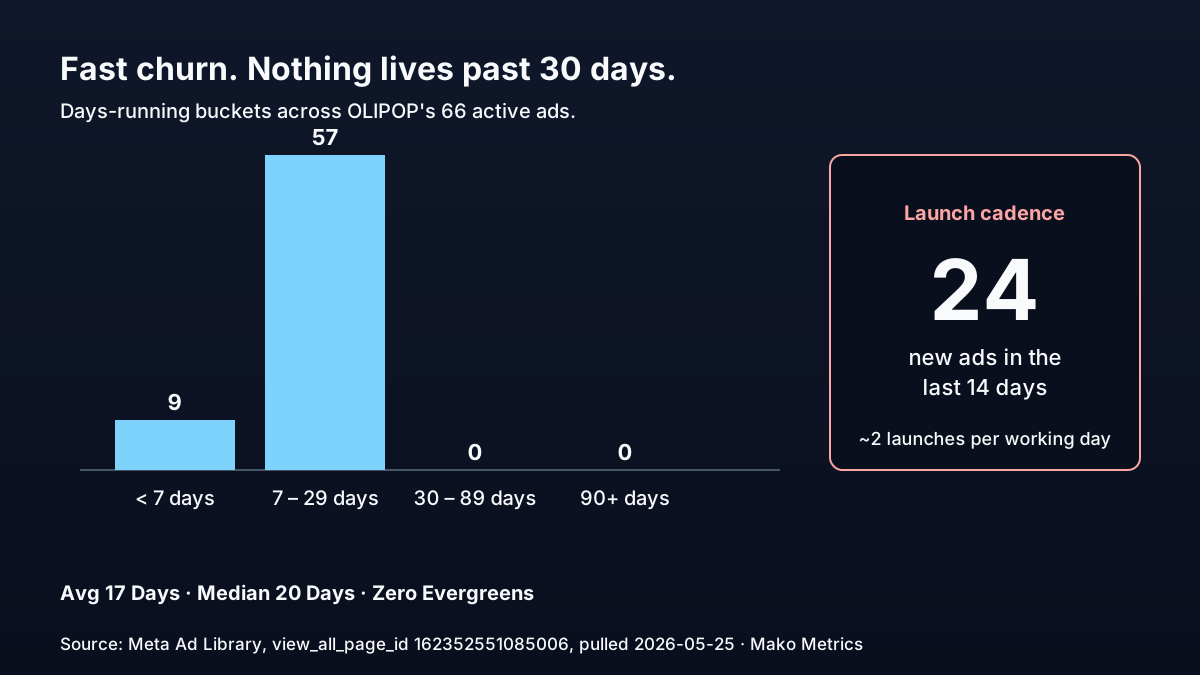
Read that bucket distribution carefully. There is no evergreen tier. OLIPOP is not running anything that's earned the right to keep running. Either they're killing winners early (unlikely at this scale), or the library is churning because nothing has stood up to enough frequency to deserve a longer flight. Given the headline data in Finding 4, the second read is more plausible.
For a competitor, this changes how you monitor them. A one-time audit is outdated within two weeks. If you're tracking OLIPOP as a comparable, watch them on a recurring cadence (a saved Ad Library tab, a weekly note in your competitive doc, or a recurring Mako pull). Treat any specific creative read as fresh produce, not canned.
There is a second read here that's about your own account, not theirs. Twenty-four launches in 14 days is a batch process, not the output of an "ad team of fifty." The math is roughly two creatives per work-day, which is achievable for one in-house producer plus a UGC creator network, or for a small agency running on a weekly creative cadence. If you've been telling yourself you can't keep up with the volume of a category leader, OLIPOP's library is the counter-example: it's volume, but it's also repetition, and repetition is cheap. You can match their throughput with a fraction of the headcount if you accept that most launches are minor variations.
If your account is in the band where creative fatigue compounds fast, the lesson cuts the other way: a 2-3 week refresh cadence is the floor, not the ceiling.
Finding 4: The Real Opening. Repetition Without Diversity.
This is the section a challenger should read twice.
OLIPOP runs a lot of ads. Under the hood, those ads are running the same copy. Three numbers from the pull:
- Headline diversity ratio: 0.03. Three percent. The most-repeated headline appears on 43 ads.
- CTA: a "Shop Now" monoculture. Of the 43 ads where we captured a CTA, every one of them said "Shop Now." Nothing pointed to "Learn More," "See How," or anything mid-funnel.
- Median variants per ad: ~1. Few ads carry visible in-modal A/B copy variants. Most are a single creative.
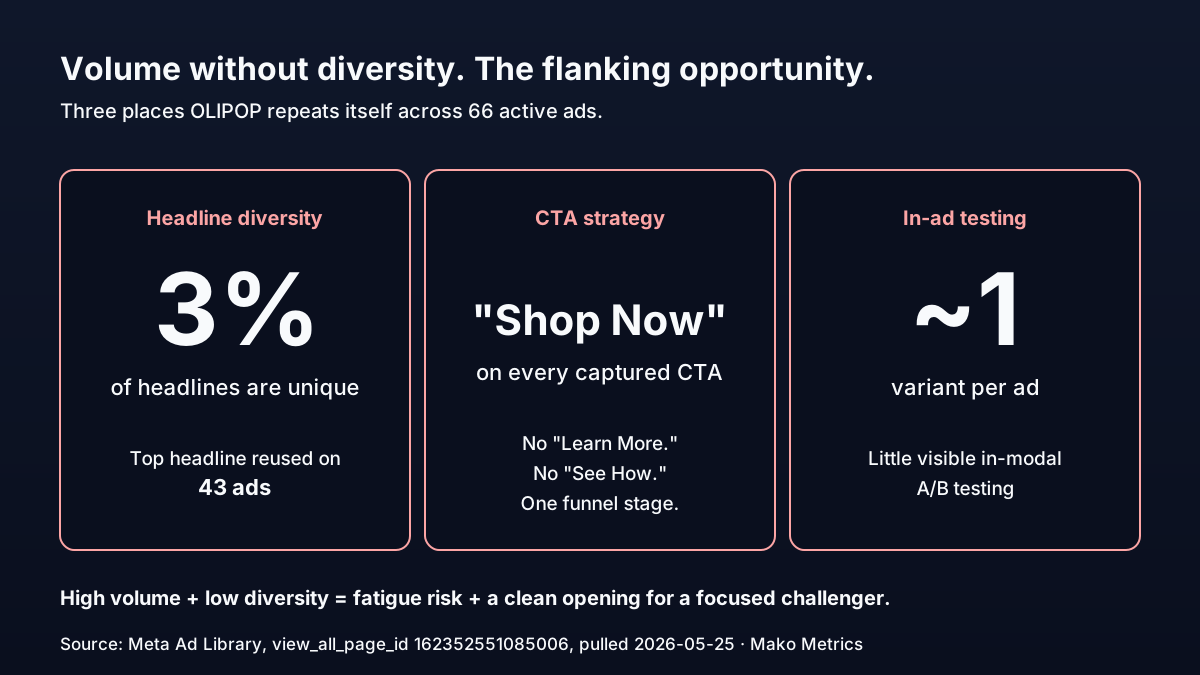
Stack those together. High volume, fast churn, low diversity, single funnel stage. That's a library optimized for one motion: get a known buyer to a Shop Now click on a fiber stat. Inside that motion, it's tight. Outside of it, there is no library. No awareness funnel. No category-education arc. No comparison play. No price/value workhorse. No claim variation to keep frequency healthy on the buyers who already saw the fiber hook last week.
Call it a budgeting choice, not sloppiness. OLIPOP has earned the right to spend on prospects who will convert on a fiber stat. Most challenger brands haven't earned it, so a different play wins for them.
The asymmetric move shows up in the three counter-positioning sections below.
Want this same teardown on your actual competitor?
The pull above took our pipeline about an hour and produced a 27 MB deliverable: 66 real ads with copy, CTA, days running, local media files, a filterable HTML catalog, and a PDF report. We did it for OLIPOP because it's a clean example. We do it for any active Meta advertiser you name.
Look at a sample first. No login, no card.
Read OLIPOP's Library Like a Filterable Database
The Meta Ad Library page is the source of truth. It's also a scroll, not a database. Half the work of a teardown is forcing the data into a shape you can filter against. For this run, we did that automatically: every Mako report now ships an offline, filterable HTML catalog alongside the PDF.
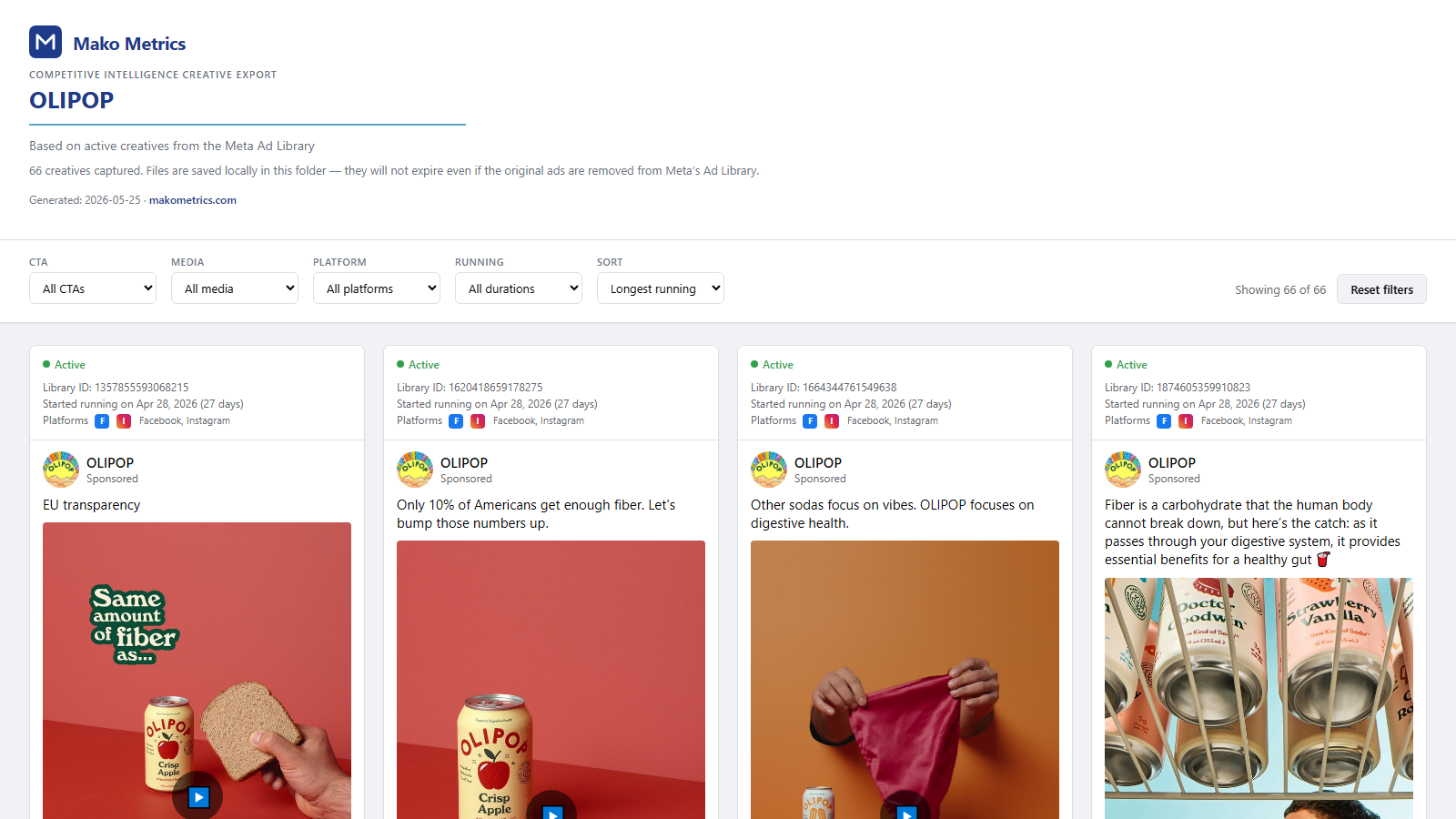
Three filters worth trying first against any library you pull:
- Media type = video, sort by duration desc. For OLIPOP, every ad still running at 24 days or more is a video (13 of 13), and the fiber and gut-health hooks dominate that group. That tells you where their longest-conviction bets sit.
- CTA = Shop Now. When the filter returns "everything," you've found a funnel-stage gap. That's an opening in the same shape Finding 4 named.
- Duration bucket >= 7 days. Anything that survived OLIPOP's own kill threshold. Those are the angles they've decided to keep paying for.
Sixty seconds of filtering this way teaches you more about a competitor than an hour of scrolling. That is what the catalog is for: getting the operator to "what's the pattern" without the manual labor.
Three Counter-Positioning Moves a Challenger Should Test
Findings only matter if they change what you test next week. Three moves that map directly to the gaps above:
Move 1: Own an adjacent theme they under-run
OLIPOP is loud on gut health and fiber. They are nearly silent on energy, mood, sleep, and price/value. Functional beverages live in those rooms too. If you're a smaller brand in the space, build a three-ad test against one of those angles, with one clear stat carrying the load (the same trick they're using on fiber). The category-contrast frame they pioneered ("Other sodas focus on X. OLIPOP focuses on Y.") is reusable. Pick a Y they don't own.
A concrete example: an afternoon-energy angle. Three ads, same offer. Ad one opens with a stat about the 3pm crash and how often it kills the rest of the workday. Ad two does the category-contrast move ("Other functional sodas treat you like a gut. We treat you like someone with a 3pm deadline."). Ad three is a 15-second UGC clip of a creator drinking the can at their desk. That's a complete test set against an angle OLIPOP has run zero times. You're not competing for the same impression. You're occupying a room they walked past.
Move 2: Add funnel-stage CTAs
If "Shop Now" is the only CTA your competitor runs, an awareness-stage CTA is free real estate. Test "Learn More" or "See How" on top-of-funnel video, "Compare" on a consideration set, and reserve "Shop Now" for warm audiences. You're not abandoning direct response. You're catching the buyers OLIPOP isn't even talking to yet. The mechanics of reading a competitor's audience strategy from their copy patterns help here.
Move 3: Out-iterate them on hook diversity inside a single ad set
OLIPOP runs ~1 variant per ad. They are not stress-testing copy inside ad sets. You can. Run four to six distinct hooks per ad set, same audience, same offer, and let Meta sort. The hooks have to actually differ, not be the same sentence with a synonym. A fast formula that works: one stat hook, one objection hook ("I tried other functional sodas and..."), one founder/origin hook, one comparison hook, one outcome hook ("Two weeks in, what changed"). Five hooks, one creative each, same offer, same audience. Run the set for ten days. Read the results. Kill the bottom two. Replace with fresh variants. That cycle, repeated, produces a creative library OLIPOP isn't even attempting to build.
Their 3% headline diversity is an asymmetric advantage waiting for someone to claim. If our B2B teardown on Gusto reads as the same method on a different vertical, that's because it is. The Stripe teardown runs the same play on a 200-ad fintech library and finds the same shape of opening (CTA monoculture, slow refresh). To see OLIPOP's category run side by side, our DTC beverage benchmark reads Liquid Death, Celsius, and Ghost on the same dimensions. The pattern works.
The Closing Take
OLIPOP's Meta library looks like a giant. Pulled apart, it looks like a giant running a single, disciplined play at high volume. That play is working for them, and it is also legible. A focused challenger can beat OLIPOP on a budget by being the brand running the funnel-stage CTA OLIPOP skips, on the adjacent theme OLIPOP leaves uncovered, with the hook diversity OLIPOP never bothers to test. All of that takes careful reading rather than creative genius.
The takeaway is even simpler. The competitor you fear most is probably running fewer ideas than you think, and the room to flank them is bigger than you've been told.
If you want this read on a brand you actually compete with, that's what Mako Metrics builds.
By the Mako Metrics team. We pull Meta Ad Library data, turn it into operator-ready reports, and write the occasional teardown when the pattern is worth sharing.