
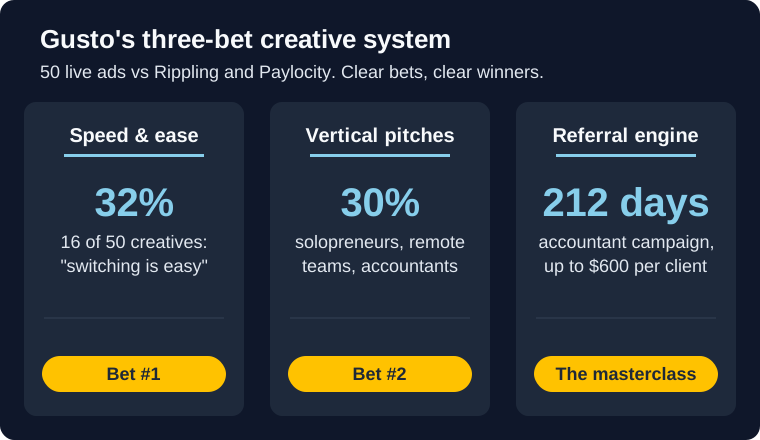
Gusto is running 50 active image ads on Meta right now. Nine of them have been live for more than 90 days, and one campaign cluster has been running for 212. That is a creative system with clear bets and clear winners.
I pulled 50 of Gusto's active ads from the Meta Ad Library on May 13, 2026, alongside Rippling (50 ads) and Paylocity (19 ads) for context. The plan: read what Gusto runs, name the strategy behind it, and call out where the comparison set exposes gaps. Every example below is verbatim copy from the actual ad, with a screenshot and a link back to the Library record. If you want the methodology, we covered it in our Meta Ad Library guide.
This is a creative read, not a performance read. Public data hides CPA and ROAS. What it does show is which bets a competitor is willing to defend with sustained spend, and that signal usually beats a conference panel.
TL;DR: Gusto's three-bet creative system
- Bet 1: Speed and ease drives 32% of creatives (16/50). "Switching is easy" is the dominant narrative.
- Bet 2: Vertical feature pitches drive another 30% (15/50), split cleanly between solopreneurs, remote teams, and accountants.
- Bet 3: A 212-day accountant referral campaign with five active creatives offering up to $600 per migrated client. The longest-running bet in the library.
- The gap: Gusto has almost no cold-traffic offer ladder outside the accountant program, and its CTA mix is "Learn More" or "Sign Up." Rippling shows what a richer offer and CTA strategy looks like.
The footprint: what Gusto actually runs on Meta
Pull Gusto's page in the Meta Ad Library and the first thing you notice is volume. 50 active image creatives in the scrape window, with an 80% headline diversity ratio. That means roughly 4 out of every 5 ads have a unique headline. For comparison, Rippling's diversity ratio is 44% in the same week.
The average primary text runs 110 characters. Short, punchy, mobile-first. The kind of length you can read in a thumb-stop.
Time-in-flight is where the operation really shows its age. Mean flight time is 70 days, the median is 35, and 9 ads have been running for more than 90 days. Neither Rippling nor Paylocity has a single ad past 90 days in this scrape. Gusto has nine.
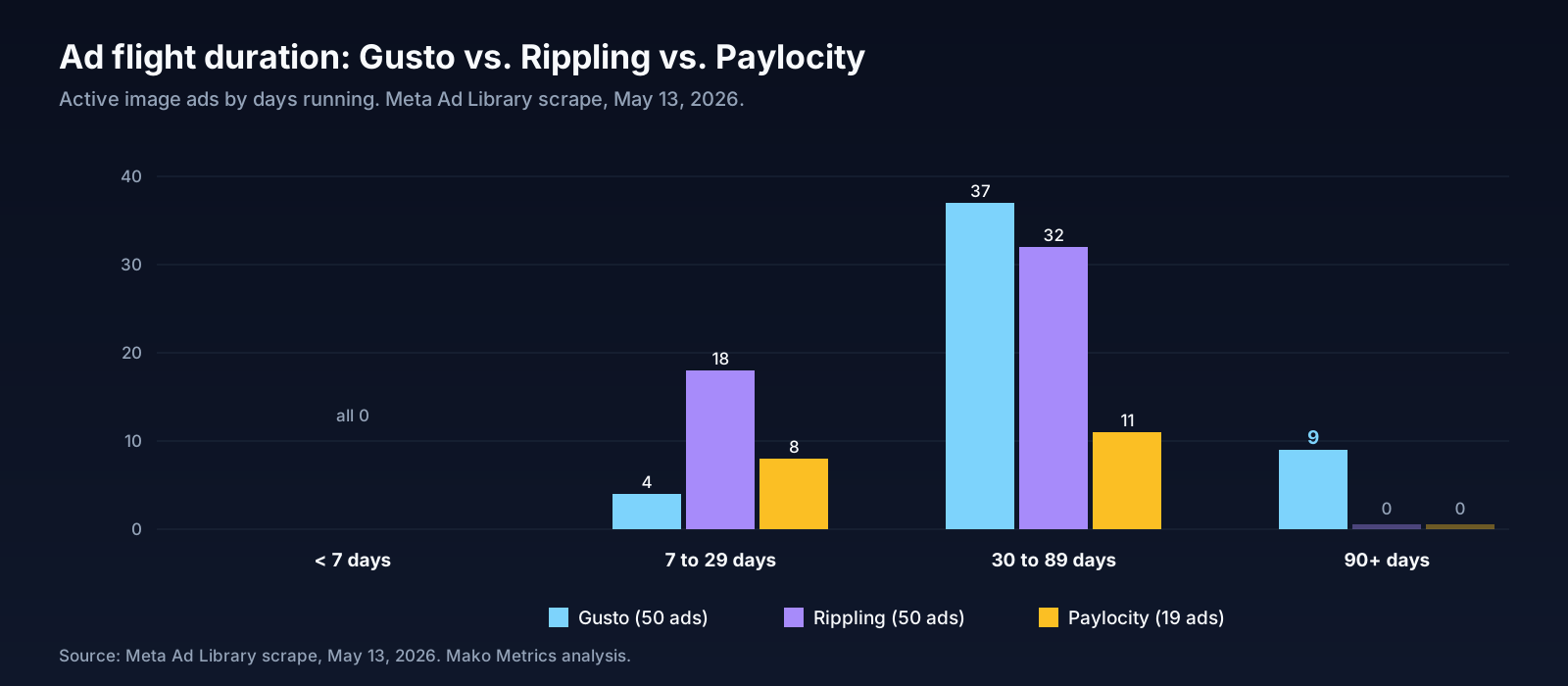
The takeaway from the footprint alone, before you read a single ad: Gusto runs a confident, mature program. They test broadly, they're not afraid to let winners ride, and they have enough budget to keep 50 creatives in active rotation. Most B2B SaaS teams I've seen can't keep one ad alive past 30 days. Gusto is operating in a different tier. It's the opposite end of the spectrum from our Verizon teardown, where the median flight was 5 days and 69 of 80 ads were under two weeks old.
Bet #1: Speed and ease as the north star
Sixteen of Gusto's 50 ads (32%) live in the speed-and-ease cluster. That's the largest single theme in the set, and it tells you what Gusto thinks the biggest objection in the payroll category actually is: switching is annoying, and customers stall.
Three verbatim examples:
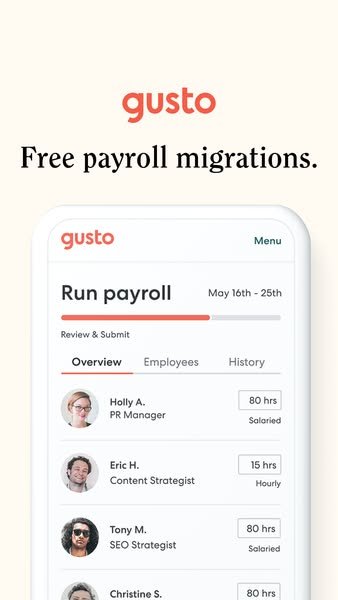
- "Switch to Gusto today. Join 400k businesses." Body: "Switching is easy! Join Gusto to seamlessly pay, insure, and support your team today." (Library ID 1615189103079575)
- "The clear way to close the year. Add clients. Earn cash. Simple!" (Library ID 933746495720104)
- "One login. Everything HR." (Body copy points to integrated payroll, benefits, and HR in a single platform.)
When a third of your active footprint repeats some version of "this is easy," you've made a strategic call. You've decided the buyer's blocker is friction, ahead of price, features, or proof. And every dollar of your media spend is going to argue against that one blocker.
That's worth copying if you're in a category with high switching costs (HR software, accounting, CRM, anything with data migration). It's worth questioning if you're in a category where buyers actually want more depth, not more simplicity.
Bet #2: Vertical feature pitches
Another 30% of Gusto's ads (15/50) are feature-led. What makes this cluster interesting isn't that Gusto runs feature pitches. Everyone runs feature pitches. It's that Gusto splits them cleanly by audience.
Three audience clusters show up in the data:
- Solopreneurs: "GUSTO.COM/SOLO Automated payroll for solopreneurs." Body: "Save hours on compliance and thousands on your taxes as an S-corp. Try Gusto Solo today." (Library ID 1940606943288700)
- Remote teams: "HR for Remote Teams." Body: "Your HR toolbox just got bigger. Now go build an even stronger team!" (Library ID 952248017213139)
- Accountants and bookkeepers: the entire 212-day cluster we'll cover next.

Each cluster reads like it routes to its own landing page. Gusto Solo gets a /solo URL. Remote teams gets HR-toolbox positioning. Accountant ads route into a partner program. This is exactly the audience-and-landing-page coherence we cover in our piece on how to reverse-engineer competitor targeting. When you see distinct headline patterns mapping to distinct URL paths, you're looking at a deliberately segmented funnel.
Most competitors in adjacent categories run one feature pitch at everyone. Gusto runs three feature pitches at three different audiences, each with its own copy register. If you only steal one thing from this post, steal the discipline of writing ads for one audience at a time.
Bet #3: The 212-day accountant referral campaign
This is the most under-discussed pattern in Gusto's footprint. Five different creatives in the "Add clients. Earn cash. Simple!" family have been running for 212 days. Not 21. Two hundred and twelve.
The five verbatim headlines:
- "Your year-end cash reward is waiting Add clients. Earn cash. Simple!"
- "Get through year-end and get rewarded Add clients. Earn cash. Simple!"
- "Turn year-end pain into a big cash gain Add clients. Earn cash. Simple!"
- "Serve your clients while Gusto serves up the cash Add clients. Earn cash. Simple!"
- "Your big payout for adding new clients Add clients. Earn cash. Simple!"
The body copy quotes the offer directly: "Help clients switch to Gusto this season and enjoy streamlined reporting, automation, and rewards up to $600 per client." (Library ID 1453261246255009)
A 200-day flight is rare. It usually means three things are all true at once. First, the offer lands. $600 per migrated client is real money for a bookkeeper with a book of 20 small businesses. Second, the audience is tight. Accountants and partner-program prospects are a defined, lookalike-able segment, which makes the ad set easier to scale without saturation. Third, the creative is durable. Five variations on the same hook keep the unit fresh enough that Meta's auction can rotate without burning the angle.
That last point matters. Look at the headlines again. Same offer, five different ways in: cash reward, get rewarded, big cash gain, serves up the cash, big payout. Same body, different first impression. This is what creative refresh looks like when you have a winner and you don't want to break it. We've written about the opposite problem in our creative fatigue detection playbook. The 212-day campaign is the inverse case: how to keep a winner alive instead of letting it die.
Want this kind of teardown on your own competitor? Browse our sample competitor reports to see the format, built from the same Ad Library scrape and cluster analysis we used to write this post.
Gusto vs. Rippling vs. Paylocity, head to head
Reading Gusto in isolation tells you Gusto. Reading Gusto next to two adjacent payroll and HCM brands tells you what's a category pattern and what's a Gusto choice.
The 4-column comparison
| Metric | Gusto | Rippling | Paylocity |
|---|---|---|---|
| Active image ads (in scrape) | 50 | 50 | 19 |
| Headline diversity ratio | 80% | 44% | 68% |
| Mean days in flight | 70 | 37 | 50 |
| Ads at 90+ days | 9 | 0 | 0 |
| Avg primary text length | 110 chars | 121 chars | 101 chars |
| Dominant theme cluster | Speed / ease (32%) | Offer / promotion (24%) | Feature-led (63%) |
| Top CTAs (raw mentions) | Learn More (62), Sign Up (40) | Learn More (88), Download (11), Book a Demo (6) | Learn More (38) |
Three patterns jump out.
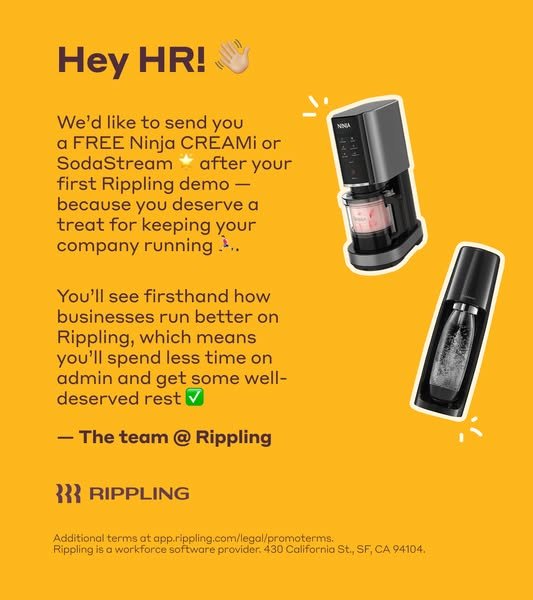
Rippling bets on offers. Their largest theme cluster is offer/promotion at 24%, and the offers themselves are aggressive. "Demo Rippling -> Choose Your Free Gift", "Book a Demo & Get Free AirPods", "Claim Your 6 Free Templates". Those are bottom-funnel hooks with real material value attached. Gusto has nothing comparable on the cold-traffic side. The accountant program is offer-led, but it's gated to a partner audience.
Rippling diversifies CTAs. Three CTAs in regular rotation (Learn More, Download, Book a Demo) means Rippling has built funnel stages for three different intent levels. Download captures a name in exchange for a lead magnet. Book a Demo is for high-intent prospects. Learn More handles everything else. Gusto runs essentially two CTAs, both of them ambiguous about intent.
Paylocity is over-rotated on features. 63% of Paylocity's ads are feature-led, and they all route to a single CTA: Learn More. That's the trap Gusto is avoiding. Paylocity does have one strength worth noting: a customer-story cluster with named brands. "See Why Scrub Daddy Loves Paylocity" and "See Why Tonal Loves Paylocity. From a 3-day payroll process to just 4 hours." Those are proof points with quotable outcomes. Gusto's social-proof cluster is thinner (7 ads, mostly badges like "G2's #1 Product for Small Biz") and could use the named-customer treatment.
If you're in this space, the read is clear. Gusto wins on creative discipline and longevity. Rippling wins on offer aggression and CTA diversity. Paylocity wins on named-customer storytelling but loses on every other axis. There's no single best operator here. There are three different bets, and each one has a teachable lesson. We unpacked this kind of cross-brand reading in our competitive audit deliverable guide.
What's working for Gusto
Three things Gusto is doing that the comparison set isn't.
Headline diversity at 80%. Out of 50 ads, roughly 40 have distinct headlines. Rippling repeats "See Rippling In Action" more than 10 times in their 50-ad set, which drags their diversity ratio to 44%. High diversity tells you Gusto is actively testing new hooks instead of stamping out copies of last quarter's winner. That's the engine that produces the 212-day breakout in the first place.
The discipline to age winners past 90 days. Nine ads in the 90+ bucket is a quiet flex. Most teams I've worked with either kill winners too early (frequency fear, recency bias from the dashboard) or starve them by chasing new creative every two weeks. Gusto keeps winners running because they trust their own evidence. That's a culture decision more than a media decision.
Tight 110-character body copy. Mobile-readable, thumb-stoppable, no padding. Paylocity is even tighter at 101 characters and that's worth studying too. Rippling at 121 isn't catastrophic but it's the longest of the three and probably leaves CTR on the table for cold audiences.
What Gusto could be doing better
This is where the comparison set earns its keep. Four specific gaps.
The cold-traffic offer ladder is thin. The 212-day campaign is offer-driven, but it's gated to accountants. For cold prospects who aren't in the partner program, Gusto has almost no material offer. Compare to Rippling: "FREE Kindle or Theragun is yours after your first Rippling IT demo!" or "Get 6 free templates to help you run better check-ins, reviews, and developmental conversations." Those work because they create a low-stakes first action. Gusto's cold-traffic ads ask the prospect to switch payroll providers, which is a high-stakes ask with no soft alternative.
The CTA mix is a monoculture. Of all the CTA phrases in Gusto's ads, "Learn More" appears 62 times and "Sign Up" 40 times. "Get started" shows up twice. There's no Download, no Book a Demo, no Try Free. That means Gusto has no funnel layer between "tell me more" and "give me your credit card." A free downloadable for the small-business owner audience (year-end checklist, S-corp tax guide, payroll mistakes audit) would fill that gap and create a retargetable lead list.
No video creative in this scrape. Every ad in the sample is image-led. That's a category pattern, not just a Gusto thing. Rippling and Paylocity are both image-heavy too. But a category-wide gap is also a category-wide opportunity. One reasonable test next quarter: a 15-second explainer video for the Solo product or the accountant program.
The "Real people. Real help." ad is orphaned. Gusto's pain-point cluster has exactly one ad in it, the one headlined "Real people. Real help." That's a meaningful angle, especially for buyers who've been burned by software-only support models. Either kill it and reallocate the budget, or build it into a three-to-five-creative pillar with real founder quotes and named support stories.
Five moves you can run this week
The point of any teardown is to translate it into your account by Monday.
- Audit your headline diversity ratio. Pull your last 60 days of Meta ads, count unique headlines, divide by total. If you're under 60%, you're under-testing. Gusto's at 80%. Aim for at least 65% inside a quarter.
- Find your $600 offer. What's the one offer that could justify keeping an ad alive for 200 days? Gusto's is $600 per migrated client to accountants. Yours might be a free audit, a credit, a referral bounty, or a guaranteed-results clause. If you can't name one, that's your most important strategy question this quarter.
- Build one vertical cluster. Pick one customer segment with a distinct pain. Write three creatives, point them at a segment-specific landing page, run them as their own ad set. Use Gusto Solo as the model: one audience, one offer, one URL.
- Test a video this week. Even one. Doesn't have to be expensive. A 15-second screen recording with a voiceover beats no video. If your category is image-heavy, motion is the gap.
- Diversify your CTAs. Add a Download CTA pointing to a real lead magnet, even if it's a simple PDF. You'll get a retargetable email list and a funnel stage that doesn't exist today. Rippling proves the playbook works in adjacent B2B.
You can also use our free competitor research checklist to systematize the weekly version of this work.
Closing
Gusto runs a three-bet system: speed and ease for cold prospects, vertical feature pitches for defined audiences, and a 212-day offer-driven campaign for accountants. The system works because each bet is anchored to a specific audience and a specific stage of decision pressure, and because Gusto's team has the discipline to let winners age past 90 days instead of killing them out of nervousness.
The system also has gaps. No cold-traffic offer ladder, a CTA monoculture, no video, and an orphaned pain-point cluster. Rippling and Paylocity each show what the alternative bets look like. None of these brands is the single right answer. They're three different operators with three different theories of the buyer, and reading all three at once is more useful than reading any one of them in a vacuum.
This is a creative read, not a performance read. Don't confuse "ad ran for 212 days" with "ad has the best ROAS." Performance answers require account access. Creative reads are the public layer of the strategy, and they're often more honest than what shows up on a panel slide.
Mako Metrics' Competitor Snapshot ($24.99) gives you the same Meta Ad Library scrape, theme scoring, and editable brief I used to write this teardown. Hand us a competitor, get back a report like this one. See pricing or see sample reports on a few brands first.