
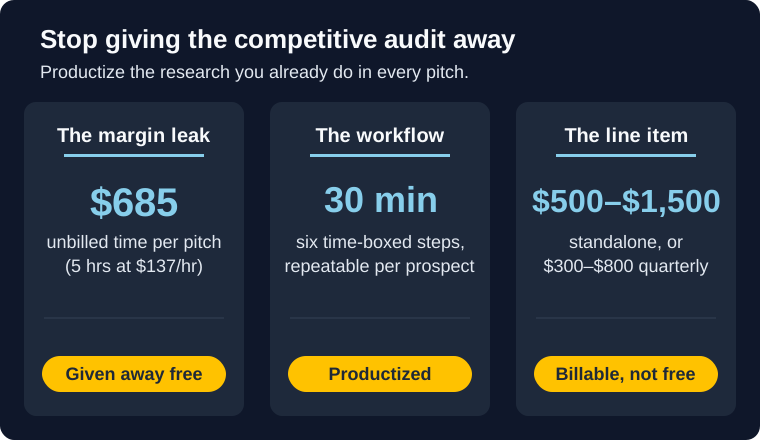
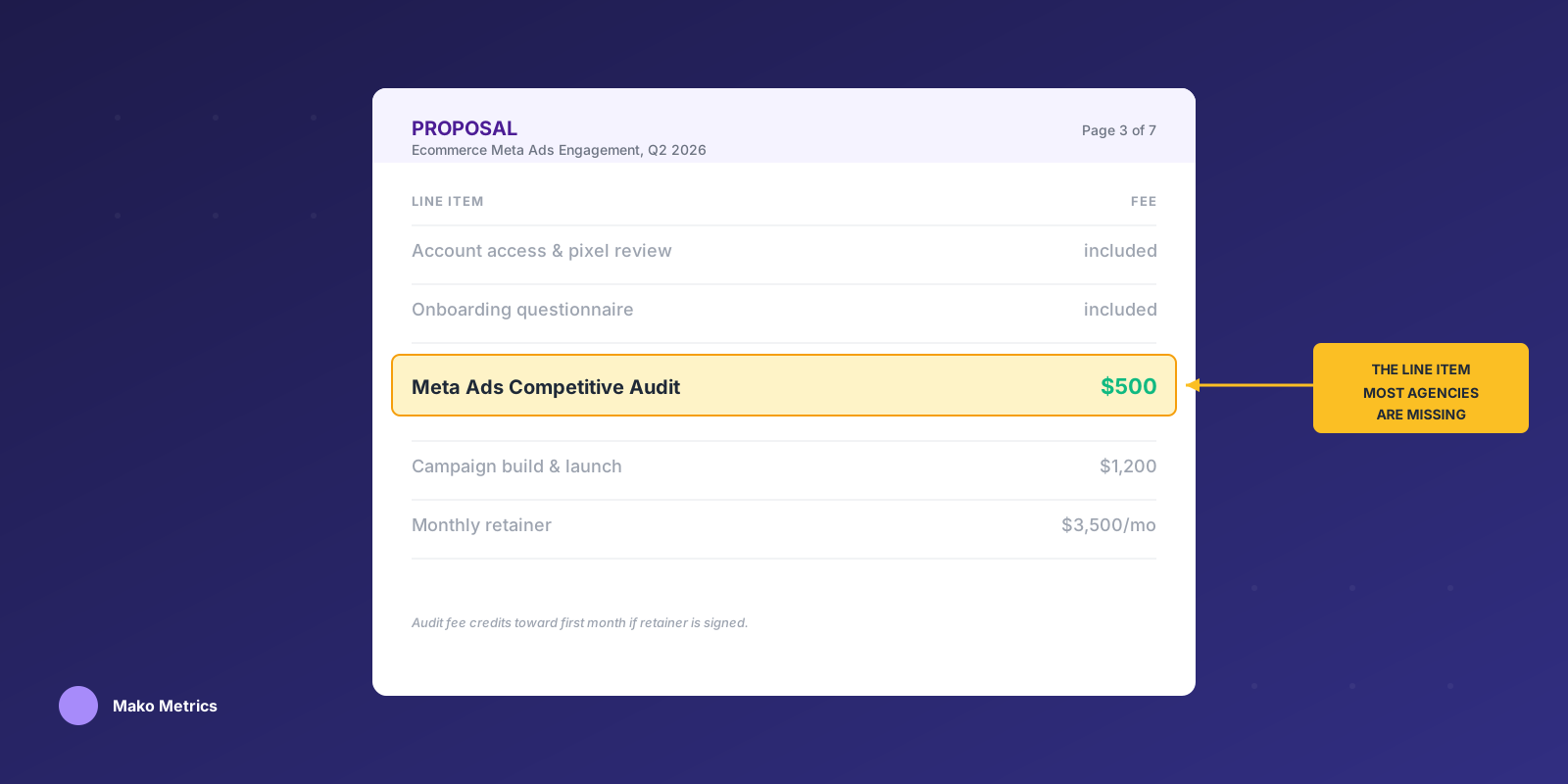
Every ecommerce agency I talk to runs the same play: 4 to 6 hours of unpaid competitive research before a contract is signed, dropped into a pitch deck, then either credited toward a setup fee or written off when the prospect ghosts. That research is the single most defensible thing the agency produces during the sales cycle, and most shops give it away. A Meta ads competitive audit is the deliverable, not the pre-work.
This post lays out how to productize the audit, run the production workflow in 30 minutes, structure the deliverable as a client-ready PDF, and price it as a real line item. If you're doing this work for free during pitches, you're leaving five figures a year on the table.
Bottom line
- Pitch-stage competitive research is a margin leak. 4–6 hours per prospect at agency rates ≈ $1,000+ in unbilled time per signed client.
- What the deliverable contains: defined competitor set, creative landscape, longevity signals, exploitable gaps, and 3–5 prioritized recommendations.
- Production target: 30 minutes. Six steps, time-boxed, repeatable on any prospect.
- Pricing models: $500–$1,500 standalone, $1,000–$2,000 bundled into setup, or $300–$800 quarterly recurring.
- The mistake that kills the model: shipping data without judgment. Recommendations are what clients actually pay for.
Why agencies are bleeding margin on free competitive research
Doing competitive research before the contract is signed is one of the worst-defended margin leaks in the agency P&L, and almost nobody talks about it.
Run the math. The average Facebook ads agency rate is around $137/hr. A serious competitive workup, the kind that actually moves a pitch forward, takes 4 to 6 hours: pulling competitor ads, sorting by format and angle, noting longevity, building a creative recap, drafting a recommendations slide. Call it 5 hours. At $137/hr, that's $685 of agency time per prospect. If you're pitching 4 prospects a month and closing one, you've given away roughly $2,700 of work to land a client whose first month of retainer might be $3,000. That's a 90% discount on month one, not a sales investment.
It gets worse if you actually deliver the research. Pitch decks with competitor screenshots and creative recommendations are easy to lift. The prospect thanks you, says they need to "talk internally," and you watch them launch a campaign with your angle six weeks later. Agency Twitter is full of this complaint. The Midsummer Agency team has written about spending 20+ hours weekly on competitive research, most of it folded into pitches and onboarding without a clear billable line.
So why does every onboarding playbook still treat competitor research as background prep? Because the dominant agency content tells them to. The OrangeTrail Facebook Ads Client Onboarding Guide, which ranks for the queries every new agency owner reads, walks through five onboarding phases without mentioning competitive analysis once. The deliverable framing simply isn't in the air.
Here's the position: stop doing free competitive research during pitches. Productize it. Charge for it. Let it be the first paid thing the prospect ever buys from you, before the retainer signs.
What a productized Meta ads competitive audit actually is
Before workflow or pricing, the deliverable needs a clean definition. A productized Meta ads competitive audit is a fixed-scope, fixed-price PDF report on a defined set of competitor brands' Meta advertising activity, structured around what the client should do with the findings. It is a billable artifact, distinct from an account audit and from a generic competitor research dump.
| What it is | What it isn't |
|---|---|
| A scoped, paid deliverable with a fixed price | A free pitch sweetener |
| Focused on competitor advertising activity | A full account or pixel audit |
| Built around a defined competitor set (4–6 brands) | An exhaustive list of every brand in the category |
| Anchored by 3–5 prioritized recommendations | A raw export of competitor ads |
| Delivered as a client-ready PDF | A Google Doc with screenshots |
| A standalone product OR week-1 deliverable | A pre-sale freebie absorbed into setup |
The pricing context backs this up. Linear Design's agency pricing guide puts one-time audit projects in a $500–$5,000 range industry-wide. PricingLink's breakdown of Facebook ads agency pricing models shows setup fees of $500–$7,000 explicitly covering market and competitor analysis as scoped work. The market already pays for this. Most agencies just don't charge for it.
The deliverable framing matters because it changes how the client receives it. A free pitch deck reads as marketing. A $750 audit PDF reads as work. The same screenshots, the same recommendations, the same hour of effort, but one signals "we did this to win you" and the other signals "you hired us, here's the first thing you bought."
The 30-minute production workflow
This is the operational core. The reason this whole model works is that the audit, properly scoped, produces in 30 minutes. Not 30 minutes of focus time on a heroic day. 30 minutes on a Tuesday afternoon while you're also returning a Slack message.
The workflow is six steps. Time-boxed.
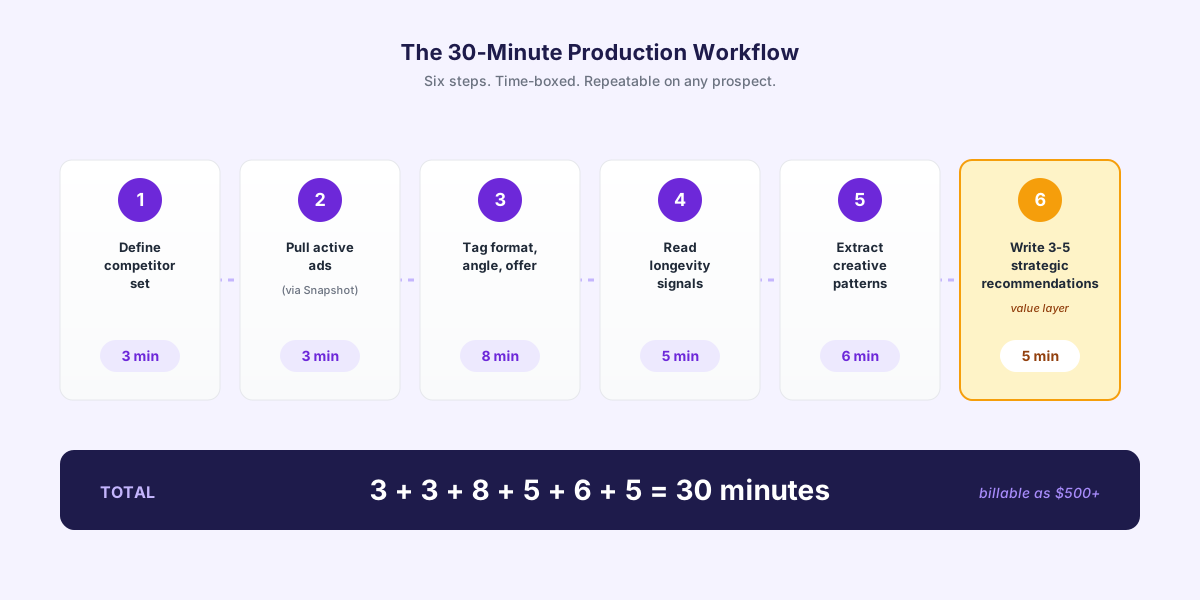
Step 1: Define the competitor set (3 minutes)
Pick 4 to 6 brands. Two direct competitors (same category, similar AOV, similar customer). Two aspirational (brands the client wants to be next to). One or two adjacent (different category, same buyer, useful angle ideas). Write the rationale in two sentences per brand.
This step is where most agencies fluff. They pick 12 brands "to be thorough," then drown in screenshots three tabs later. Six is the cap. Tight competitor sets produce tight recommendations.
Step 2: Pull active ads (3 minutes with Mako Metrics, ~45 minutes manual)
If you're handing this to a Mako Metrics Snapshot instead, you name the competitor and the active ads come back tagged. You're at minute 6. (Browse sample reports to see the format first.)
If you're going manual, the Meta Ad Library is free, and the VSSL Agency walkthrough is the cleanest public guide for the click path. Plan for 30 to 45 minutes per competitor set, mostly because the Library's filtering UI and screenshot workflow are not built for batch work. We've also covered the underlying mechanics in our Meta Ad Library guide, and if your prospect is still on the fence about paying for tools at all, the 7 free ways to spy on competitor Facebook ads post has the full DIY path.
The 30-minute target only holds if a tool collapses this step. Agencies on the manual path are looking at closer to a 90-minute production, which is still defensible at $500+ but kills the impulse-buy pricing. If you're evaluating which tool to build your audit workflow around, we've compared ten Meta ads competitor spy and tracking tools across features, pricing, and output format.
Step 3: Tag by format, angle, and offer (8 minutes)
Three columns. Format (UGC video, static image, carousel, reel). Angle (problem-aware hook, social proof, founder story, before/after, price-anchor). Offer (no offer, % off, BOGO, free shipping, gated content, subscribe-and-save).
Don't get clever. The point of this tagging schema is pattern recognition, not taxonomic perfection. If three competitors are all running founder-story UGC with no offer, that's the signal. If one brand runs 80% carousels and the other five are 90% reels, that's a signal too.
Step 4: Read longevity signals (5 minutes)
The BrandSearch competitor analysis guide frames this well: ads running 60+ days in the Ad Library are likely profitable enough to keep funding. Not always (some brands are sloppy and leave dead ads on), but at the population level, longevity is a usable proxy for what's working.
Mark every ad in the set that has been live 60+ days. Note the format/angle/offer combination of those long-runners specifically. This is the section clients care most about, because "what's been working for them all year" is the question that pays for the audit.
Caveat to include in the deliverable: ad longevity is a probabilistic signal, not a profitability statement. Long-running ads are probably profitable. Worth saying out loud so the client doesn't over-rotate.
Longevity is also the single most useful calibration input for your own refresh cadence. If three competitors are rotating creative every 10–14 days and your account is holding at 21+, that's a real signal. The creative fatigue detection playbook covers the spend-band thresholds for translating that into a refresh decision on the accounts you manage.
Step 5: Extract creative patterns (6 minutes)
Summarize 3 to 5 patterns across the competitor set. Examples: "All three direct competitors lead with founder-shot UGC under 30 seconds." "The two aspirational brands are running carousel-heavy social proof, no UGC." "Nobody in the set is testing reels with native captions, which is a cheap edge."
This is also where you start pulling targeting hypotheses. Creative reveals targeting; if every direct competitor is running parent-of-toddler imagery, they're probably bidding on parent interest stacks. We walked through the read-out method in how to reverse-engineer competitor Facebook targeting, and that section's worth referencing inside the deliverable PDF when the client asks "how do you know what they're targeting?"
Step 6: Write 3–5 strategic recommendations (5 minutes)
This is the value layer. Skip it and you've delivered a report. Include it and you've delivered an audit.
Each recommendation should name (a) what the client should do, (b) which competitor signal it's based on, (c) the rough cost or effort to test. Three real ones from a recent set:
- "Test a 25-second founder-shot UGC angle. Three of four direct competitors are running this pattern with 60+ day longevity. Estimated production cost: one half-day shoot."
- "Add a free-shipping offer at $75 threshold to your prospecting ads. Both aspirational brands run this, neither direct competitor does. You'd be matching a higher-tier brand's offer architecture."
- "Move 20% of carousel budget into native-caption reels. Zero competitors in the set are testing this format with captions. Cheap to test and the inventory is underbid."
Write fast. The client is buying judgment, not poetry.
The client-ready output: structuring the deliverable PDF
A Google Doc with screenshots is not a deliverable. The PDF is the deliverable, and its structure matters as much as the analysis.
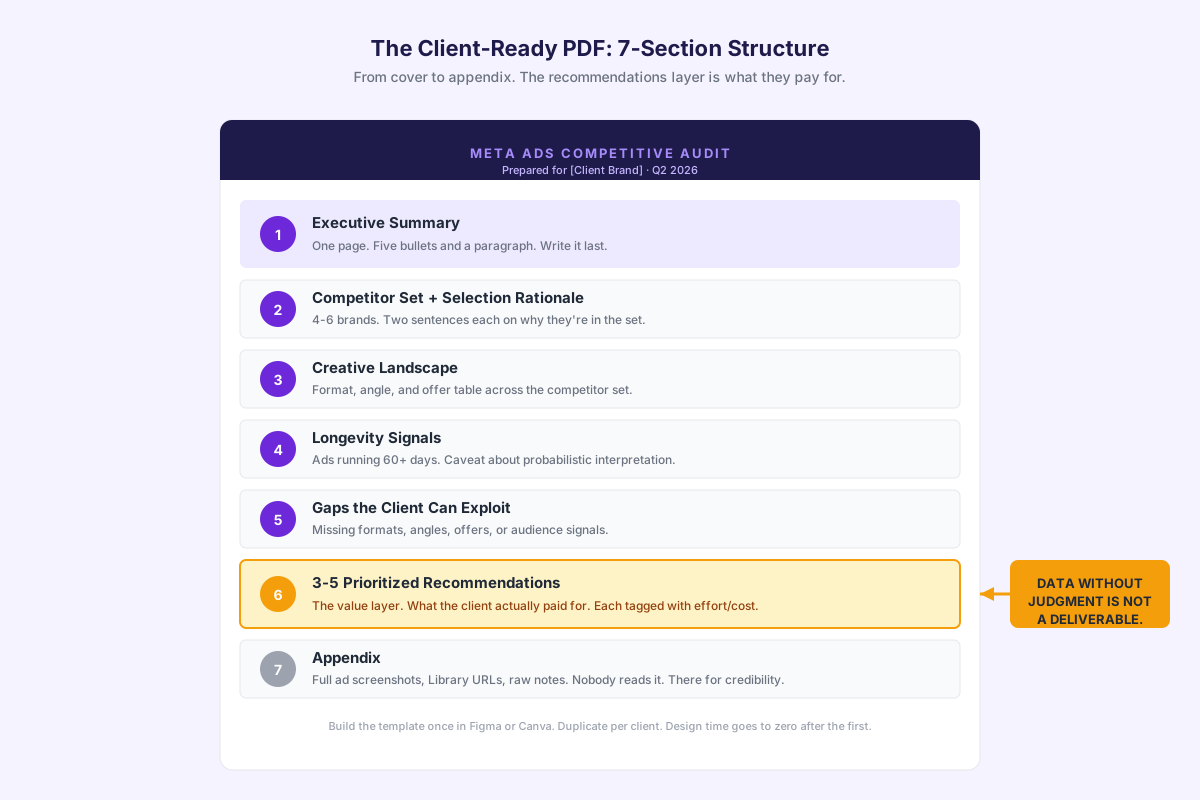
The seven sections, in order:
- Executive summary (1 page). What you found, what to do about it, in five bullets and a paragraph. Most clients read this and skim the rest. Write it last.
- Competitor set + selection rationale. Names, URLs, two-sentence reasoning per brand. Shows the client you didn't pick at random.
- Creative landscape. A clean table of formats, angles, and offers across the set. The tagging schema from Step 3 above turns into this section directly.
- Longevity signals. What's been running 60+ days, broken out by competitor. Caveat about probabilistic interpretation. Annotated screenshots of the standout long-runners.
- Gaps the client can exploit. Where the competitor set is collectively weak: missing formats, missing angles, missing offers, missing audience signals. This is the high-trust section.
- 3–5 prioritized recommendations. Same as Step 6 above. Each one tagged with effort/cost.
- Appendix. Full ad screenshots, Library URLs, raw notes. Nobody reads the appendix. It's there for credibility.
If your audit doesn't end with section 6's prioritized recommendations, you delivered a data dump, and the client will treat it like one. The BrandSearch guide on competitor analysis is right that the analysis matters more than the data, and the structure above forces the analysis layer to exist.
One production tip: build a Figma or Canva template once, then duplicate per client. The template enforces consistency, makes the deliverable look like a product, and cuts the design portion of the work to almost zero after the first one.
How to price and sell a Meta ads competitive audit
Three pricing models, three uses. Pick the one that matches the prospect.
| Model | Price range | When to use |
|---|---|---|
| Standalone paid audit | $500–$1,500 | Prospect is shopping multiple agencies. The audit becomes the only paid work happening before the contract decision. |
| Onboarding deliverable bundled into setup | $1,000–$2,000 setup fee | Signed retainer, week-1 deliverable. Audit fee is part of the setup line. |
| Quarterly recurring competitive review | $300–$800 / quarter, retainer add-on | Existing clients, portfolio agencies. Maps to ongoing competitive intelligence. |
The standalone model is the most useful one for how much to charge for a Facebook ads audit as a productized agency deliverable. $500 to $750 is the sweet spot for ecommerce DTC clients, where the line item is small enough to approve without procurement and big enough to feel like a real product.
The discovery-call positioning script that works:
"We don't pitch decks for free. What we do for prospects is a paid Meta ads competitive audit. It's a fixed-scope PDF, you get it within a week, the price is $750. If you sign a retainer afterward, the audit fee credits toward your first month. If you don't, you keep the audit. Either way, you walk out with something useful."
That script does three jobs at once. It signals confidence (you don't pitch for free). It removes the price objection (credit toward retainer). It removes the risk objection (you keep it either way).
For agencies running Mako Metrics Market Dominator on a portfolio basis, the recurring quarterly model layers cleanly on top of existing retainers. You're already pulling the data. Productizing the recap as a $400/quarter client-facing deliverable adds margin without much new work.
Mistakes that kill the model
Watching agencies try this and fail tends to come down to four mistakes.
Scope creep into account audits. Competitive ≠ account health. The moment you start auditing the client's pixel setup, campaign structure, or attribution windows, you're 8 hours deep on a $500 line item and the model breaks. Keep this audit ruthlessly external-facing.
Caving and giving the audit away "to close the deal." Once you do this, every prospect expects it free. The price tag is what makes the productized model work. Drop the price tag and you're back to writing free decks.
Skipping the recommendations layer. Data without judgment is a report, not a deliverable. Clients pay $750 for "what should we do," not "what are competitors doing." The Step 6 work is the work.
White-labeling tool exports verbatim. Snapshot, Foreplay, Atria, Panoramata: none of these are the deliverable. They're inputs. If your PDF is a screenshot dump from another tool, the client will figure that out and you've just productized somebody else's product.
See what 30 minutes actually looks like
Want to see what one of these audits looks like before you bill a client for it? Browse the Mako Metrics sample reports to see the raw inputs you'd get, then run a Snapshot on a brand you'd pitch this week. You can decide whether 30 minutes of agency time gets you a $500 line item.
What to remember
- Pitch-stage competitive research is a margin leak. Productize it as a paid audit, don't give it away.
- A defensible Meta ads competitive audit covers a defined competitor set, creative landscape, longevity signals, exploitable gaps, and 3–5 prioritized recommendations.
- The 30-minute production target is achievable with a tool collapsing the data-pull step. Manual via Meta Ad Library runs closer to 90 minutes.
- Recommendations are the value layer. Data without judgment is a report, not a deliverable.
- Three pricing models work: standalone ($500–$1,500), bundled into setup ($1,000–$2,000), or recurring quarterly ($300–$800).
- Position the audit on discovery calls as a paid first step that credits toward retainer if the prospect signs.