
You signed up for an ad spy tool to answer one question: what is my main competitor running on Meta right now? Two hours into BigSpy's dashboard, you've filtered a billion ads across ten platforms and you still don't have the answer. You have tabs.
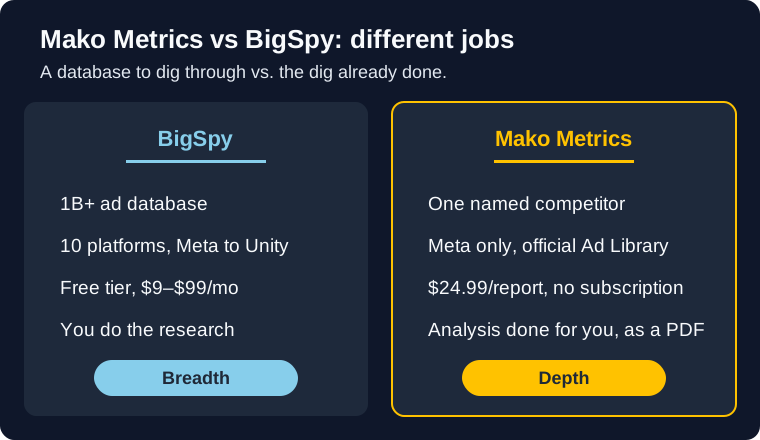
That's the gap this mako metrics vs bigspy comparison is about. BigSpy and Mako Metrics both start from competitor ads, but they hand you different things. BigSpy gives you a database to dig through. Mako Metrics gives you the dig already done, as a report on the one competitor you named. Neither is "better." They're built for different jobs, and the right pick depends on which job is yours.
The split underneath is platform scope. BigSpy is a generalist across ten ad platforms. Mako does Meta only. If Meta is where your budget goes, a specialist on that channel beats paying for nine platforms you never open. Same math if you're an agency lead briefing a Meta-only client: you need a deliverable on one named competitor, not another dashboard login to babysit.
Bottom line
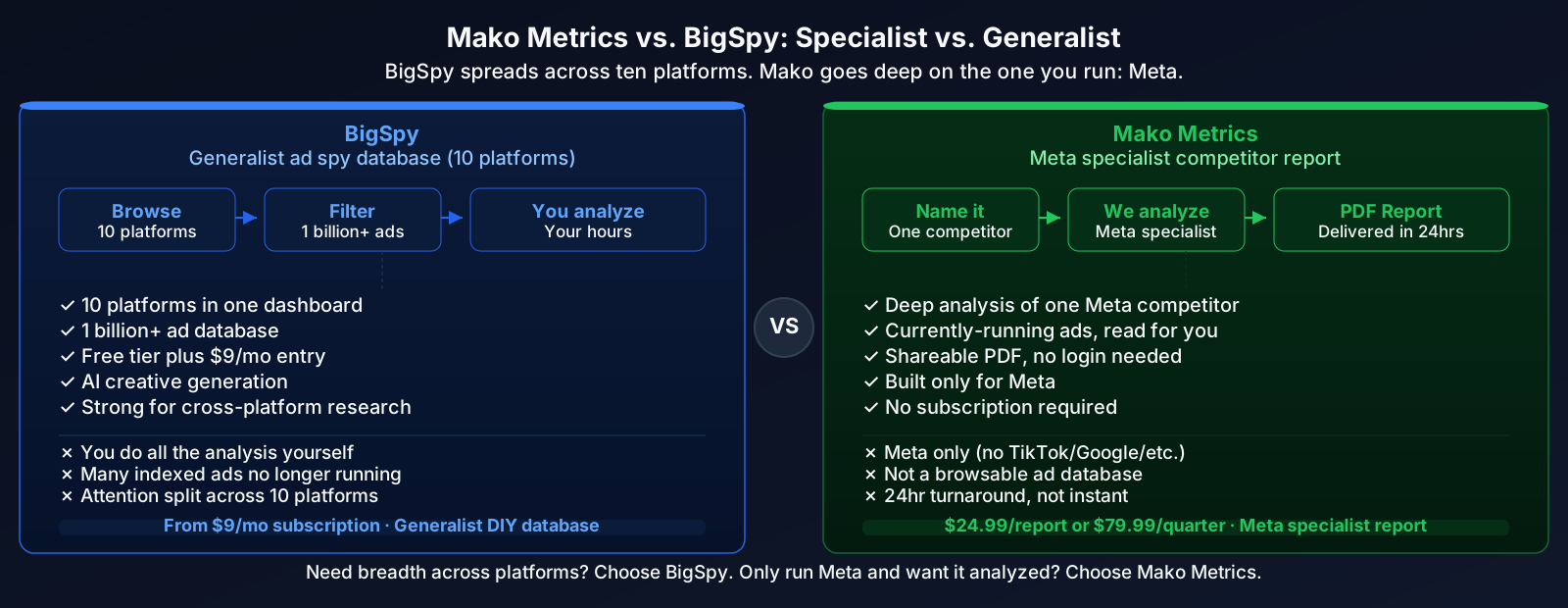
- BigSpy: a freemium, self-serve ad spy tool covering 10 platforms (Facebook, Instagram, TikTok, YouTube, Google, X, Pinterest, Yahoo, Unity, AdMob) with a 1 billion+ ad database. You do the research.
- Mako Metrics: a done-for-you PDF report analyzing one named competitor's Meta ads, built on Meta's official Ad Library. The analysis is done for you.
- Pricing model: BigSpy is a subscription (free tier, then $9/mo Basic, $99/mo Pro). Mako is per report ($24.99 Snapshot) or quarterly ($79.99 Market Dominator).
- Output: BigSpy = a searchable dashboard. Mako = a shareable PDF you can forward to a creative team or bring to a strategy meeting.
- Decision rule: Need cross-platform breadth and like doing your own digging? BigSpy. Only run Meta, have named competitors, and want the answer handed to you? Mako Metrics.
In This Article
TL;DR: The Core Difference
BigSpy wins on breadth: ten platforms, search and filter at scale, and you supply the hours to turn ads into a decision.
Mako wins on depth for one Meta competitor: you name the brand, and you get back what's running now, why it's likely working, and what to do next. You supply the competitor name, not the research shift.
| BigSpy | Mako Metrics | |
|---|---|---|
| Tool type | Self-serve ad spy database | Done-for-you competitor intelligence report |
| Pricing model | Subscription (free tier, then $9-$99/mo) | Per report ($24.99) or quarterly ($79.99/qtr) |
| Focus | Generalist across 10 platforms | Meta specialist (Facebook + Instagram only) |
| Output | Searchable dashboard of ads | PDF report delivered within 24 hours |
| Who does the analysis | You do | Done for you |
| Best for | Cross-platform research at volume | One named Meta competitor, analyzed |
What Is BigSpy?
BigSpy is one of the better-known facebook ad spy tools in the category. Most BigSpy reviews settle on the same headline: cheap and broad. That reputation holds up on the strengths first, then the tradeoffs.
What BigSpy does well
BigSpy covers ten ad platforms from a single dashboard: Facebook, Instagram, TikTok, YouTube, Google, X, Pinterest, Yahoo, Unity, and AdMob. If you run ads across more than one channel, that single-login coverage is hard to beat. AdSpy, by contrast, is Facebook and Instagram only.
The database is enormous. BigSpy claims over a billion ad creatives across 71 countries and 23 languages, updated daily. For trend-spotting and creative inspiration across niches, that volume is hard to match.
The entry price is the lowest in the category. There's a free tier with a handful of daily searches, a Basic plan at $9 per month, and a $1 three-day trial on the Pro plan. If you just want to poke around and confirm a tool works before paying, BigSpy lets you do that for almost nothing. It also bundles AI creative generation, which the raw-database tools don't.
Where it falls short
The same breadth that's a strength becomes a cost if you only run one platform. You're paying for nine channels you don't touch, and the dashboard surfaces them whether you want them or not.
Freshness is the bigger issue for competitor work. A database that deep is mostly historical. Ads from two or three years ago sit next to ads running today, and G2 reviewers often note that many indexed ads are no longer live. That's fine for spotting creative patterns over time. It breaks down when you need to know what this specific competitor is spending on right now, before your next creative refresh or budget meeting.
And the search experience trades precision for size. Filter combinations that should be simple ("carousel ads from a US DTC brand running 90-plus days") often take several hops and return results that feel approximate. The volume is there. Pulling a clean answer out of it is on you.
What Is Mako Metrics?
Mako Metrics works the other way around. You don't get a dashboard. You name one competitor, and an analyst pulls their currently-running Meta ads from Meta's official Ad Library, then sends back a PDF that explains the strategy, not just the ads.
The report covers what they're running, the creative formats and hooks they lean on, the offers and angles they're testing, and where the gaps are that you can move into. It's Meta only by design, and it focuses on ads that are live now, not an archive. Turnaround is within 24 hours.
The point isn't volume. Someone who only looks at Meta does the reading. Instead of filtering a billion ads and interpreting them yourself, you get the interpretation in a format you can forward to a creative team, a client, or leadership. Mako only covers Meta, so the formats, offer structures, and auction patterns in the report are the ones your account runs on.
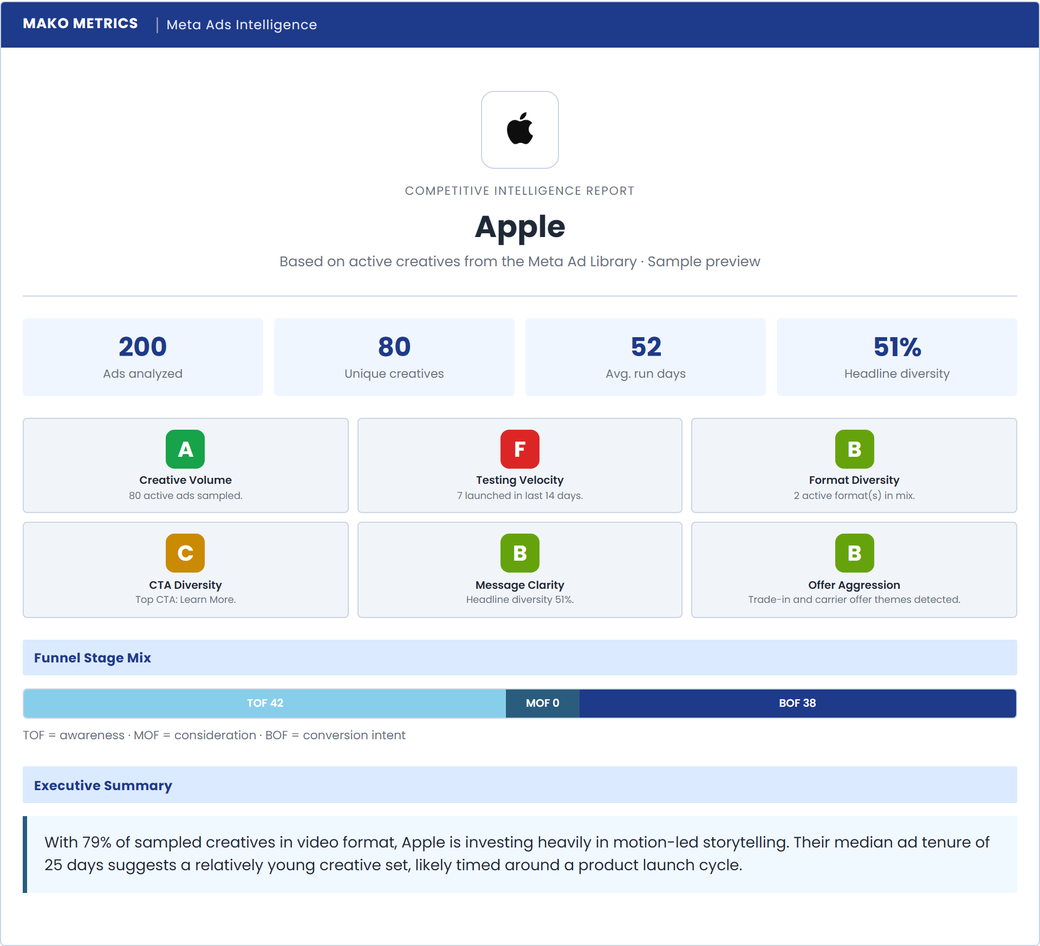
A real Mako Metrics report on Apple. This is what you get instead of a database to dig through.
Mako is not a database, not multi-platform, and not built for browsing thousands of ads across niches. If that's the job, BigSpy wins. Mako does meta ads competitor analysis on a named target, and nothing else.
Feature Comparison
Here's the side-by-side on the dimensions that drive the decision.
| Feature | BigSpy | Mako Metrics |
|---|---|---|
| Platforms covered | 10 (Meta, TikTok, YouTube, Google, X, Pinterest, more) | Meta only (Facebook + Instagram) |
| Database size | 1 billion+ ads | Not a database; built per request from the Ad Library |
| Data freshness | Deep historical archive; many ads no longer running | Focused on currently-running ads |
| Output | Searchable dashboard | PDF report you can share |
| Who does the analysis | You | Done for you |
| AI features | AI creative generation | Analyst-written strategic insight |
| Free option | Free tier (limited daily searches) | Free sample competitor reports |
| Entry price | $9/mo Basic | $24.99 per report |
| Best fit | Cross-platform, high-volume research | Named Meta competitor, analyzed |
Pricing: What You Actually Pay For
Most comparisons get the money wrong because they stop at sticker price.
On raw dollars, BigSpy is cheaper. Basic is $9 a month. Mako's Snapshot is $24.99 per report. If your only filter is sticker price, the comparison is over before it starts.
But sticker price isn't the real number. BigSpy's pricing tiers run from free, to $9 Basic, to $99 Pro, to $249 Group, up to enterprise plans. What every tier has in common is that the analysis isn't included. You're paying for access to a database. The hours you spend filtering it, reading the ads, and turning them into a decision are unpriced, and they're not small.
Mako's pricing includes that work. The Snapshot is $24.99 for one analyzed competitor. Market Dominator is $79.99 per quarter and covers up to five competitors with tracking across the period. You're not buying access. You're buying the finished read.
| BigSpy Basic | BigSpy Pro | Mako Snapshot | Mako Market Dominator | |
|---|---|---|---|---|
| Price | $9/mo | $99/mo | $24.99/report | $79.99/quarter |
| What you get | Database access | Database access | One analyzed report | Up to 5 competitors + tracking |
| Analysis included? | No | No | Yes | Yes |
Mako Metrics as a BigSpy Alternative
If you're searching for a BigSpy alternative, it's usually for one of two reasons: BigSpy is more tool than you need, or it's not giving you a straight answer on the one competitor you care about.
Mako fits the second case well. If you run Meta and not much else, a ten-platform database is breadth you're paying for and not using. If you have two or three named competitors rather than a whole niche to scan, you don't need a billion-ad archive. You need to know what those specific brands are doing now. If the output you want is something you can hand to a creative team or a client, a report beats a dashboard.
It's not the right swap for everyone. If you need TikTok, YouTube, and Google coverage in one place, or you do high-volume product hunting across niches, stay on BigSpy or look at the full landscape of competitor tracking tools before deciding. If your problem is creative inspiration rather than competitor intel, compare Mako Metrics vs Foreplay too. And if the database you're weighing is Facebook-only with deeper filters rather than BigSpy's ten-platform spread, we put Mako Metrics vs Tyver head to head as well. And if you haven't tried the free route yet, there are seven free ways to spy on competitor Facebook ads worth working through first.
Mako is the better-fit alternative specifically when your problem is Meta-shaped and you want the analysis done, not the access.
Who Should Choose Which
Choose BigSpy if…
- You run ads on more than one platform and want TikTok, YouTube, Google, and Meta in one place.
- You do high-volume or daily research, scanning many niches for winning creative.
- You're in dropshipping or affiliate work and need to spot trending products fast.
- You want a cheap, self-serve database and you're happy doing the analysis yourself.
- You like filtering ads by hand and trusting your own read.
Choose Mako Metrics if…
- Meta is your main or only paid channel, and you'd rather have a specialist on it than a ten-platform generalist.
- You have specific, named competitors rather than a whole category to scan.
- You want the analysis done for you, not a dashboard to interpret.
- You need a shareable report for a creative team, a client, or leadership.
- You care most about what a competitor is running right now, not three years ago.
If that second list sounds like you, start with the free version before paying for anything. Browse Mako's sample competitor reports. They show real brands' live Meta ads from the Ad Library and the report format in a couple of minutes, no subscription and no credit card. If it's useful, you'll know exactly what the paid report adds.
The Real Distinction: Breadth vs. Depth
Strip away the feature lists and the choice comes down to one thing.
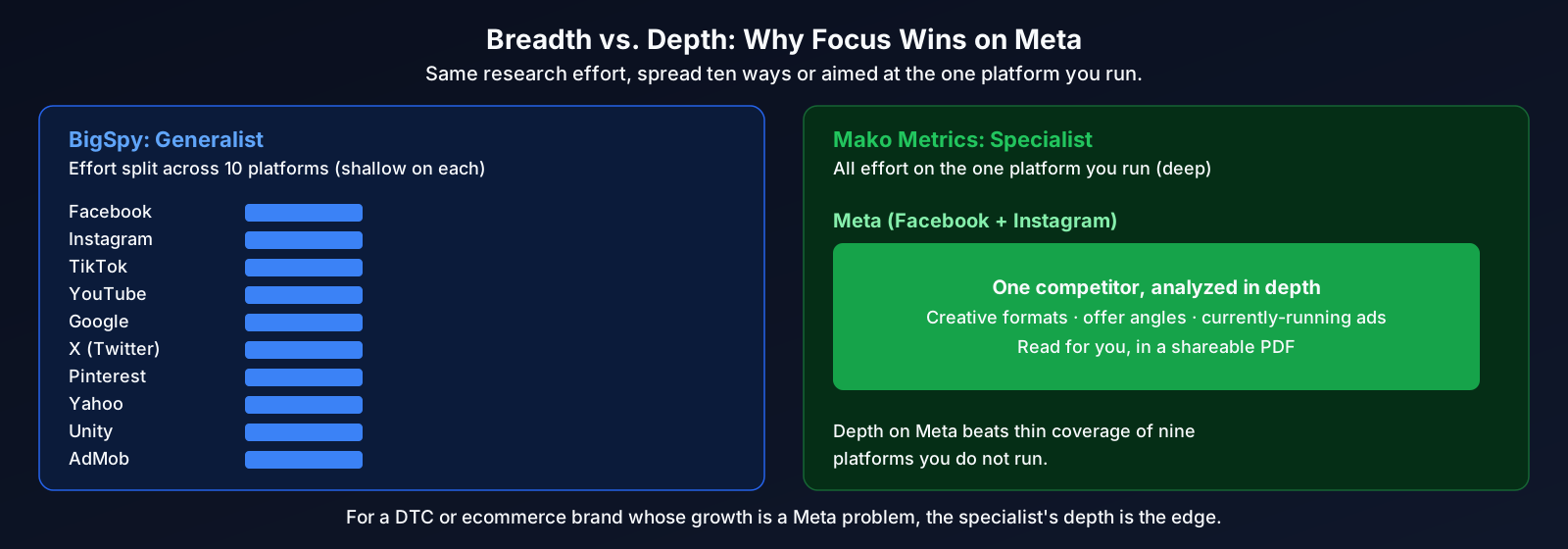
BigSpy is built for breadth: ten platforms, a billion ads, the whole field in one searchable place. That works when your problem is "show me what's out there." You do the reading, and a lot of what you're reading isn't running anymore.
Mako is built for depth on one channel: one competitor on Meta, analyzed while the ads are still live. That works when your problem is "tell me what this brand is doing and what I should do about it." You give up volume browsing to get that focus.
A ten-platform tool spreads data, filters, and attention across all of them. A Meta-only tool can go deeper on the one channel you pay for. For a DTC brand or agency account where growth is mostly a Meta problem, that depth usually beats reach across channels you don't run.
The question is whether your job today is "show me lots of ads everywhere" or "go deep on what my competitor is doing on Meta right now."
Frequently Asked Questions
Is BigSpy free?
BigSpy has a free tier with a small number of daily searches, plus a $1 three-day trial on the Pro plan. Paid plans start at $9 per month for Basic. The free tier is enough to confirm the interface works for you, but not enough for sustained research.
Is BigSpy worth it?
It depends on your platform mix and whether you'll do the analysis. If you run ads across several platforms and want a cheap, broad database to dig through yourself, BigSpy is one of the best-value options out there. If you only run Meta and want the read done for you, a report-based tool is a closer fit.
Does BigSpy cover TikTok?
Yes. BigSpy covers TikTok along with YouTube, Google, X, Pinterest, and others. That multi-platform coverage is its main edge. Mako Metrics is Meta only by design, so if you need TikTok specifically, BigSpy is the better tool for it.
BigSpy vs AdSpy: which is better?
They serve similar jobs with different coverage. BigSpy is multi-platform and cheaper at entry; AdSpy is Meta-focused with a single $149/month tier and deeper comment-level search. We broke down what AdSpy actually costs separately if you're weighing that one.
How much does BigSpy cost?
BigSpy runs from a free tier to $9/mo Basic, $99/mo Pro, $249/mo Group, and custom enterprise pricing above that. Annual billing lowers the effective monthly rate on Pro.
Still deciding? See a finished report first.
You don't need another subscription to see what a competitor report looks like. Browse a Mako sample on a real brand, pulled from the official Ad Library, in a couple of minutes. Free, no card. Then name your own competitor when you order.
See Sample ReportsThe bottom line: BigSpy and Mako Metrics aren't competing for the same job. BigSpy is a cheap, broad database for teams that research across platforms and do their own analysis. Mako is a done-for-you report for teams with named Meta competitors who want the answer, not the access.
If your job is breadth and DIY, stay on BigSpy. If it's one Meta competitor analyzed for you, see Mako's pricing, or order a Competitor Snapshot for $24.99 and name your competitor now.
Mako Metrics delivers PDF competitor intelligence reports from Meta's official Ad Library. See plans and pricing.