You're spending $8k/month on Meta conversion campaigns, and your CPA just spiked 35%. You've tried new creatives, tested different audiences, bumped the budget up and down. Nothing sticks. Here's the problem most ecommerce brands won't hear until they've burned through a few months of stalled growth: running only bottom-of-funnel campaigns is a structural dead end. You're fishing in a shrinking pond, and the fish are getting more expensive.
The "just run conversions" playbook worked fine in 2020–2023 when Meta had deep user data and broad targeting was cheap. Post-iOS privacy changes, that world is gone. Retargeting pools are smaller. Cold audience conversion campaigns get brutally expensive at scale. And Advantage+ campaigns, while powerful, can't fix a funnel that doesn't exist.
This guide is the practical build manual. Not a vague awareness-consideration-conversion diagram. An actual campaign structure with budget splits, audience definitions, creative types, and KPIs for each stage. I've seen this framework help brands push past the $10–15k/month ceiling without CPAs spiraling. Let's build it.
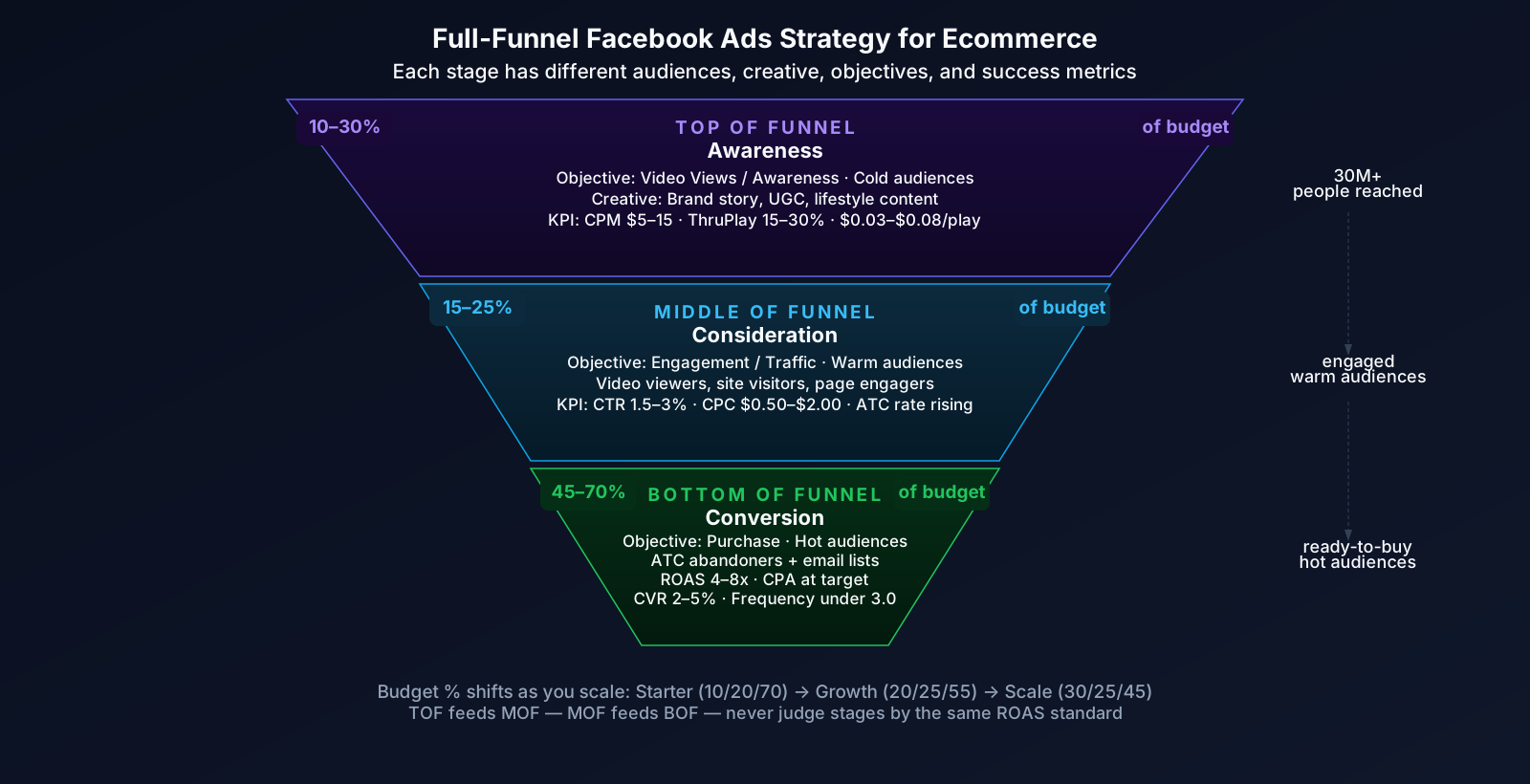
Bottom line
- The problem: Conversion-only campaigns hit a ceiling at $5–15k/month. CPAs spike because you're not feeding fresh audiences into the funnel.
- The fix: A 3-stage funnel, TOF (awareness), MOF (engagement), BOF (conversion), each with distinct objectives, audiences, creatives, and KPIs.
- Budget split: Start at 70/20/10 (BOF/MOF/TOF) and shift toward 45/25/30 as you scale past $15k/month.
- Expected results: BOF ROAS of 4–8x when the funnel is healthy. Blended ROAS of 2.5–4x depending on industry. Lower blended CPA than conversion-only at the same spend level.
- Timeline: Give the funnel 30–60 days to stabilize before judging performance.
Why Single-Campaign Structures Hit a Ceiling
Here's what happens to almost every ecommerce brand that only runs conversion campaigns on Meta:
Months 1–3: Things work. You're spending $3–5k/month, CPA is acceptable, ROAS looks healthy at 2.5–3.5x. Meta's algorithm finds low-hanging fruit in your target audiences.
Months 4–6: You increase budget to $8–12k/month. CPA creeps up 15–25%. ROAS dips. You test new creatives, some help temporarily, but the trend is clear.
Months 7+: You're stuck. Pushing past $12–15k/month sends CPA through the roof. You cut budget back, CPA improves, but growth stalls. You're on a treadmill.
The reason is structural, not tactical. Conversion-only campaigns are asking Meta to find people ready to buy right now. That audience is finite. When you've shown ads to most of them, Meta starts reaching less qualified people at higher costs. Meanwhile, your retargeting pools are shrinking thanks to iOS privacy changes, fewer tracked website visitors means fewer people to retarget cheaply.
Without top-of-funnel spending, you're not creating new potential buyers. You're just recycling the same shrinking audience. It's like running a store where you never advertise to new people and wonder why repeat customer revenue is flattening.
I've seen brands double their ad spend with lower blended CPAs after adding proper TOF and MOF campaigns. The math works because warming up audiences before asking them to buy reduces the cost of conversion significantly.
The 3-Stage Funnel Framework
Forget the textbook funnel diagrams. Here's the practical version for Meta ads:
| Stage | Objective | Audience Temperature | Goal | Primary KPIs |
|---|---|---|---|---|
| TOF (Top) | Awareness / Video Views | Cold, never heard of you | Introduce brand, build audiences | CPM, ThruPlay rate, cost per ThruPlay |
| MOF (Middle) | Engagement / Traffic | Warm, engaged but not buying | Build trust, drive consideration | CTR, CPC, engagement rate, add-to-cart rate |
| BOF (Bottom) | Conversions / Sales | Hot, visited site, added to cart | Close the sale | ROAS, CPA, conversion rate |
Each stage has a different campaign objective, different audiences, different creatives, and, critically, different success metrics. You can't judge TOF by ROAS, and you shouldn't judge BOF by CPM. More on measurement later.
Meta's algorithm optimizes differently based on your campaign objective. An Awareness campaign finds people likely to remember your ad. A Conversion campaign finds people likely to buy. They're pulling from different parts of Meta's user graph. When you run all three, you're systematically moving people from "never heard of you" to "ready to purchase", and that pipeline is what lets you scale.
TOF: Awareness Campaigns That Actually Work
TOF is where most brands either skip entirely or waste money. Done right, it's the engine that fuels everything below it.
Campaign Setup
- Objective: Awareness or Video Views. Don't use Reach, it optimizes for impressions regardless of quality. Video Views gives you trackable engagement audiences.
- Audience: Broad targeting (1–5% of total population in your target geo) or wide interest-based audiences. Don't over-narrow here, let Meta find who's receptive.
- Budget: 10–30% of total ad spend depending on your scaling stage (exact splits below).
Creative That Works at TOF
Cold audiences don't know you. They don't care about your 20% off sale or your product features. They care about their problems and their interests. TOF creative should:
- Brand story videos (30–60 seconds): Why you exist, what you believe, who you serve. Authentic beats polished.
- Educational content: How-to videos, myth-busting, industry tips. Position your brand as knowledgeable.
- UGC unboxings and first impressions: Real people reacting to your product. This bridges awareness and social proof.
- Lifestyle content: Show the product in context. Not a product shot on white, a person using it in their life.
The goal isn't immediate sales. It's stopping the scroll and making someone think, "Huh, that's interesting."
KPIs to Track
- CPM: $5–$15 for most ecommerce verticals (varies by audience competition). If CPM is above $20, your audience is too narrow or your creative isn't resonating.
- ThruPlay rate: 15–30% is healthy for 15-second videos. Below 10% means your hook is weak.
- Cost per ThruPlay: $0.03–$0.08 is a solid range. This is your cost to add someone to your video viewer audience.
- Video watch %: Track 25%, 50%, 75%, and 95% completion. These become your MOF audiences.
Every dollar spent on TOF creates retargetable audiences: video viewers, page engagers, profile visitors. A $1,500/month TOF budget generating ThruPlays at $0.05 each adds 30,000 people per month to your warm audience pools. That's 30,000 people who now cost significantly less to convert at BOF. Think of TOF as buying inventory for cheaper future conversions.
Why TOF Feels Wasteful (But Isn't)
TOF ROAS will look terrible, often 0.5–1.5x if you even measure it. That's fine. You're not trying to convert cold audiences directly. You're building the audience pipeline that makes MOF and BOF more efficient. Brands that cut TOF to "improve ROAS" see short-term gains followed by a steady decline in BOF performance as warm audiences dry up. I've watched it happen repeatedly.
MOF: Warming Up Engaged Audiences
MOF is the most neglected stage. Many brands jump from cold audiences straight to retargeting with purchase-focused ads. That's like asking someone to marry you on the second date. MOF bridges the gap.
Campaign Setup
- Objective: Engagement or Traffic (optimized for landing page views, not link clicks; landing page views filter out accidental taps).
- Audience: Custom audiences of people who've interacted with your brand but haven't purchased:
- Video viewers (25–95% completion from TOF campaigns)
- Page/profile engagers (last 30–90 days)
- Website visitors who didn't purchase (30–60 day window)
- Instagram/Facebook engagers
- Budget: 15–25% of total ad spend.
Creative That Works at MOF
These people know you exist. Now you need to give them reasons to trust you and consider buying:
- Social proof: Customer testimonials, review compilations, before/after results.
- Product demos: Show the product in action. Address objections before they form.
- Comparison content: Why your product vs. alternatives (without being sleazy about competitors). Use our competitor research guide to understand positioning.
- Behind-the-scenes: Manufacturing, quality control, team stories. Builds authenticity.
- Long-form UGC: Detailed reviews from real customers. 60–90 seconds.
KPIs to Track
- CTR: 1.5–3.0% for MOF ads. If below 1%, your creative isn't relevant to this audience.
- CPC: $0.50–$2.00 for landing page views. Varies by industry.
- Engagement rate: 3–8% for carousel/video ads.
- Add-to-cart rate: Track this even though it's not your primary objective. Rising add-to-cart rates from MOF audiences signal that the funnel is working.
Custom Audience Strategies for MOF
Build layered audiences based on engagement depth:
- Light engagement: Video viewers (25%+), page likers, ad engagers → show educational and social proof content.
- Medium engagement: Video viewers (75%+), website visitors (browsed but didn't add to cart) → show product demos and comparisons.
- Heavy engagement: Add-to-cart abandoners, multiple site visits → these graduate to BOF.
The key is excluding BOF audiences from MOF campaigns and vice versa. If someone has already added to cart, they don't need a testimonial video, they need a nudge to complete the purchase. Audience overlap between stages wastes budget and confuses the algorithm.
BOF: Converting Warm Audiences
BOF is what most brands are already running. The difference is that with a proper funnel feeding it, BOF campaigns perform dramatically better.
Campaign Setup
- Objective: Conversions (optimized for Purchase). If your pixel doesn't have enough purchase data (under 50 purchases/week), optimize for Add to Cart first and shift to Purchase once you have volume.
- Audience:
- Add-to-cart abandoners (7–14 days)
- Website visitors (7–30 days), exclude purchasers
- MOF engagers who've shown high intent
- Email/SMS subscriber lists (synced to Meta)
- Lookalike audiences based on purchasers (1–3%), for scaling BOF
- Budget: 45–70% of total ad spend depending on scaling stage.
Creative That Works at BOF
These people are ready. Your creative should remove the last barriers to purchase:
- Urgency and scarcity: Limited stock, sale ending, seasonal messaging. Be honest: fake urgency backfires.
- Discount codes: 10–15% off for first purchase, free shipping thresholds. Test discount depth, sometimes 10% converts as well as 20%.
- Cart reminder ads: Dynamic product ads (DPA) showing the exact products they viewed or added to cart.
- Product-specific ads: Highlight the specific item they browsed, not generic brand ads.
- Risk reversal: Free returns, money-back guarantee, "try before you buy." Address the final objection.
KPIs to Track
- ROAS: 4–8x is the target range when the funnel is healthy. If BOF ROAS is below 3x with warm audiences, something's off in your creative, offer, or landing page.
- CPA: Track this against your breakeven threshold. For most ecommerce brands, BOF CPA should be 30–50% lower than cold-traffic CPA.
- Conversion rate: 2–5% from ad click to purchase for warm audiences. Below 1.5% suggests a landing page or checkout problem, not an ads problem.
Warning: Don't judge your entire funnel by BOF ROAS alone. A brand with 6x BOF ROAS on $3k spend isn't outperforming a brand with 4x blended ROAS on $20k spend. Blended metrics (MER, blended ROAS) are what matter at scale. And remember, iOS attribution often underreports ROAS by 20–40%, so your real numbers are likely better than what Meta shows.
Budget Allocation Framework (With Dollar Amounts)
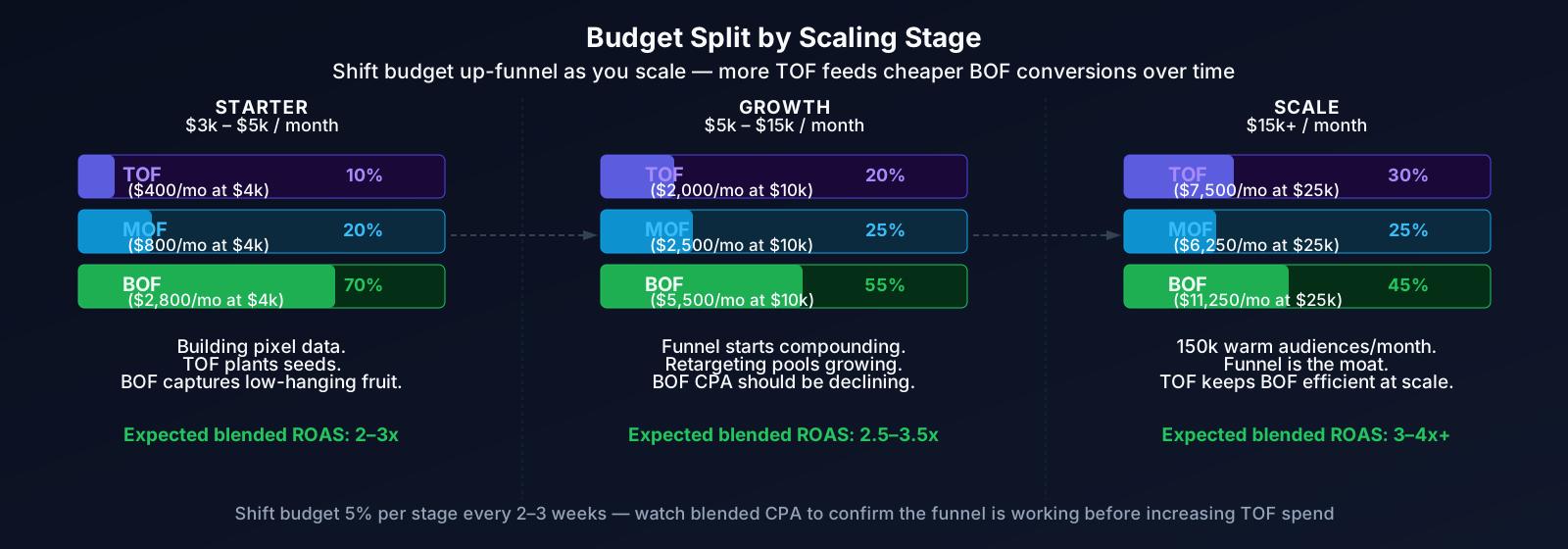
Budget split depends on where you are in the scaling journey. Here's the framework I recommend:
Starter: $3–5k/month
You're still building pixel data and learning what works. Most budget stays at BOF.
| Stage | % of Budget | Dollar Amount ($4k example) | Focus |
|---|---|---|---|
| TOF | 10% | $400/month | 1 awareness campaign, broad video views |
| MOF | 20% | $800/month | Retarget video viewers + site visitors |
| BOF | 70% | $2,800/month | Conversion campaigns, DPA |
At this level, TOF is modest, you're planting seeds. But even $400/month on video views at $0.05/ThruPlay generates 8,000 warm audience members monthly.
Growth: $5–15k/month
You've got pixel data and a sense of what creative works. Time to feed the funnel more aggressively.
| Stage | % of Budget | Dollar Amount ($10k example) | Focus |
|---|---|---|---|
| TOF | 20% | $2,000/month | 2–3 awareness campaigns, multiple creative angles |
| MOF | 25% | $2,500/month | Layered engagement campaigns, social proof |
| BOF | 55% | $5,500/month | Conversions + DPA + lookalikes |
This is the stage where you'll feel the funnel start compounding. After 30–60 days, you should see retargeting pools growing and BOF CPAs declining relative to your pre-funnel baseline. The account stops feeling like a daily firefight and starts giving you more than one lever to pull.
Scale: $15k+/month
You're past product-market fit for ads. The funnel is proven. Now you scale TOF to keep feeding the machine.
| Stage | % of Budget | Dollar Amount ($25k example) | Focus |
|---|---|---|---|
| TOF | 30% | $7,500/month | Multiple awareness campaigns, broad reach, video + static |
| MOF | 25% | $6,250/month | Deep engagement sequences, multiple touchpoints |
| BOF | 45% | $11,250/month | Conversion optimization, scaling lookalikes, DPA |
At $25k/month with 30% on TOF, you're generating roughly 150,000 warm audience members monthly (at $0.05/ThruPlay). That's a massive retargeting pool that keeps BOF efficient even at high spend.
Don't jump from 10% TOF to 30% TOF overnight. Increase by 5% every 2–3 weeks and watch blended CPA. If blended CPA holds or improves as you shift budget upward, keep going. If it spikes, hold at the current split for another 2–3 weeks before trying again. The funnel needs time to build pipeline.
How to Shift Allocation as the Funnel Matures
Watch these signals to know when to increase TOF/MOF spend:
- Retargeting pool size is shrinking → you need more TOF
- BOF frequency is above 3.0 → your warm audiences are seeing ads too often; feed more from the top
- BOF CPA is rising despite good creative → structural issue, not tactical
- You have budget headroom but BOF can't absorb it profitably → classic scaling ceiling; invest in TOF/MOF
Measuring Funnel Performance
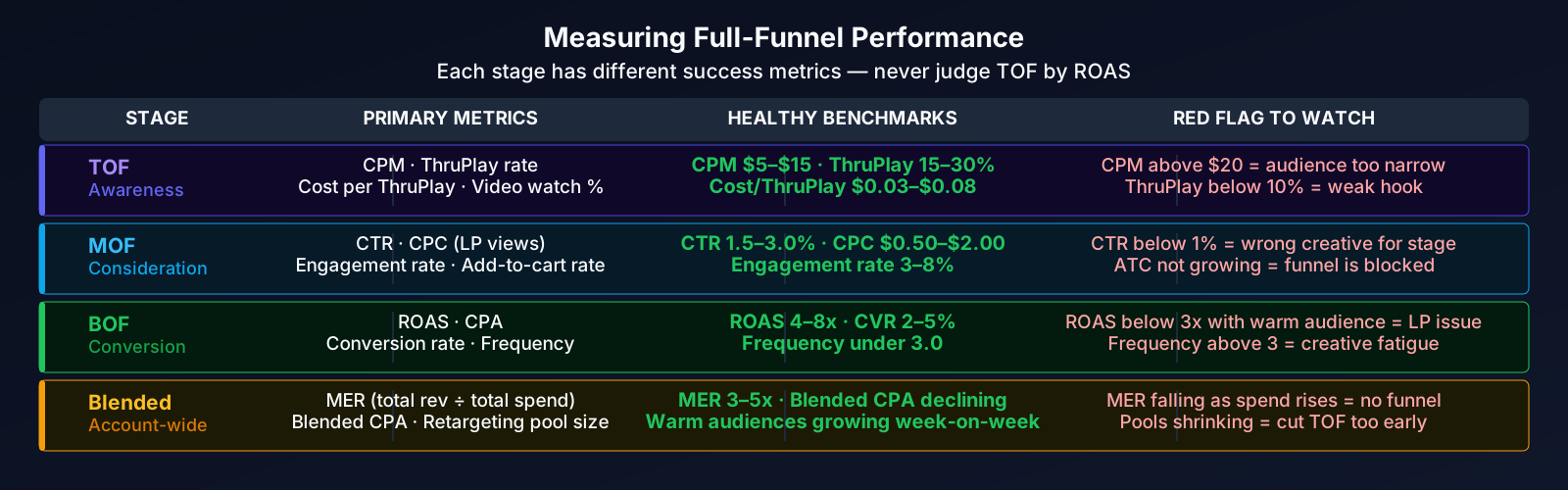
The biggest mindset shift: each funnel stage has different success metrics. Judging TOF by ROAS is like judging a billboard by direct sales, it's the wrong measurement.
Stage-Specific Metrics
| Stage | Primary Metrics | "Good" Benchmarks | What to Watch |
|---|---|---|---|
| TOF | CPM, cost per ThruPlay, video watch % | CPM $5–15, ThruPlay $0.03–0.08 | Audience pool growth rate |
| MOF | CTR, CPC, engagement rate | CTR 1.5–3%, CPC $0.50–2.00 | Add-to-cart rate from MOF audiences |
| BOF | ROAS, CPA, conversion rate | ROAS 4–8x, CVR 2–5% | Frequency (keep under 3.0) |
Blended Metrics That Actually Matter
For the overall health of your funnel, track:
- MER (Marketing Efficiency Ratio): Total revenue ÷ total ad spend across all campaigns. This is your blended efficiency number and the most honest measure of funnel health. Target MER of 3–5x for most ecommerce brands.
- Blended CPA: Total ad spend ÷ total purchases. If blended CPA is declining as you increase total spend, the funnel is working.
- Retargeting pool growth: Are your custom audiences (video viewers, site visitors, engagers) growing week over week? This is the leading indicator. If pools are growing and BOF performance is stable, you're on track.
Attribution Challenges
Let's be honest: attribution in 2026 is a mess. Between iOS restrictions, third-party cookie deprecation, and Meta's modeled conversions, no single number tells the full story. Here's how to work around it:
- Use 7-day click attribution as your primary window in Meta. 1-day click is too narrow and underreports.
- Compare Meta-reported conversions to your Shopify/platform data. The gap between them is your attribution blind spot.
- Track blended metrics (MER) as the source of truth. Platform-level attribution will always be imperfect; business-level metrics don't lie.
- Give TOF and MOF 30 days minimum before evaluating impact. The effects compound, a TOF campaign launched today doesn't improve BOF performance until those audiences move through the funnel.
For a deeper dive on fixing attribution gaps, check our iOS attribution guide.
Common Full-Funnel Mistakes
I've seen these kill funnel performance more than anything else:
1. Cutting TOF When BOF ROAS Dips
This is the most common mistake. BOF ROAS drops, panic sets in, and the first budget to get cut is "that awareness stuff that doesn't convert." Within 4–6 weeks, BOF gets worse because you've starved the funnel of fresh audiences. It's a death spiral.
Fix: When BOF struggles, check creative fatigue and offer testing before cutting TOF. If anything, a BOF dip is a signal to refresh creative, not to shrink the funnel.
2. Using the Same Creative at Every Stage
A product discount ad doesn't work on cold audiences. A brand story video doesn't work on cart abandoners. Each stage needs creative matched to the audience's awareness level. This isn't optional, it's the whole point of a funnel.
3. Audience Overlap Between Stages
If your MOF and BOF campaigns are competing for the same audiences, you're bidding against yourself and muddying your data. Use exclusions aggressively:
- TOF: Exclude all website visitors, engagers, and customers
- MOF: Exclude add-to-cart events and purchasers
- BOF: Exclude recent purchasers (7–30 days depending on your repurchase cycle)
4. Not Giving the Funnel Enough Time
A full-funnel structure takes 30–60 days to stabilize. TOF needs time to build audiences. Those audiences need time to engage with MOF. MOF needs to push people to BOF. If you judge the funnel after 10 days and kill it, you never gave it a chance.
5. Ignoring MOF Entirely
Jumping from cold awareness straight to "buy now" retargeting skips the trust-building stage. MOF is where you turn "I've heard of them" into "I trust them enough to buy." Without it, your retargeting conversion rates suffer and BOF CPA inflates.
6. Running the Same Funnel Structure Forever
Creative fatigue hits every stage. Watch for the signs, rising CPM, declining CTR, increasing frequency, and refresh creative every 3–6 weeks at TOF/MOF, every 2–4 weeks at BOF. Your funnel structure can stay constant; the content inside it needs to evolve.
What Your Competitors Are Running
Wondering what funnel structure your competitors use? Spy on their ads to see which creative they run at different stages. You can usually tell TOF from BOF by the messaging, brand awareness vs. discount offers. Understanding their approach helps you differentiate yours.
Ready to Spy on Your Competitor's Ads?
See exactly what's working for your competitors, and what's not. Analyze their funnel structure, creative types, and messaging across every stage.
Try Free ToolWhat to remember
-
Conversion-only campaigns hit a ceiling at $5–15k/month. Without TOF feeding fresh audiences into the funnel, CPAs spike and growth stalls. This is a structural problem, not a creative one.
-
Build a 3-stage funnel: TOF (awareness), MOF (engagement), BOF (conversion). Each stage needs distinct objectives, audiences, creatives, and success metrics.
-
Budget allocation shifts as you scale. Start at 70/20/10 (BOF/MOF/TOF) at $3–5k/month. Move toward 45/25/30 at $15k+/month. Shift gradually, 5% every 2–3 weeks.
-
Don't judge TOF by ROAS. Track CPM, cost per ThruPlay, and audience pool growth. TOF compounds over time; 30-day minimum before evaluating impact.
-
BOF ROAS of 4–8x is the target when the funnel is healthy. If you're below 3x with warm audiences, check your creative, offers, and attribution setup.
-
Use blended metrics (MER, blended CPA) as your source of truth. Platform-level attribution is imperfect. Business-level numbers tell the real story.
-
Give the funnel 30–60 days to stabilize. Cutting TOF during a BOF dip is the most common mistake. Refresh creative before cutting budget.